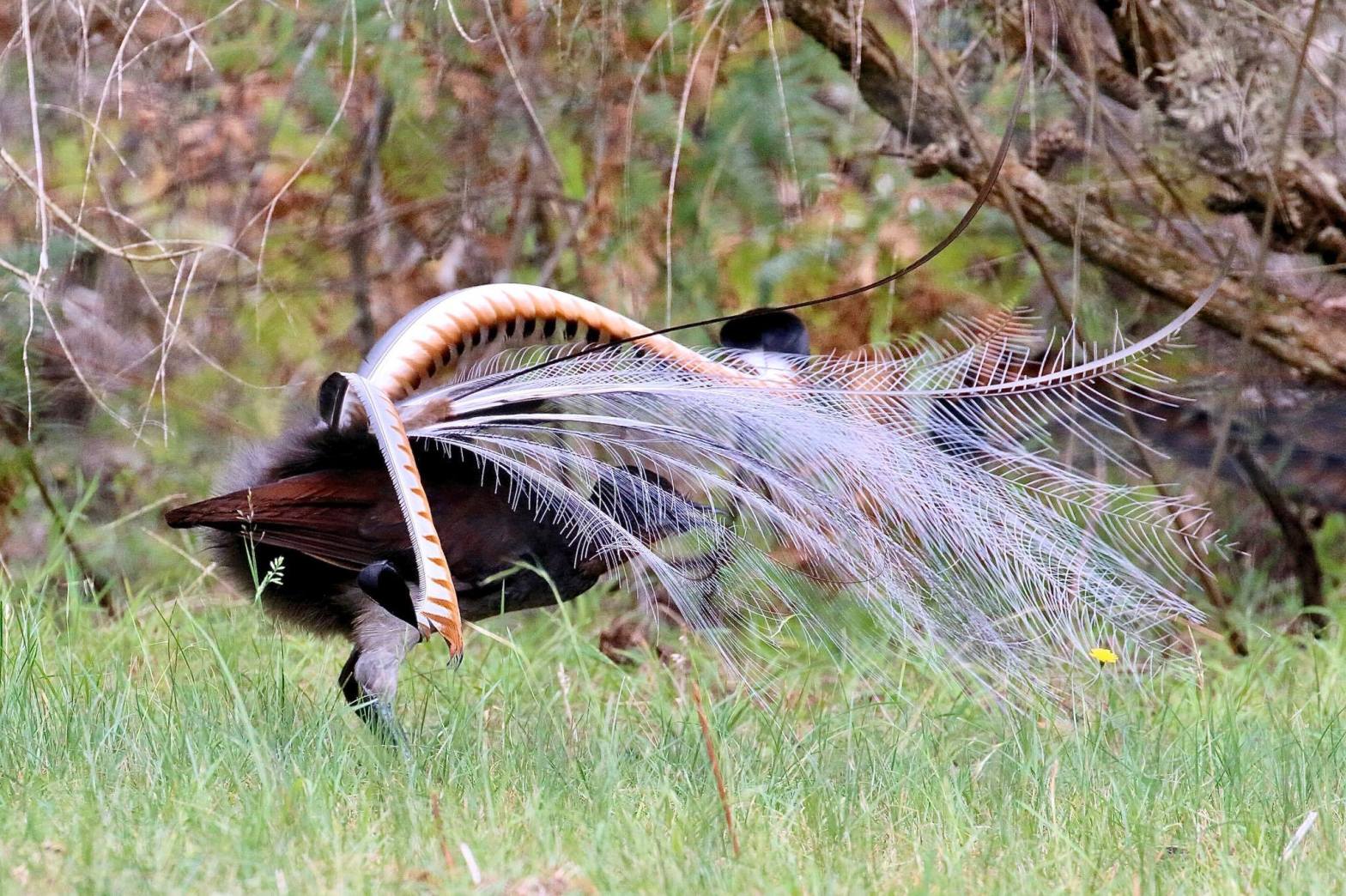
Bird of the Week: Superb Lyrebird 23 October 2020
Superb Lyrebirds are a feature of Mallacoota. They can be seen almost anywhere – in town at Devlin’s Inlet (Mortimers Paddock), in the gully near the foreshore caravan park, Shady Gully, Karbeethong, and many locals see them in their gardens. They are well distributed through the bushland as well, and can often be heard well before they are seen.
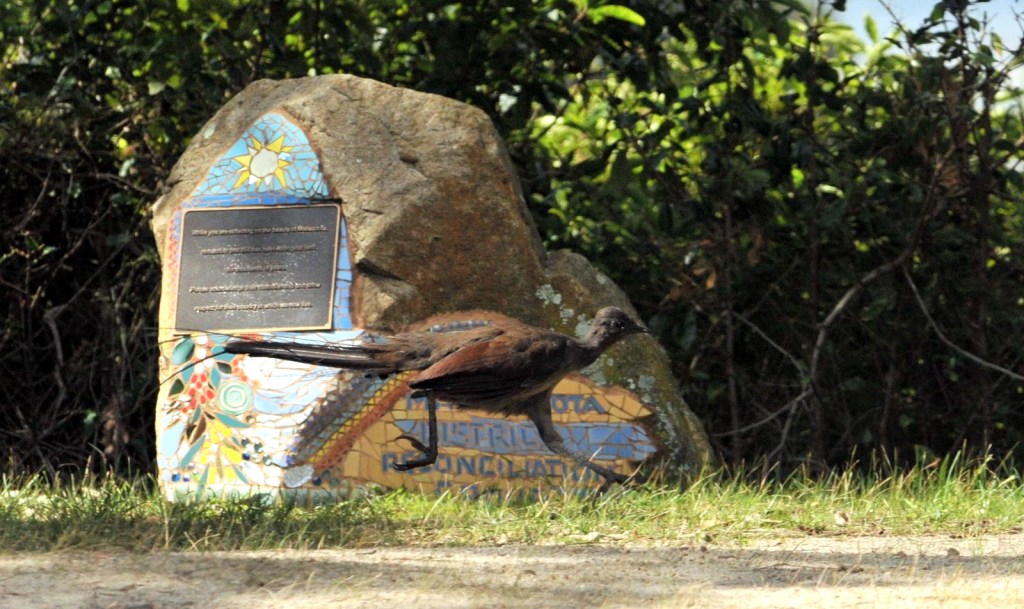
Superb Lyrebirds are best known for their thrilling song and powerful voice. They are considered the world’s finest songbird, which is strange because they are also one of the oldest types of songbird. A lyrebird fossil Menura tyawanoides was found at Riversleigh, QLD from the early Miocene (~23 million years ago).
Lyrebirds, like most songbirds, can produce two different sounds at once, due to their syrinx: a structure like a voice box, but placed and structured differently to ours. It is located at the point where the windpipe forks towards the lungs, so by using the left side and the right side differently, they can produce two totally different sounds at once.
This is why they can almost mimic a kookaburra!
Lyrebirds are an old form of songbird so their syrinx is a bit different to the other songbirds like magpies, honeyeaters, shrike-thrushes and whistlers. Though the lyrebird has fewer muscles in the syrinx, they seem to be very strong and work very well. Here’s a diagram: http://people.eku.edu/ritchisong/ritchiso/birdcommunication.html
There’s also a cool diagram here, comparing a normal songbird (oscine) syrinx against a simpler version that suboscines (eg. pittas) have: https://meetings.ami.org/2018/project/syrinx-musculature-compared-in-oscine-vs-suboscine-passerines/
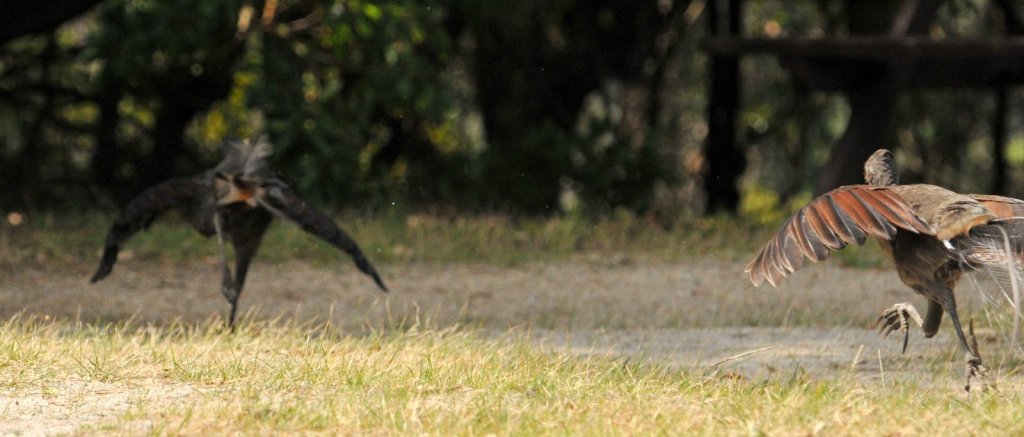
Lyrebirds can sort-of fly, and like to spend the night in the tops of trees. They have broad, round wings, and by a combination of flapping and jumping they make it up to the canopy. In the morning they use their round wings to parachute down!
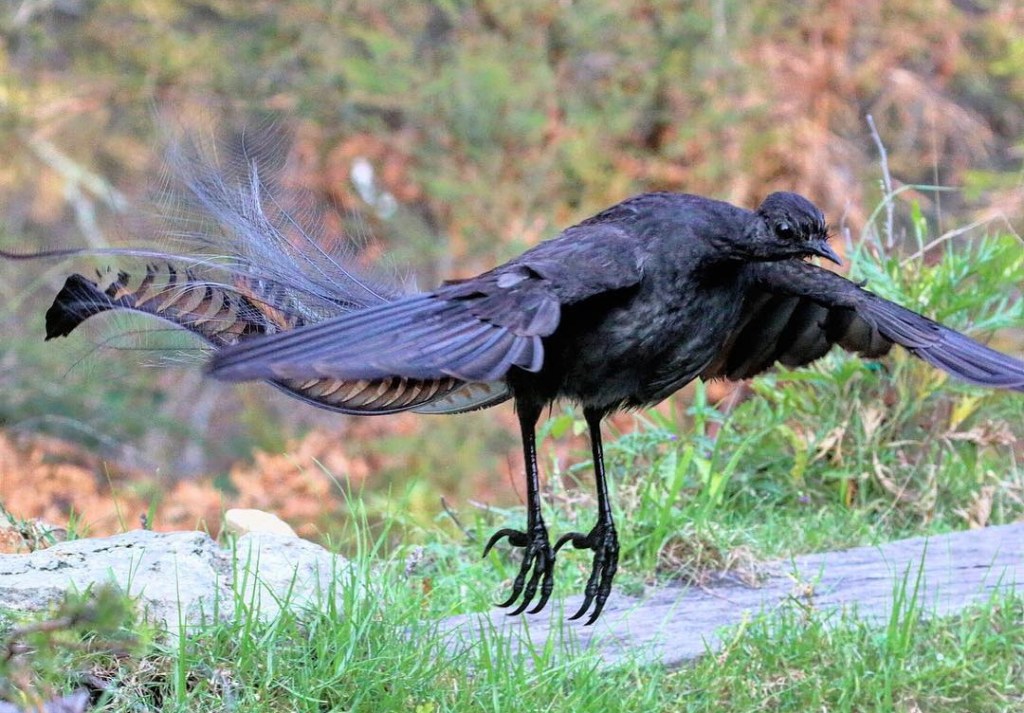
They also have huge strong feet and legs.
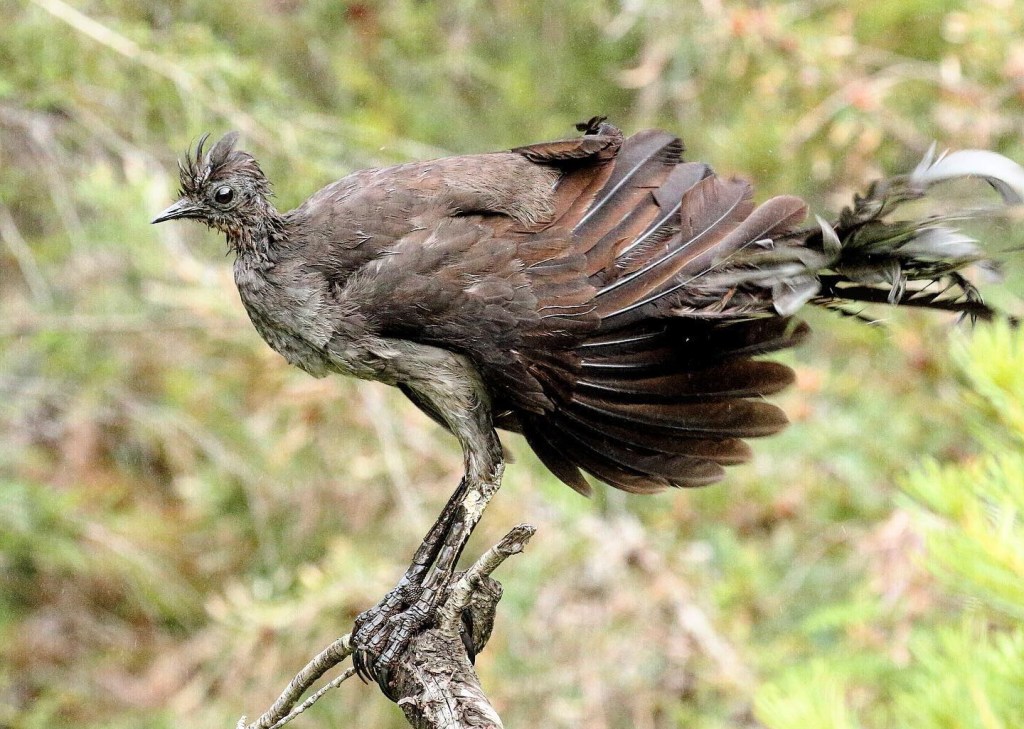
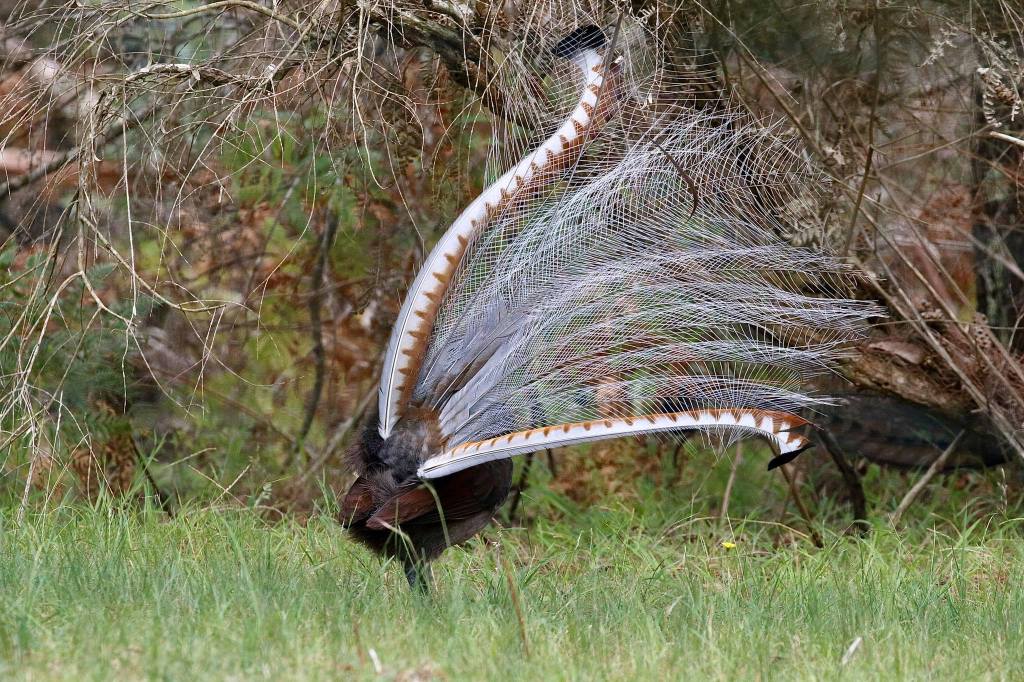
If you see an adult male with a full, magnificent tail, you know he’s been around for a long time. It takes a male 7 to 9 years to develop that tail.
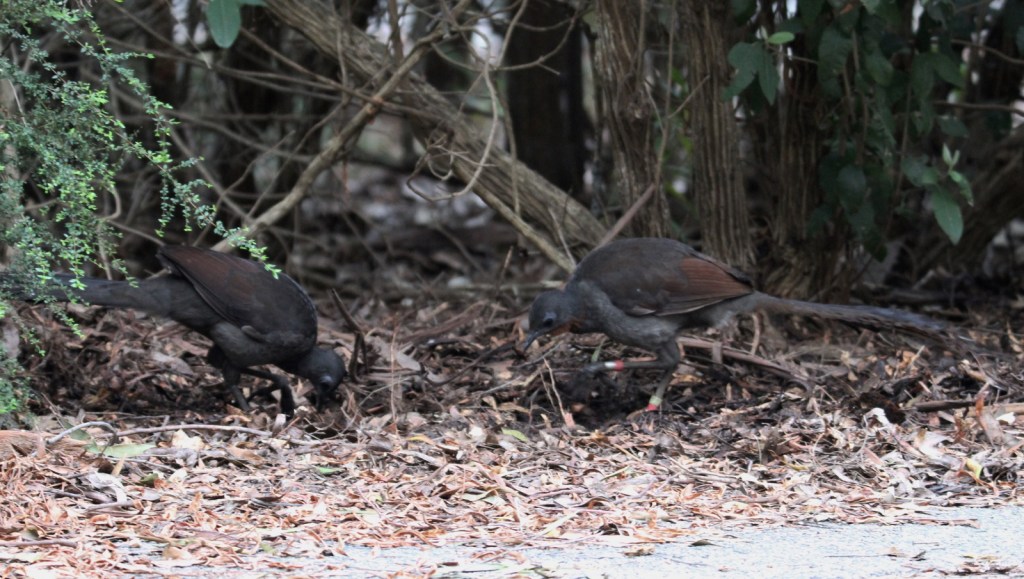
Juvenile lyrebirds start out with short plain brown tails. The tail grows longer after leaving the nest, and chick soon resembles female in size and appearance. They have a rufous forehead (1st – 2nd year) and throat (1st to 3rd year).
If female, the two outer feathers of the tail (the lyrates) will develop bars with transparent windows. They will always be shorter than the other tail feathers and not as colourful as an adult male’s. To develop a full adult female tail will take her 3 to 5 years. All the other tail feathers will remain brown and broad, with rounded tips.
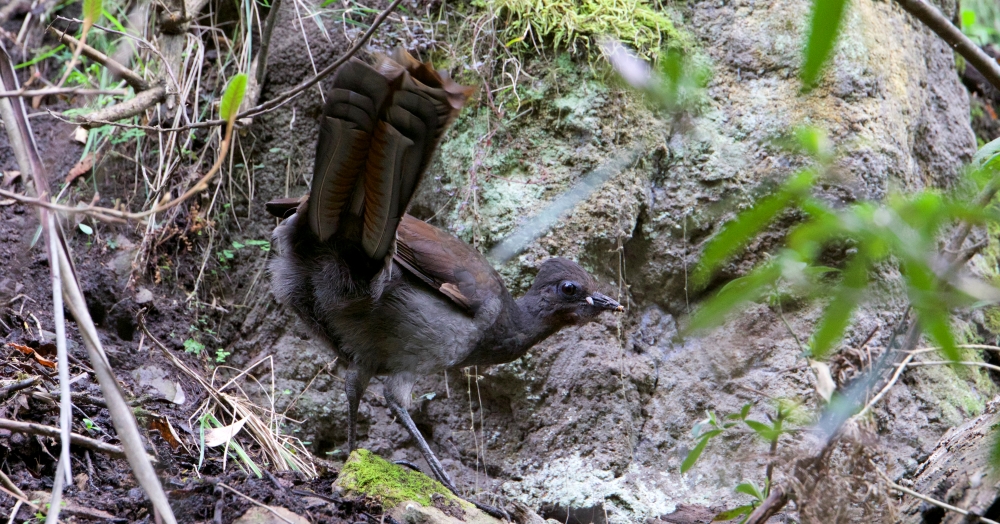
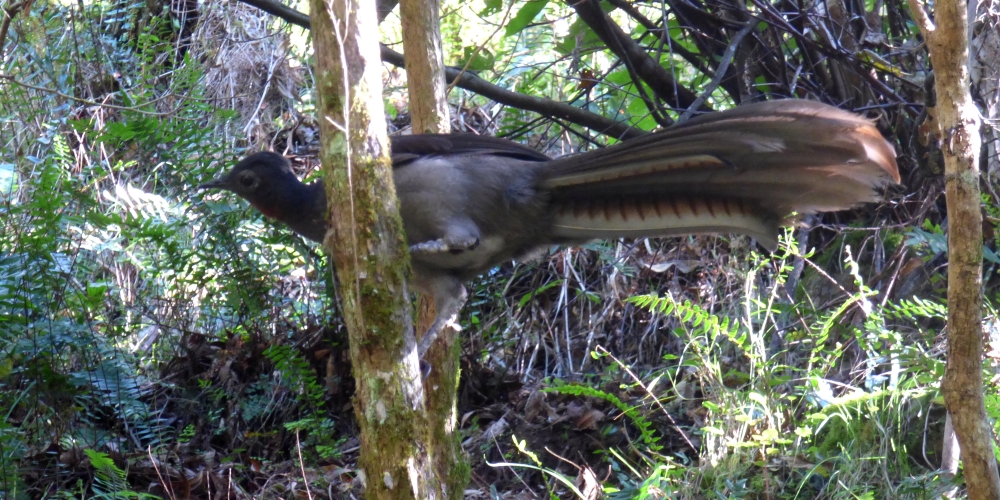
However, you can never really tell if a lyrebird with short lyrates is an adult female or an immature male, unless you see the bent tail that happens when she is nesting.
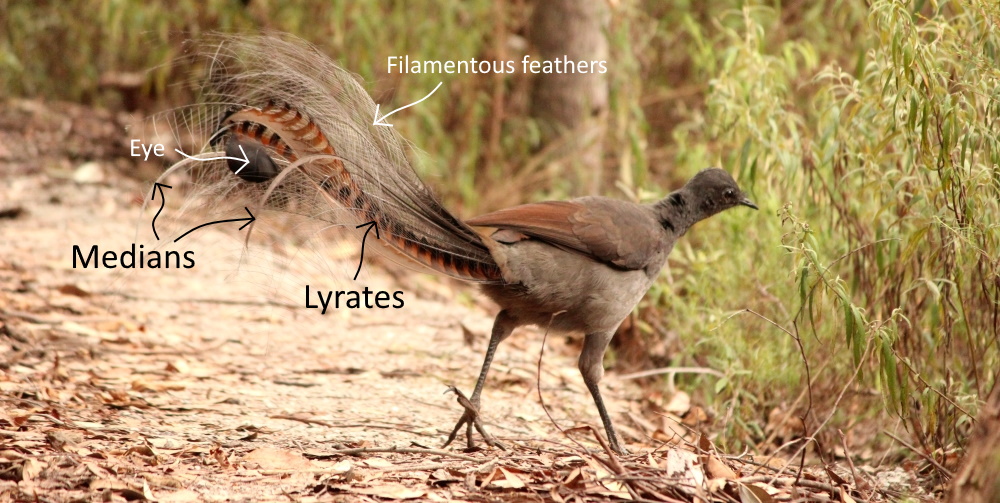
If the baby is a male, his tail will at first look like a female’s, then over time the two lyrates (outer feathers) will become longer, develop bars and transparent windows and become a beautiful rich white and chestnut brown. They will develop an eye (bell) at the tip. At around 4 to 5 years of age the filamentous feathers will develop, and the two middle tail feathers (medians) will become wire-like. By 7 – 9 years the full tail set will be complete.
Tragically, 45% of Superb Lyrebird habitat was burnt in the Black Summer bushfires.
That means that our lyrebird is now threatened species, and one of 17 birds listed for emergency intervention. https://theconversation.com/click-through-the-tragic-stories-of-119-species-still-struggling-after-black-summer-in-this-interactive-and-how-to-help-131025
How can you help? Watch out for lyrebirds in areas where you used to see them before the fires. Report any sightings to eBird, Birdata or here on the Mallacoota Birds facebook group.
In the Mallacoota area the subspecies is presumably victoriae, the darkest.
LISTEN TO THE CALLS: https://wildambience.com/wildlife-sounds/superb-lyrebird/
This amazing site includes recordings of Superb Lyrebird mimicry compared against a recording of the original bird.
Scroll through to see lots of great pics here: https://ebird.org/species/suplyr1/
Details: Superb Lyrebird Menura novaehollandiae victoriae
Location: east of Melbourne VIC through Gippsland, NSW coast to Queensland border. Introduced to Tasmania. Subspecies victoriae in Victoria & inland NSW, subspecies novaehollandiae in coastal southern to central NSW, subspecies edwardi northern NSW.
Conservation status/Learn more: Conservation status under review. https://www.birdlife.org.au/bird-profile/superb-lyrebird
More information about the new threatened status and how to help here.
Thanks to Karen Weil for information on the plumage stages of lyrebirds, Darilyn & Les Goldsmith from Goldsmiths in the Forest B&B, and Michael Barnett, Martin Maderthaner & Scott Roberts for use of photos.
 Mallacoota Birds