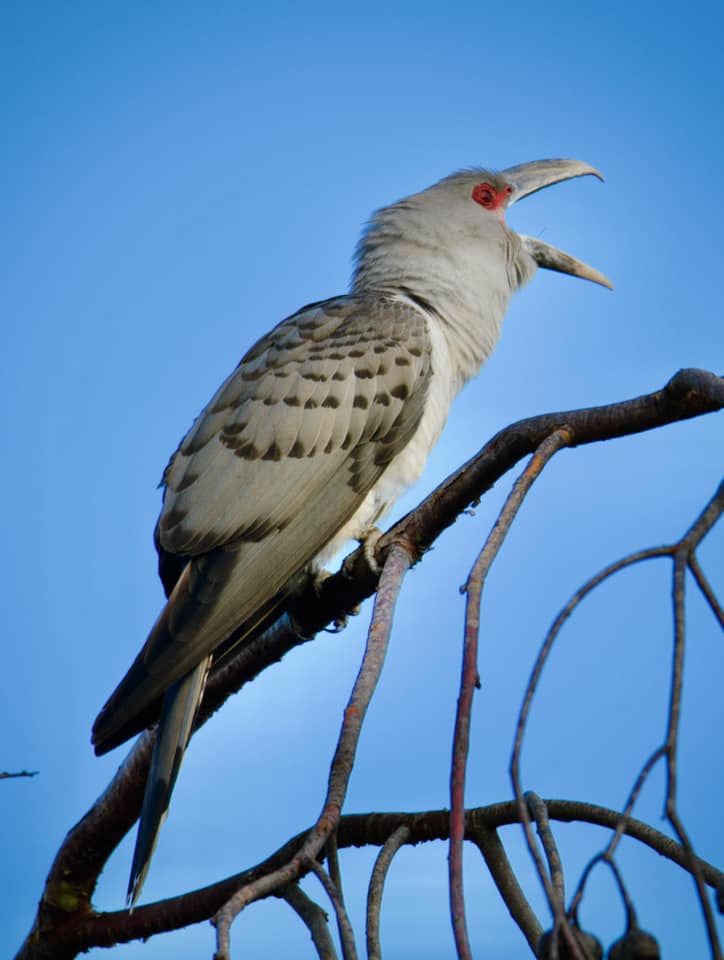
Bird of the Week: Channel-billed Cuckoo 30 October 2020
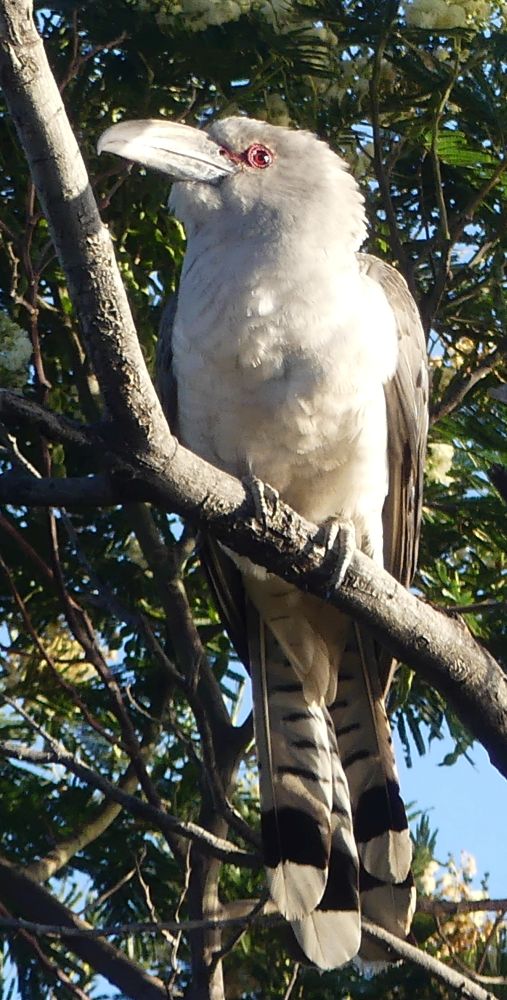
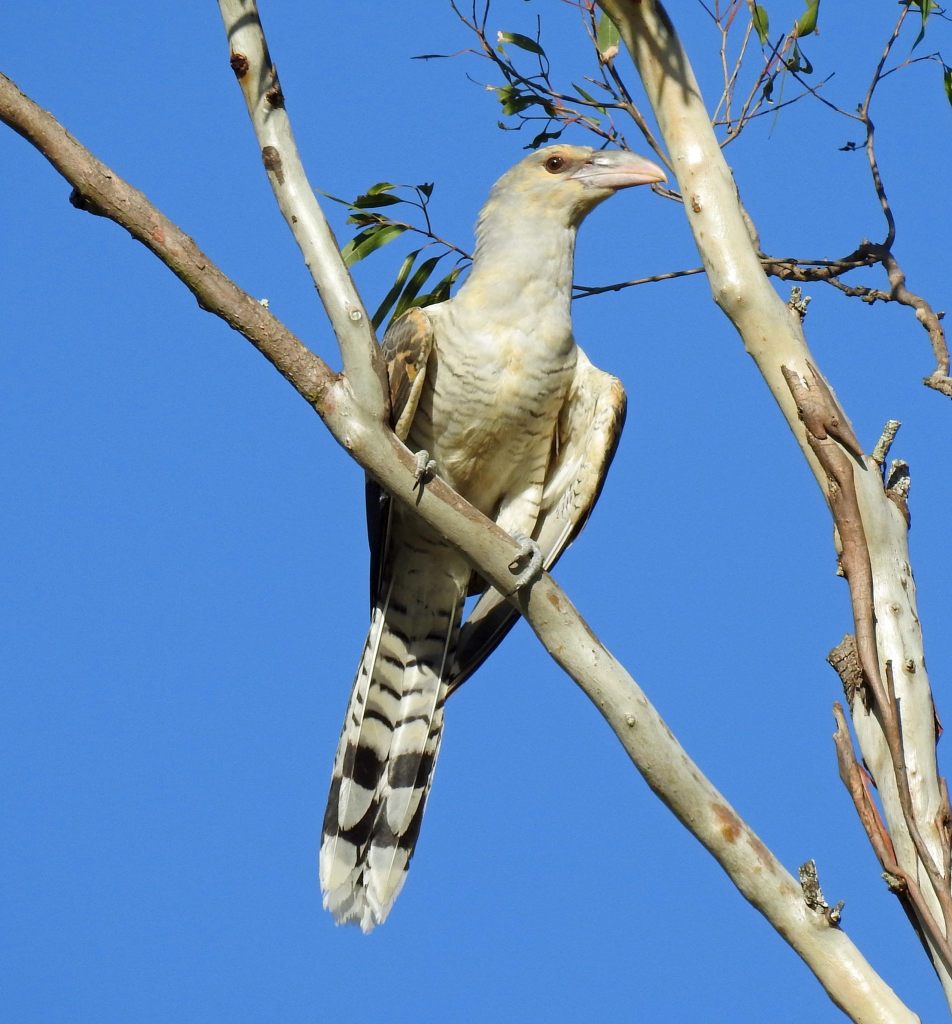
Australia has many cuckoos, including the world’s largest: the Channel-billed Cuckoo. These enormous birds fly into Australia from Indonesia and New Guinea every year, arriving in Mallacoota usually in September or October.
They are huge, but shy, so it’s easy to miss them. In flight they have a long tail, and almost raptor-like shape, except for that enormous bill.
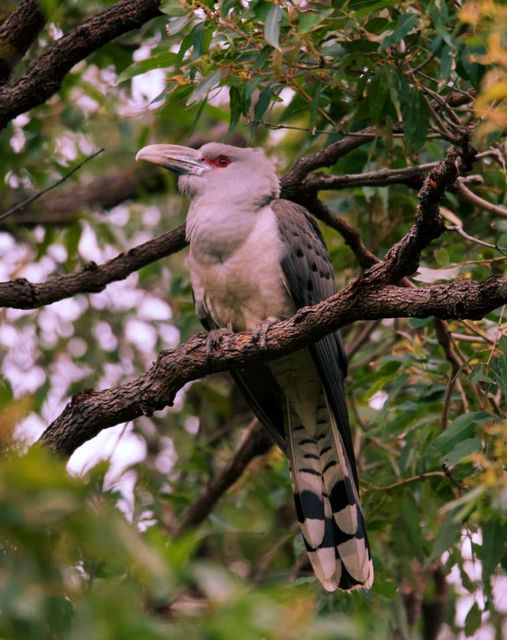
If you hear them in full call, they are impressive. It is a raucous hoot-squawk, very like a Brolga or a Blue-winged Kookaburra. The first time I heard them was at Lake Tyers Forest Park at the Lonely Bay Walk. I was intrigued, but had no idea what it was, and thought maybe a weird kookaburra song! I didn’t report it, but luckily recorded it on video. Years later I realised what it was.
They are cuckoos, and brood parasites. This means that they lay their egg (or possibly two?) in another bird’s nest. But don’t hold that against them – they are a marvel of evolution.
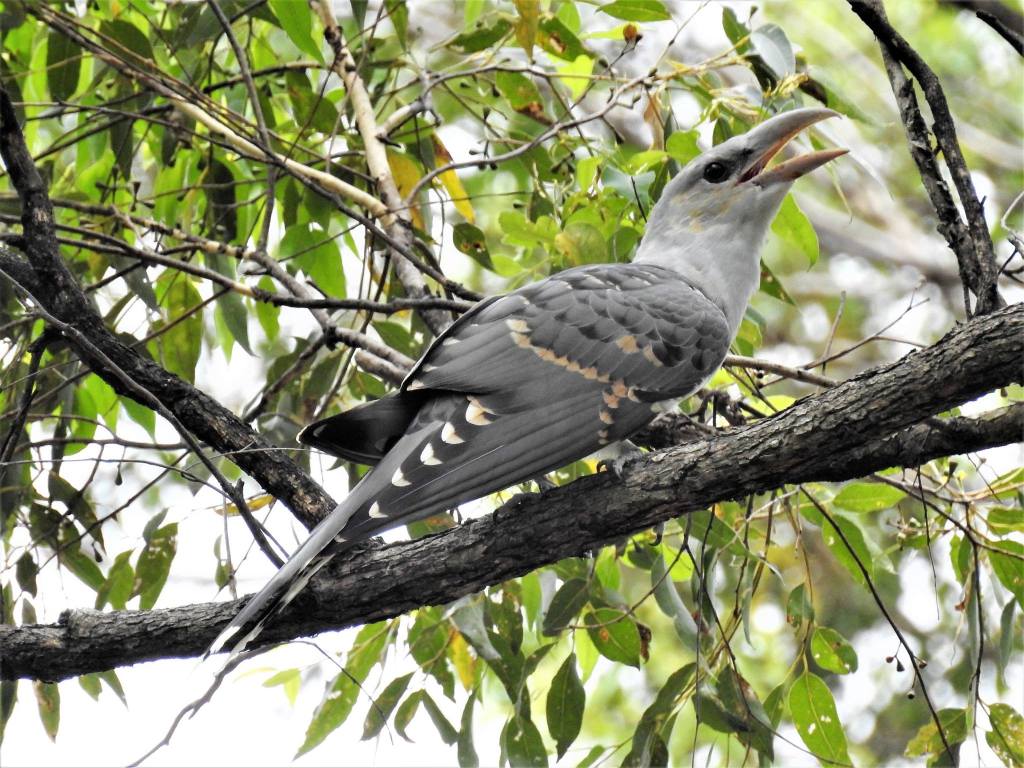
Did you know that cuckoos have developed a range of strategies to give their babies the best chance of survival? Some lay an egg that is almost exactly the size and colour of the host (Brush Cuckoo, Horsfield’s Bronze-cuckoo). Others lay eggs so dark and matte that the host parent can’t see it (Shining & Little Bronze-cuckoo) . Some cuckoos have chicks that look like the host chicks, so even then the parent can’t reject them (Shining & Little Bronze-cuckoo). Still others have chicks that hatch and learn the call of the host chick within days, even though there is no host chick to copy!!!! (Horsfield’s Bronze-cuckoo)
Read more, and see fascinating pics in this marvellous paper: ResearchGate
Channel-billed Cuckoos are not ‘evicters’ – the baby cuckoo doesn’t chuck its host siblings out of the nest, it is raised alongside the host chicks. But usually the demands of all the chicks are too much for the host parents, and the host chick rarely survives.
Their hosts are usually Pied Currawongs, but ravens, Australian Magpies and sometimes a Mudlark family get to share the load.
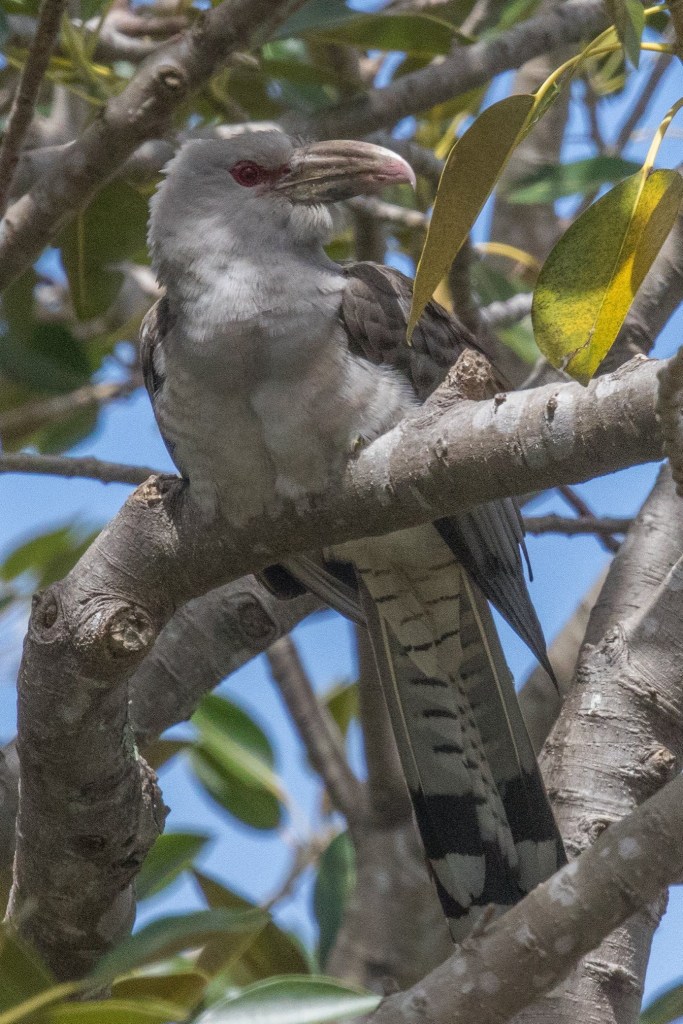
Martin Butterfield tells this story: “They are really unusual in Canberra and when one turned up there several (~10?) years ago I went to tick it. After about 30 minutes searching with no luck I met another optimist and we searched together for 15 minutes until a third joined us. Still no joy. So #3 played a call. Instantly a huge grey shape emerged from a eucalypt about 20 m from us – in the middle of the area we had been searching – flew straight over our heads and disappeared.
While I am very cautious about using call back I tried it once on Stingray Point with the local bird and same thing. It called as it flew, ending up (from its own noise) in about Radley Place about 1 km away.
The first sighting this season was one flying below our place calling as it went. About 30minutes later it flew over Betka Rd (3km away) heading West.”
LISTEN TO THE CALLS: https://www.xeno-canto.org/species/Scythrops-novaehollandiae
Scroll through to see lots of great pics here: https://ebird.org/species/chbcuc2
Details: Channel-billed Cuckoo Scythrops novaehollandiae
Location: Eastern and northern Australia, from East Gippsland VIC to the Kimberley WA and inland to central Australia through western QLD and eastern NT, New Guinea, Timor L’este, Sulawesi & the Banda Arc Indonesia, Bismarck Archipelago.
A couple are usually seen around Melbourne each year, but this seems to be an extension of their range, Martin says: I don’t have detailed records but when we used to have a place at Congo (1984 – 1990) the expert birders in the area (eg Stephen Marchant) used to regard some huge Moreton Bay Figs outside the Moruya Pub as the Southern limit of their range. By the mid-1990s there are several records in Birdata South of Pambula.
Conservation status/learn more: https://www.birdlife.org.au/bird-profile/channel-billed-cuckoo
Thanks to Martin Butterfield, Martin & Mariska Ascher, Jack Winterbottom, Sue Gadsby Lee, Karen N Mark for your lovely pics.
 Mallacoota Birds