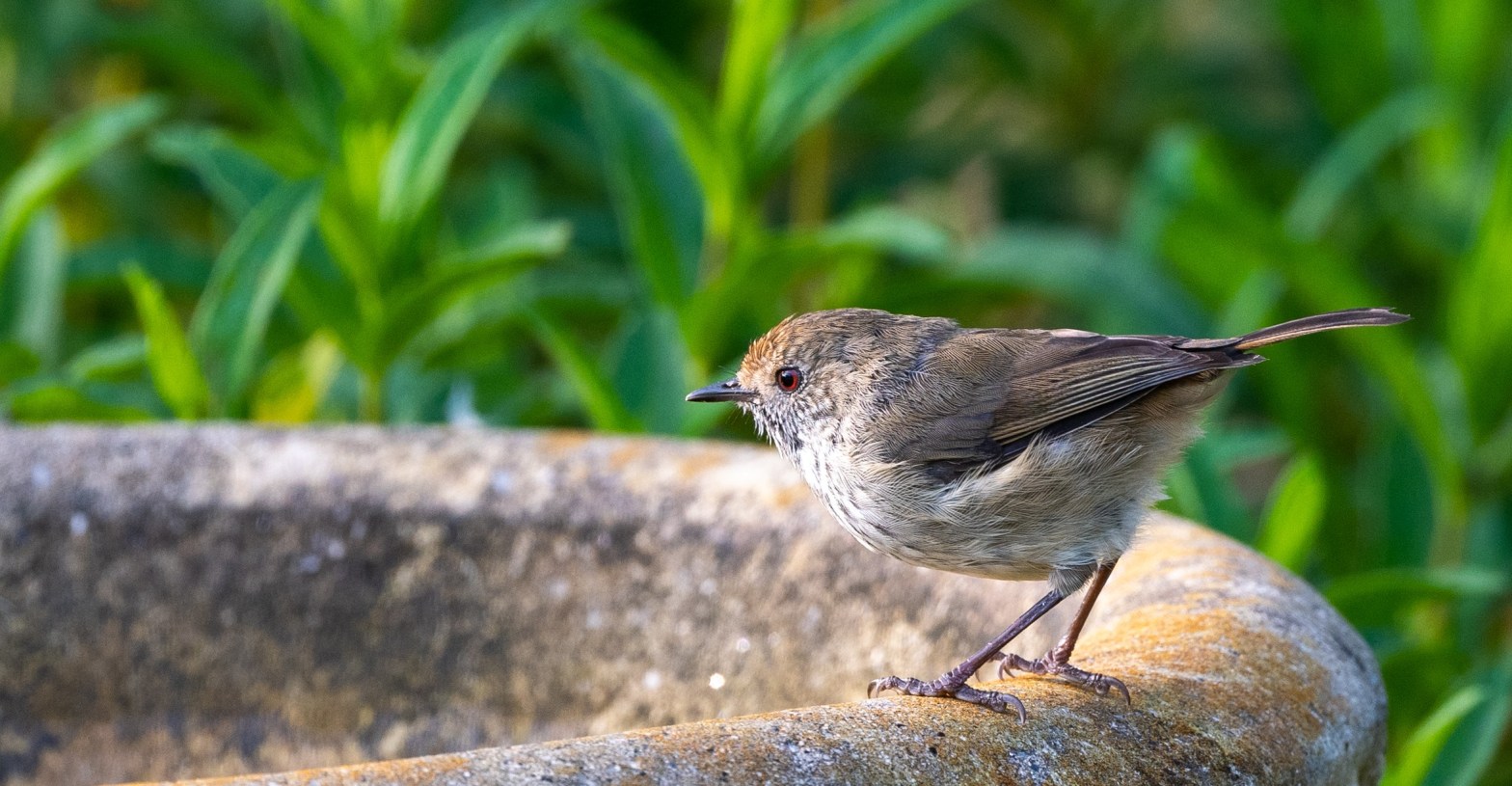
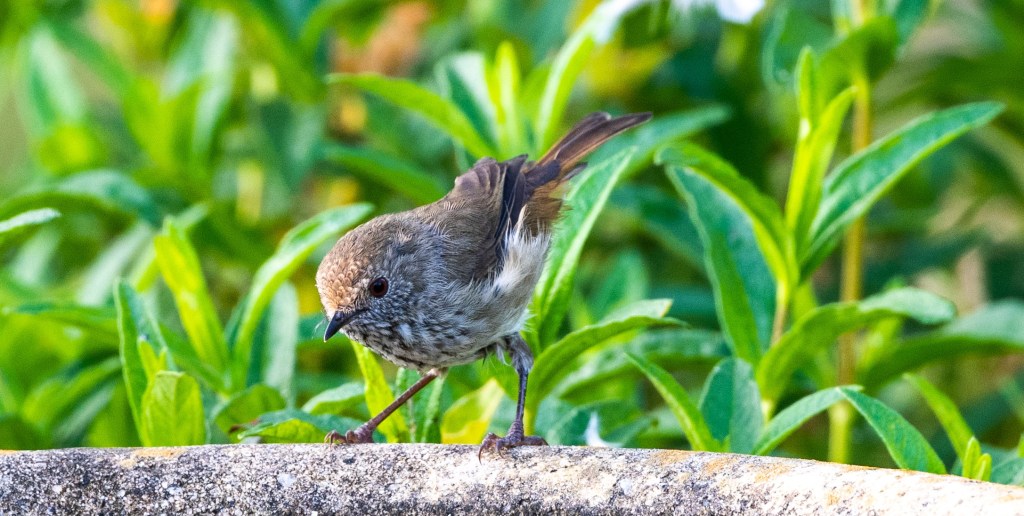
This is one of the most frequently-seen small birds in East Gippsland. They are everywhere, brave and cheerful, dear little birds.
Thornbills are cute, but hard core – telling thornbills apart is like doing a jigsaw where every piece is almost the same, and WON’T STAY STILL!!!
Luckily, thornbills make up for their challenging identification by being quite confident and familiar. They will come quite close to you if you are patient.
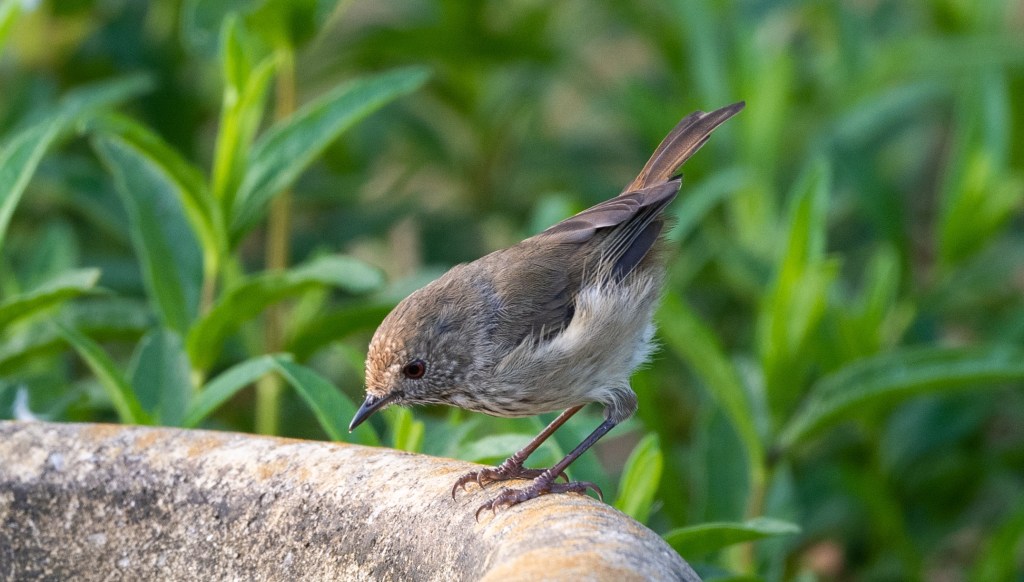
Brown Thornbill East Gippsland by Rob Clay
Keep in mind that high quality photos you see of this bird are not what you see with your own eyes. Pics of adults, like Rob Clay’s pic above, show a scalloped forehead and ear coverts, but that’s hard to see in the field.
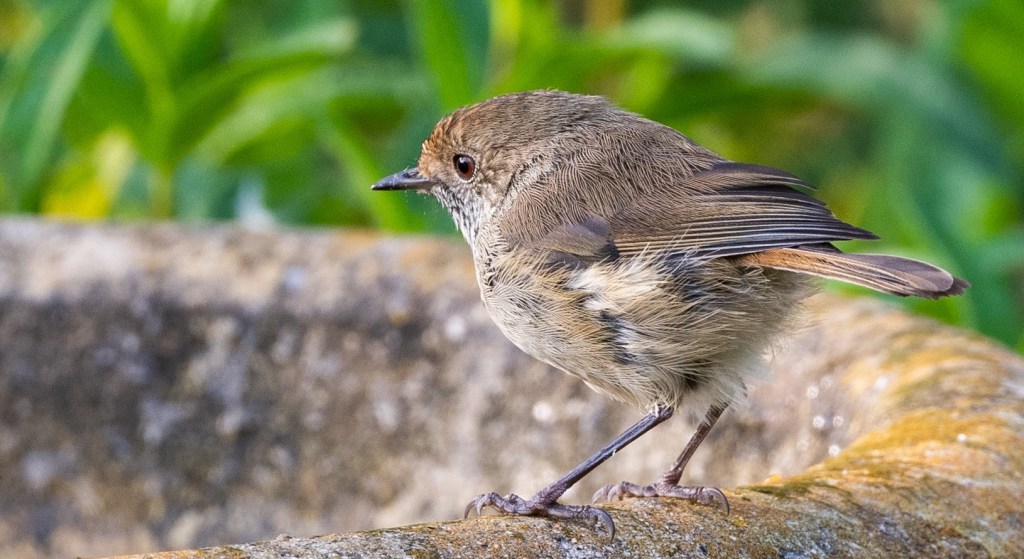
With the Brown Thornbill, I look for a bird without strong features. The overall impression is brownish-grey. They often look a bit chubby compared to other thornbills, I don’t know why.
Chubby! Brown Thornbill East Gippsland by Rob Clay
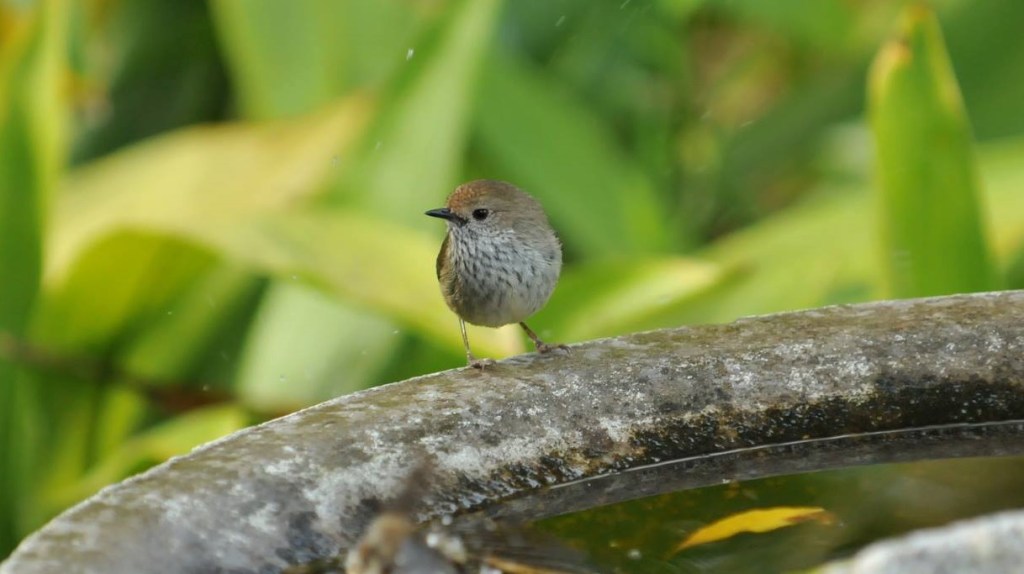
The big dark eye in a smooth, mid-grey face is the first thing I look for (compare Striated: bright white face, Buff-rumped: white eye). The front/breast has streaks but they’re not always really strong (compare Striated: really strong streaks). The forehead is a bit rufous and the rump is too, but not really strong (compare Striated: strong rufous forehead but yellowish rump. Buff-rumped: slight rufous forehead but yellowish rump).
Brown Thornbill Mallacoota by Michael Barnett & Gregory Storer. Note the big dark eye in smooth, unstreaked face. Brown Thornbill East Gippsland by Rob Clay
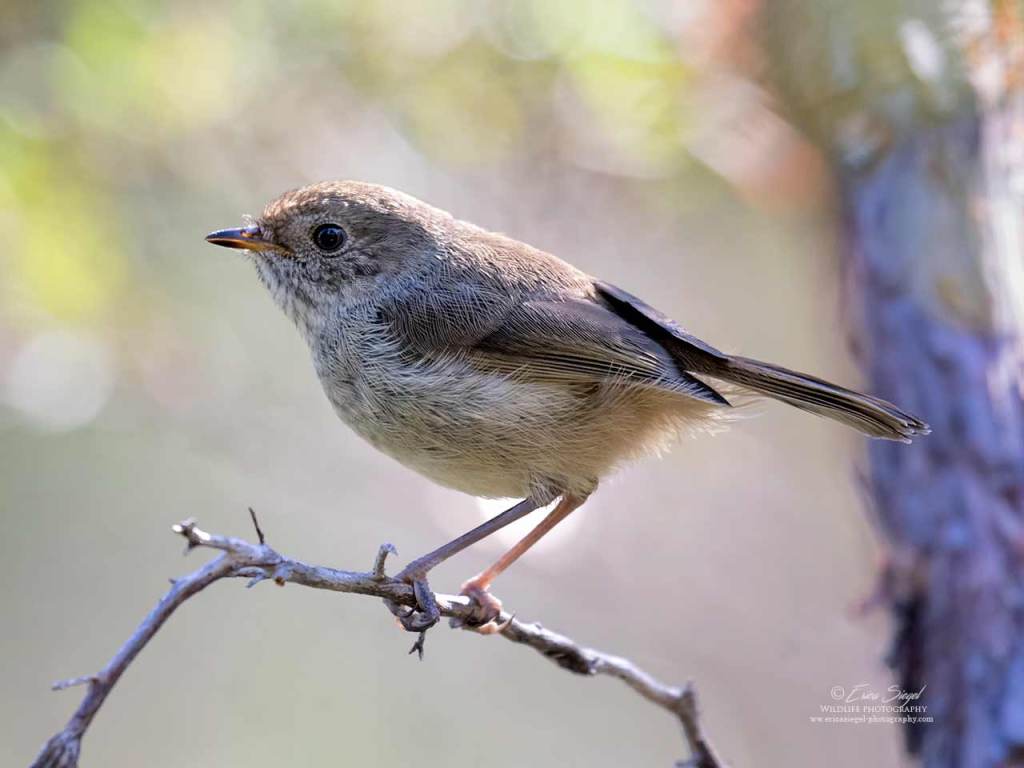
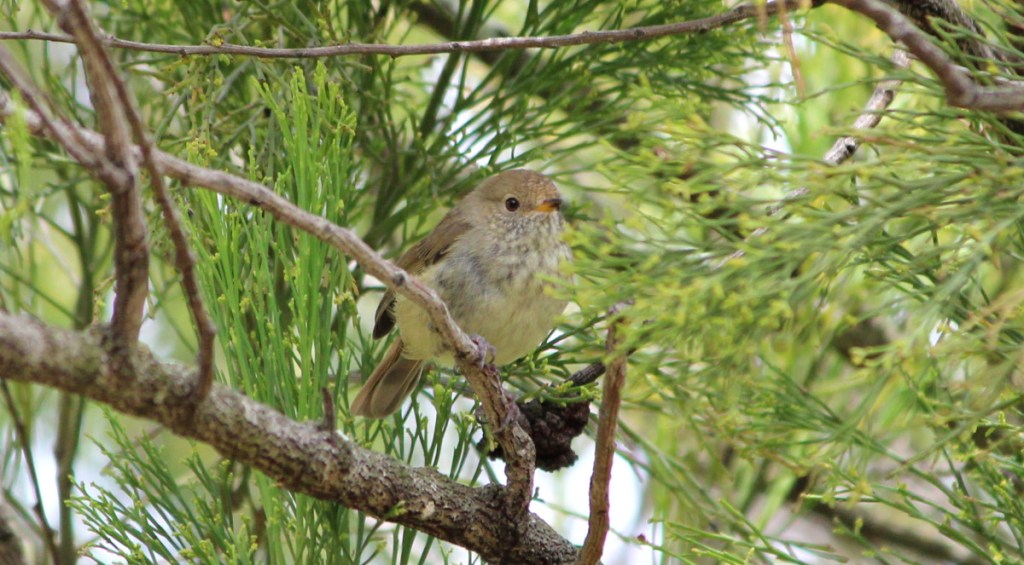
Both sexes are the same as adults, juveniles have less streaking, brown eye and a yellow gape (base of bill)
Brown Thornbill juvenile Mallacoota by Erica Siegel. Note the yellow gape and lack of streaking on the breastBrown Thornbill juvenile, You Yangs by Janine Duffy. The yellow gape on this bird is very bright
Also Brown Thornbills are more likely to be alone, or just a pair. Other thornbills are more likely to be in flocks of 10 or more.
Thornbills are a very Aussie group of birds – they only live here and in New Guinea. They are generally southern in distribution – they are pretty absent from Australia’s extreme North. Interestingly, there are some unrelated hummingbirds in South America called thornbills.
Thanks to Rob Clay, Michael Barnett & Gregory Storer, and Erica Siegel for your wonderful pics and information.
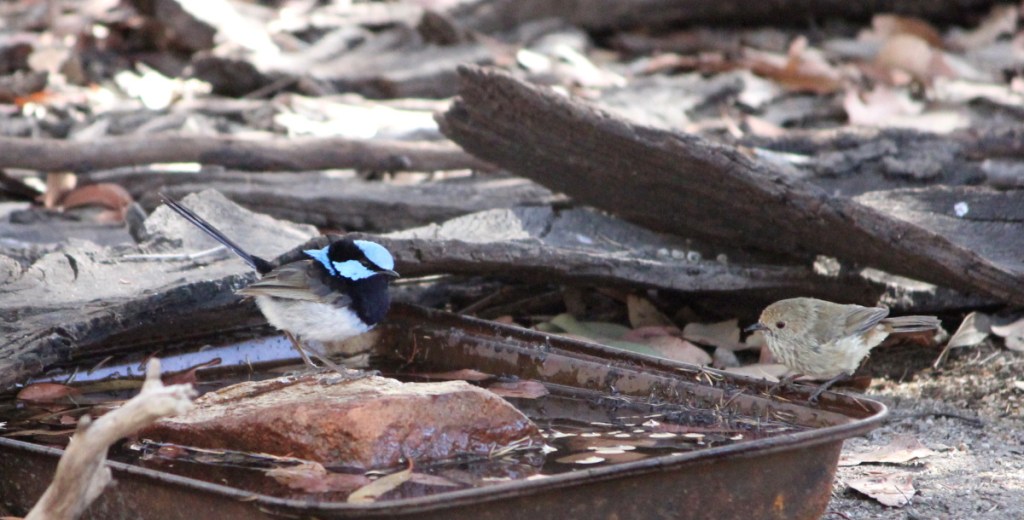
Thornbills are very tiny! Brown Thornbill (right) with a much larger Superb Fairywren, You Yangs by Janine Duffy
A quick guide to identifying thornbills in south-eastern Australia
So first, narrow it down to thornbill.
Is it very small with a short tail? Yes = thornbill, gerygone, scrubwren, pardalote, mistletoebird, firetail/finch Does it have a small, thin bill? Yes = thornbill, weebill, scrubwren, Striated Fieldwren, Chestnut-rumped Heathwren Is it streaky on head, face or breast? Yes = thornbill, White-browed Scrubwren (a little), Striated Fieldwren or Chestnut-rumped Heathwren Is it really really small, smaller than a fairywren? Yes = thornbill (scrubwren is twice the size, and fieldwrens & heathwrens are 3 x the weight of a Brown Thornbill)
Now you’re sure it’s a thornbill, which one is it?
Start with habitat – these are the thornbills most likely: Wet forest, thick gardens: Brown Thornbill, Striated Thornbill Open forest: Brown Thornbill, Striated Thornbill, Buff-rumped Thornbill, Yellow Thornbill, Yellow-rumped Thornbill Shrubby coastal, tea-tree or casuarina forest: Brown Thornbill, Yellow Thornbill Farmland, lawn: Yellow-rumped Thornbill
Then height – these are the thornbills most likely: High in foliage of trees and large shrubs: Brown Thornbill, Striated Thornbill, Yellow Thornbill Middle shrub level: Brown Thornbill, Striated Thornbill, Buff-rumped Thornbill, Yellow Thornbill Ground: Yellow-rumped Thornbill, Buff-rumped Thornbill
Check the most likely ones against your field guide. Of course, this guide is not absolute – you could see a Yellow-rumped Thornbill high in a treetop, or a Brown Thornbill on the ground. But if you do, double check.
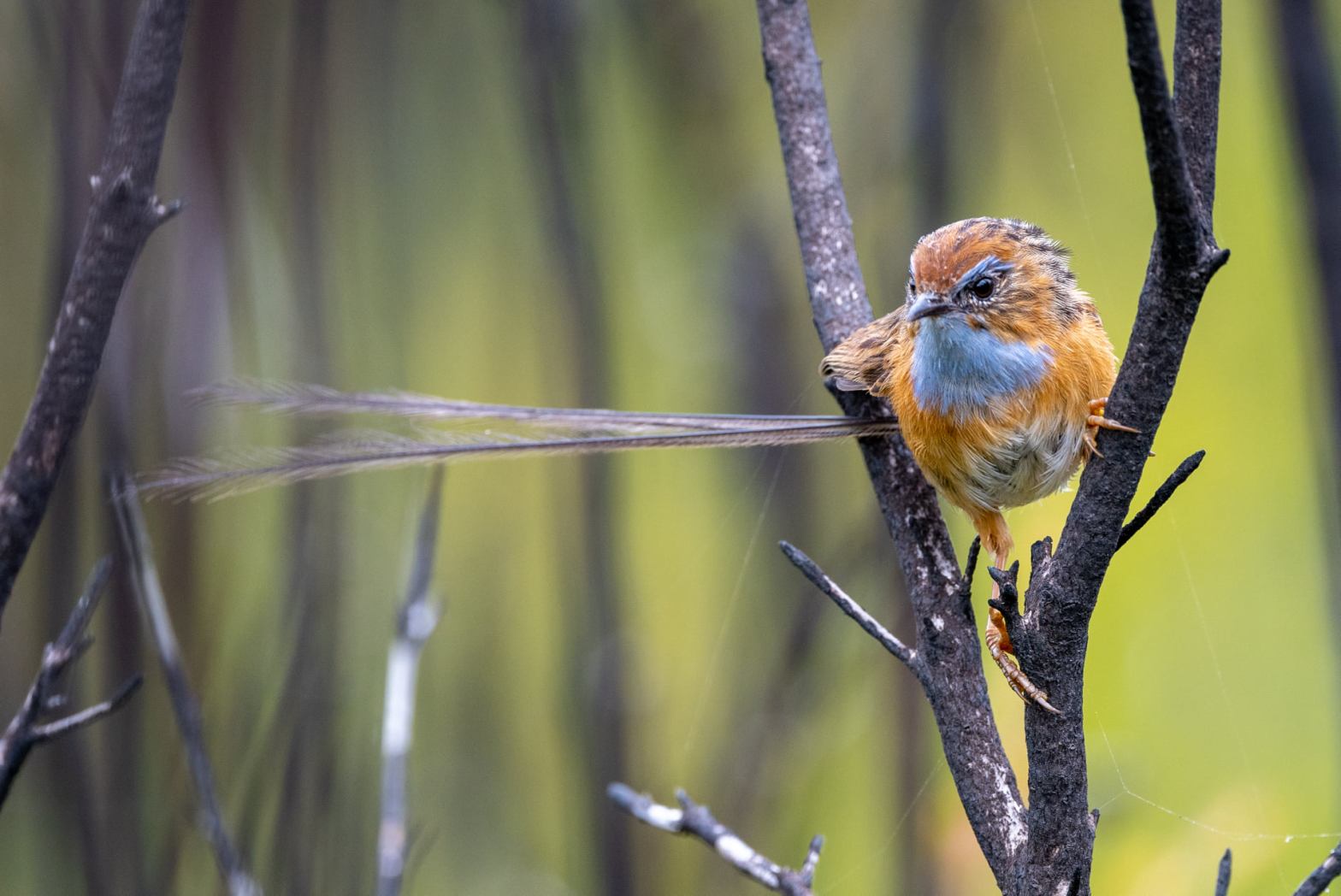
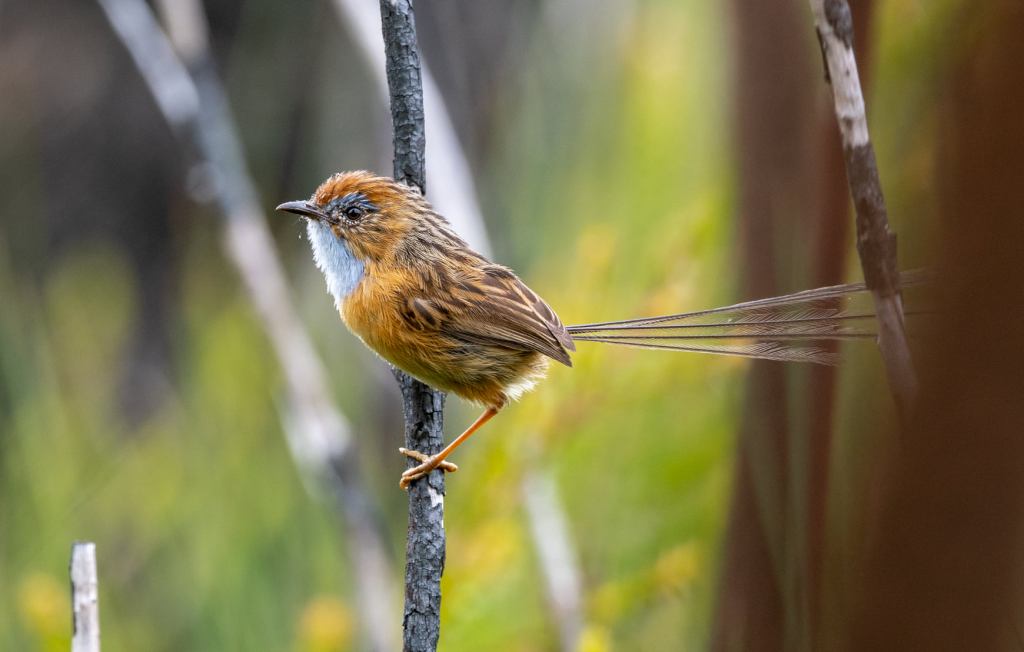
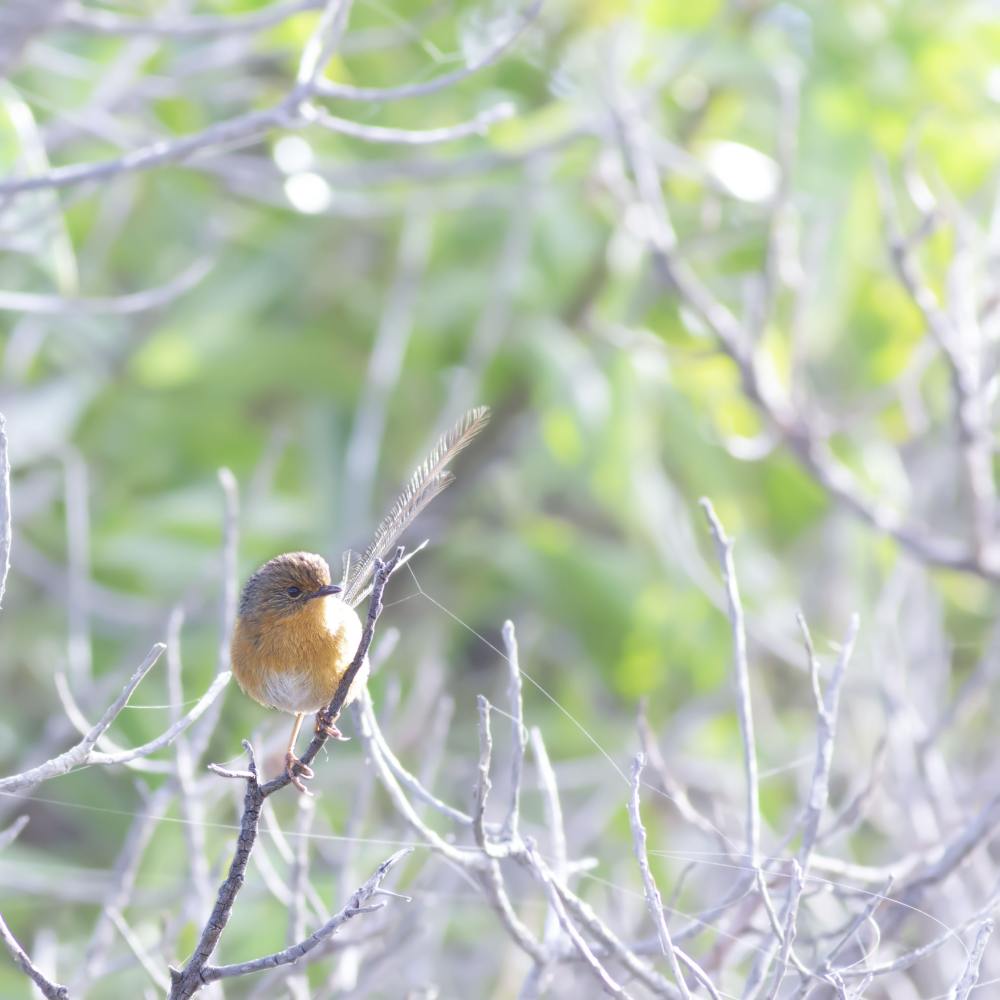
Years ago, at Double Creek near Mallacoota I saw my first Southern Emu-wren. I remember thinking “I reckon I’ve become a birder now”.
Some Australian birds are not generally noticed by the public. They are hard to see, secretive, live in remote locations, or look superficially like another bird. The Southern Emu-wren is all of those – small, quiet, living in boggy saltmarshes and impenetrable heaths in coastal Australia. If you saw one as a passerby you might have passed it off as a female Superb Fairywren. True, it looked a bit more orange, and the tail seemed overlong, but it was so brief….
Southern Emu-wren female, Green Cape by Rob Clay
It takes good eyes, fast action on binoculars or a close view to see the stunning details of this beauty. Luckily we have superb photographers in our midst to capture the details.
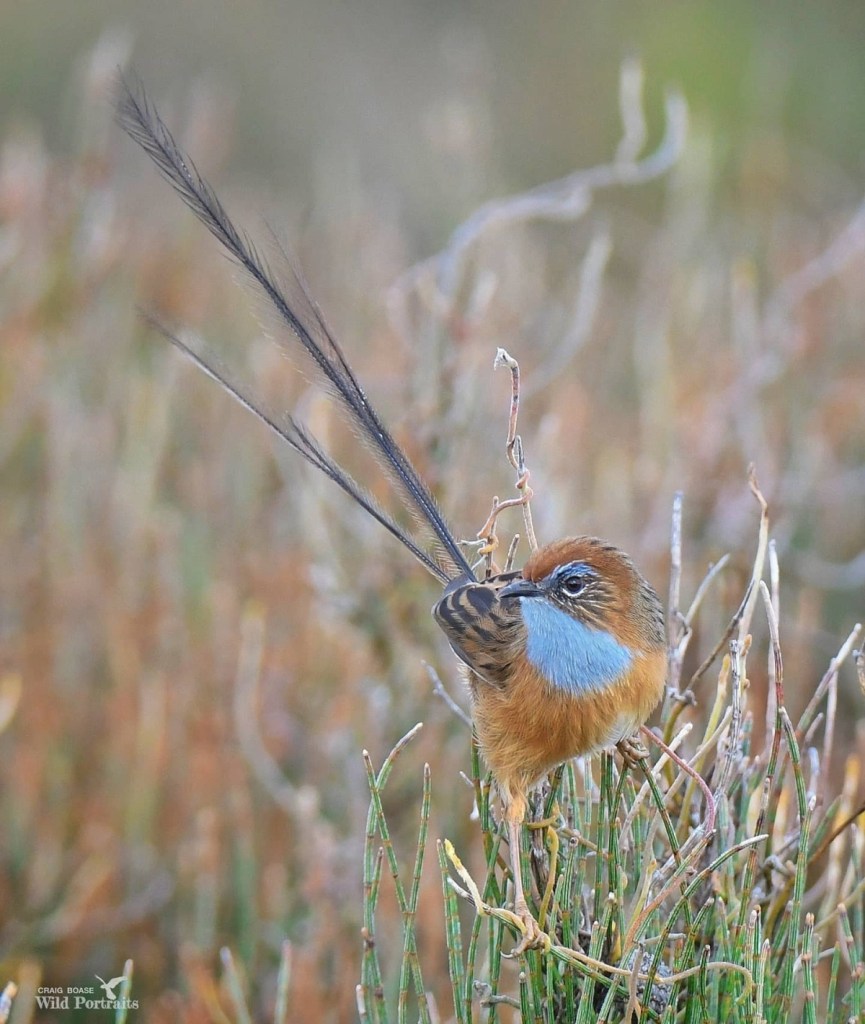
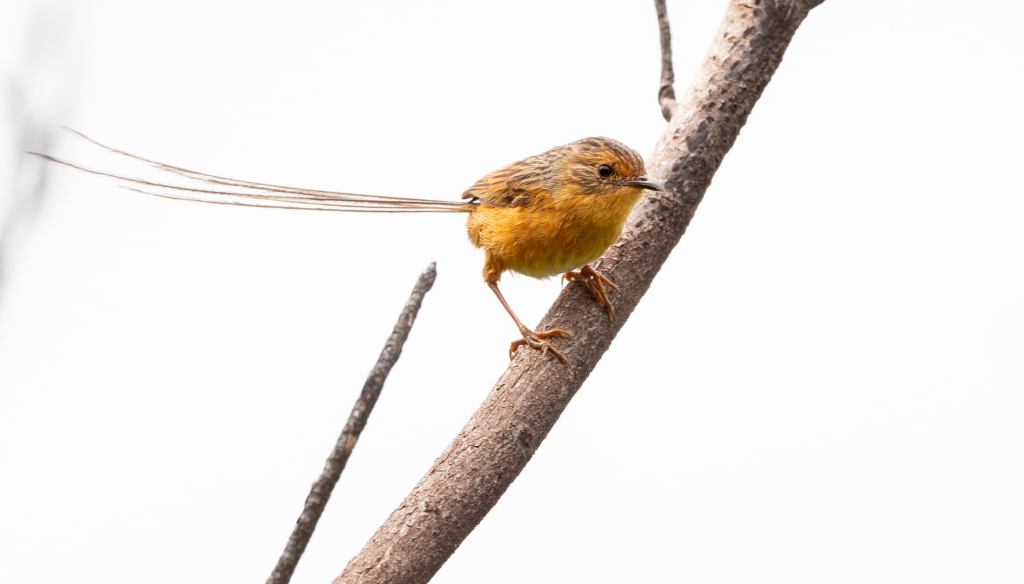
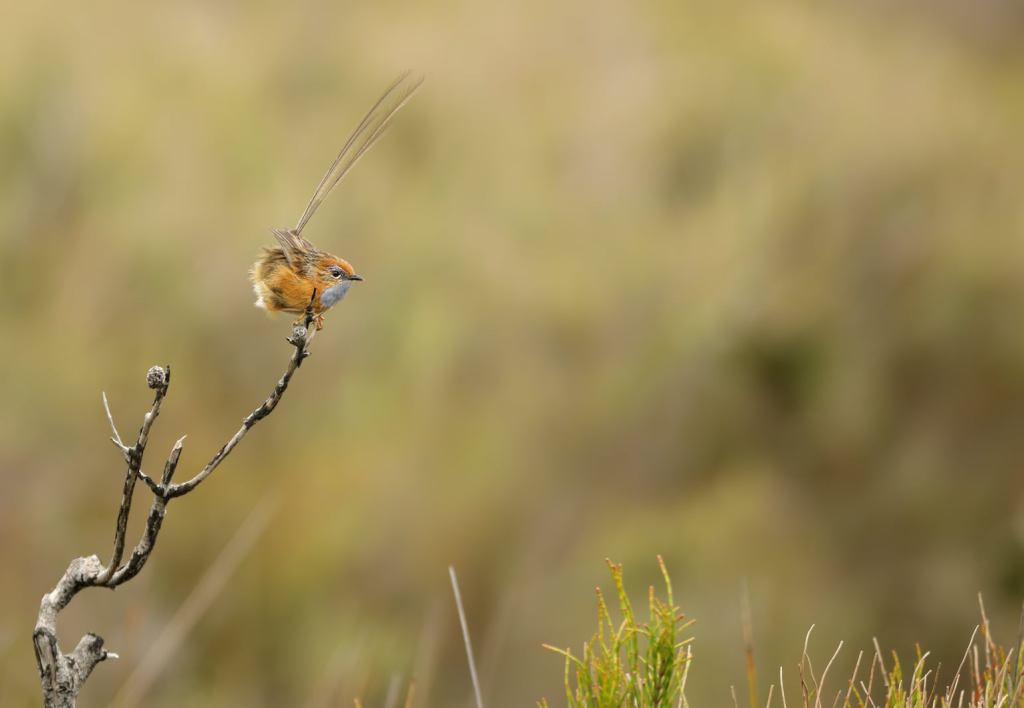
The tail fascinates me. Why is it so long? Why is it so widely-branched, like an emu feather? Why does it have only six feathers? Why, why, why?
Southern Emu-wren Walkerville by Craig Boase
Many birds around the world have ridiculously long tails, and some of them only retain them – at length – for breeding season impact. Check out the Long-tailed Widowbird of southern Africa. It’s mostly (only?) males that do that. But both female and male Southern Emu-wren have the long tails, and at all times of year.
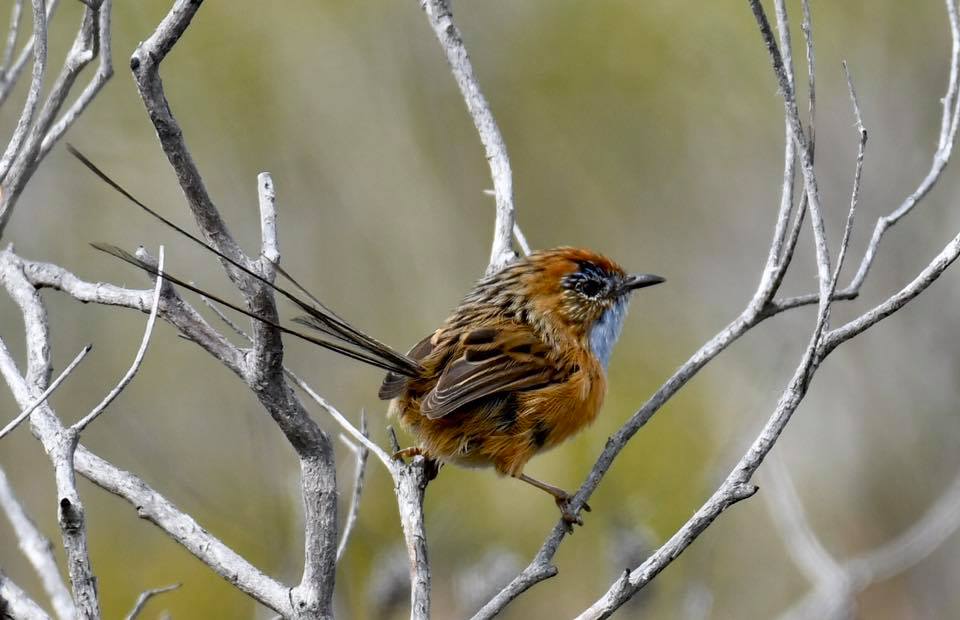
Tails are important for flight, but not critical – we’ve all seen birds flying without tails. Feathers don’t weigh much, so a long tail is not weighing them down as much as you might think, but the Southern Emu-wren only weighs 6 – 9g, so any extra weight could be costly. There is probably some extra drag from such a long tail too, which makes flying less easy. The webs don’t mesh together either, which means the tail is not an aerodynamic asset at all.
Surely the tail has a purpose.
Southern Emu-wren Green Cape NSW by Rob Clay. Note the stiff shafts of the 6 tail feathers
It is often mentioned that Southern Emu-wrens run like a mouse along the ground. Could the long, thin, soft tail be mimicking a mammal tail? If so, what is the advantage? Bird predator overlooks perceived mammal? Mammal predator misjudges defensive action by bird-appearing-to-be-mammal?
If anyone has any answers, I’d love to hear them!
Adult males have a sky blue throat and chin, and some blue above the eye. Below their eye they have a white half ring highlight. Rich orange forehead, mostly unstreaked. Black bill, pinkish-orange legs. Breast and underbody mostly orange, but with a white belly. Even juvenile males show some blue from a very young age.
Adult male Southern Emu-wren Cape Conran by Rob Clay
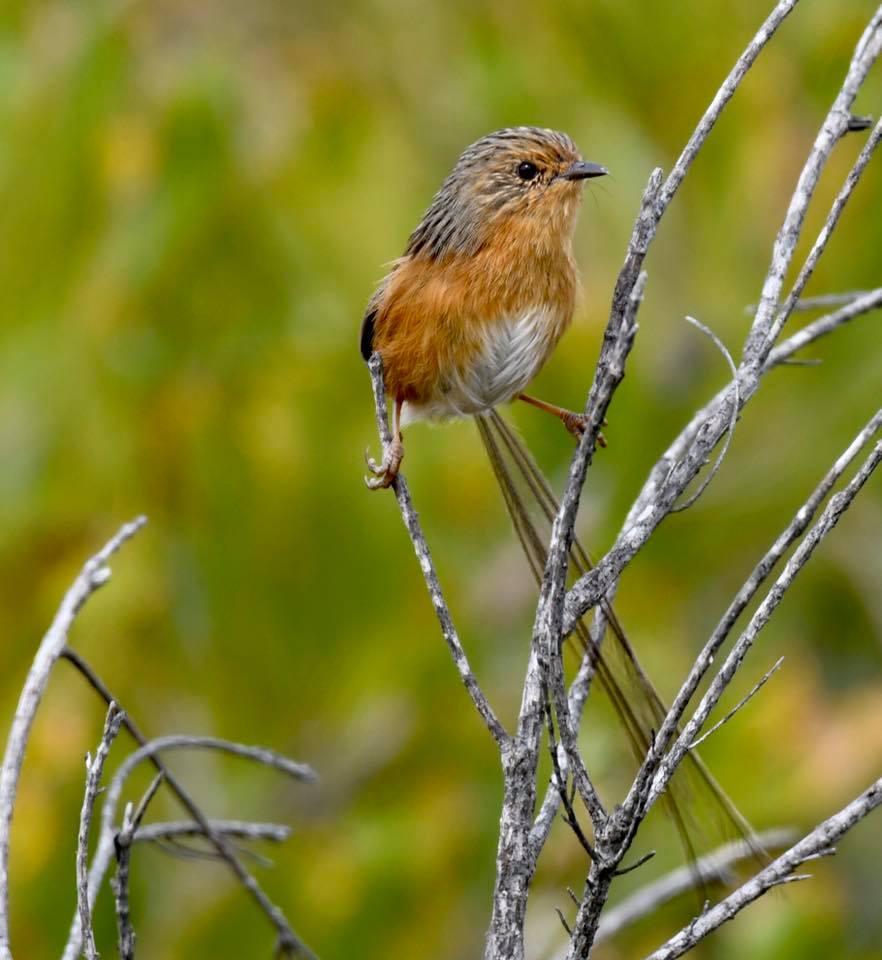
Adult females have an orange throat, breast and flanks and white belly patch. Ear coverts (feathers behind the eye) streaked with white, and rufous eyebrow.
Southern Emu-wren Mallacoota by Jess Waaleboer. Note the white belly patch.
Juveniles like females or dull males except that they lack the streaked ear coverts and rufous eyebrow.
Details: Southern Emu-wren Stipiturus malachurus malachurus. 8 subspecies – our ssp. malachurus occurs from southern Qld to the Otways west of Melbourne.
Location: coastal south-eastern and south-western Australia, including VIC, TAS, NSW, southern QLD, SA & WA
Bird of the Week:Glossy Black-Cockatoo 26 February 2021
Cockatoos and parrots are feature of the Mallacoota/Gipsy Point area – there are many species and they are highly visible. The Glossy Blacks are the top of the list for many, they are rare, quiet and can be difficult to see.
I’ll never forget bringing a group of Canadian birdwatchers to Mallacoota in the 2000’s. We knew that Glossies were a big hope for these visitors, so when I saw them on the Genoa-Mallacoota Road on the first day, I knew we had to stop everything. At the time Bill Nation was driving the Canadians in a bus with a trailer, but he was ahead of me. I radio-ed through anyway. It meant doing a U-turn on that windy road, but I had great faith in Bill.
Glossy Black-Cockatoo looking glossy East Gippsland by Rob Clay
I could hear the hesitation in Bill’s voice at first, then he replied “Okay”. I waited with the birds, hoping they wouldn’t fly off. It took 10 minutes, but Bill did it, and the birds stayed – and entertained a rapturous audience. It was wonderful.
They were already a Vulnerable species in Victoria before the Black Summer fires. So when the 2019-2020 megafires burnt 90% of their Victorian habitat, it would have severely affected these birds.
Any observation of these birds is critical, so please keep an eye out for them, take a photo, note the time and location, and submit to eBird or Birdata or post here so we can have it logged.
Even though they are one of the highlight species of Mallacoota, there have never been a lot of sightings of Glossy Black-cockatoos. October to February this year has seen 10 sightings on eBird in East Gippsland, compared to 8 in the same period in 2019-2020; 11 in 2018-2019 and 14 in 2017-2018.
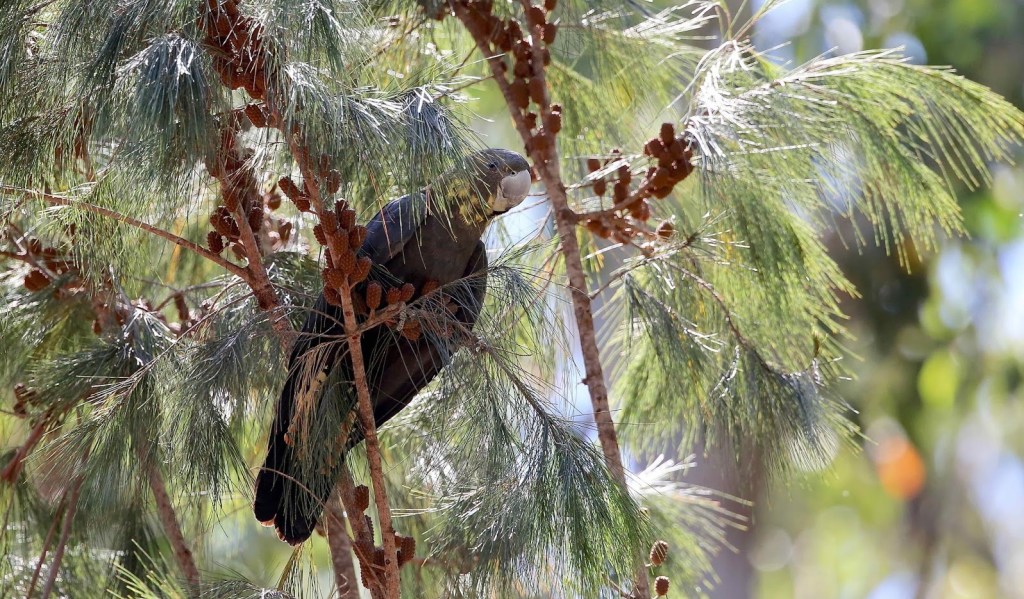
The best thing you can do for them is protect unburned forest, and plant natives in your garden. They especially love Casuarinas/She-oaks – Black She-oak Allocasuarina littoralis is their favourite. A. paludosa and A. nana also grow in East Gippsland, the former in coastal heaths, the latter in high elevation heaths in the Upper Genoa River area.
Glossy Black-Cockatoo, in she-oak Newmerella by John Hutchison
You can often tell their age and sex from their plumage:
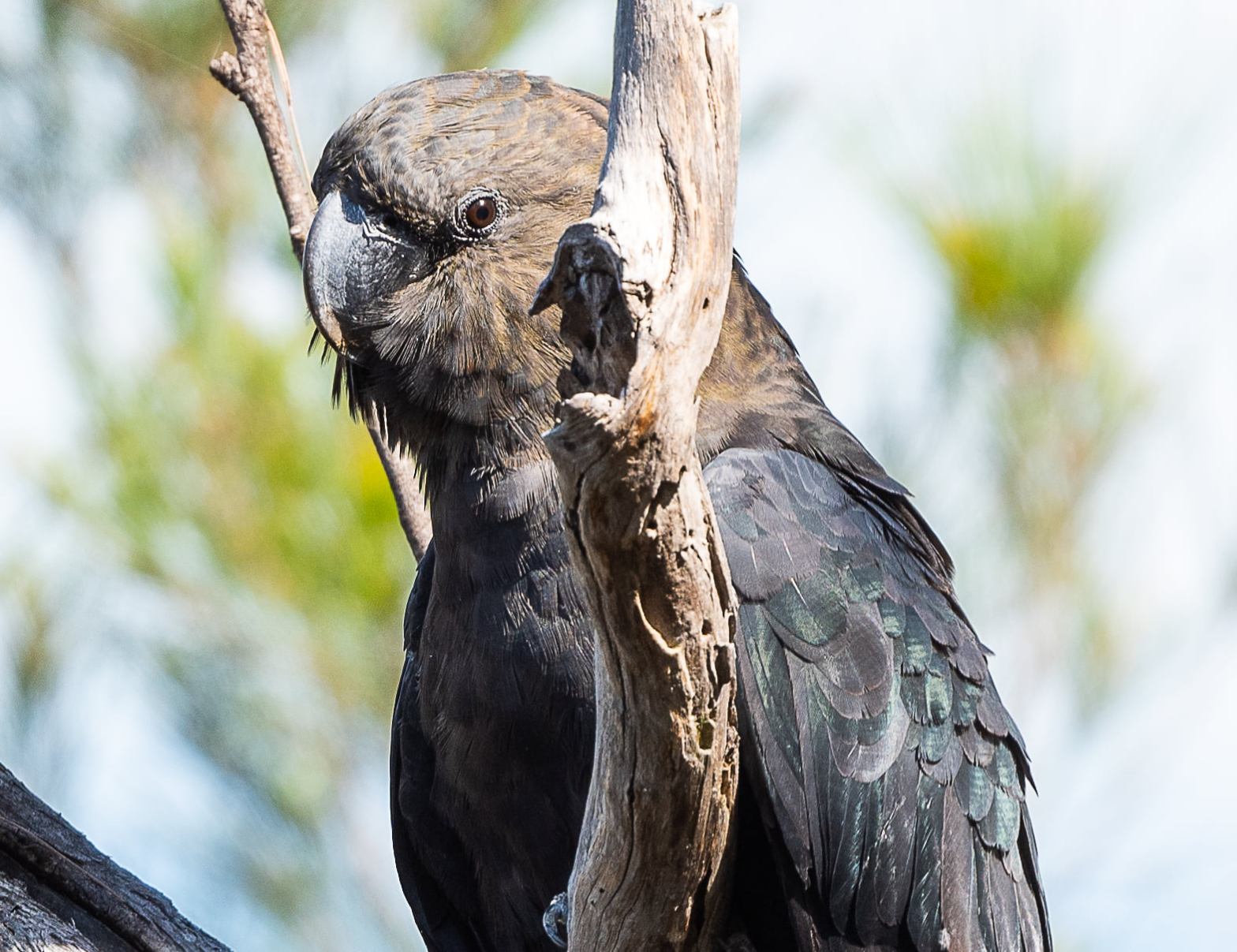
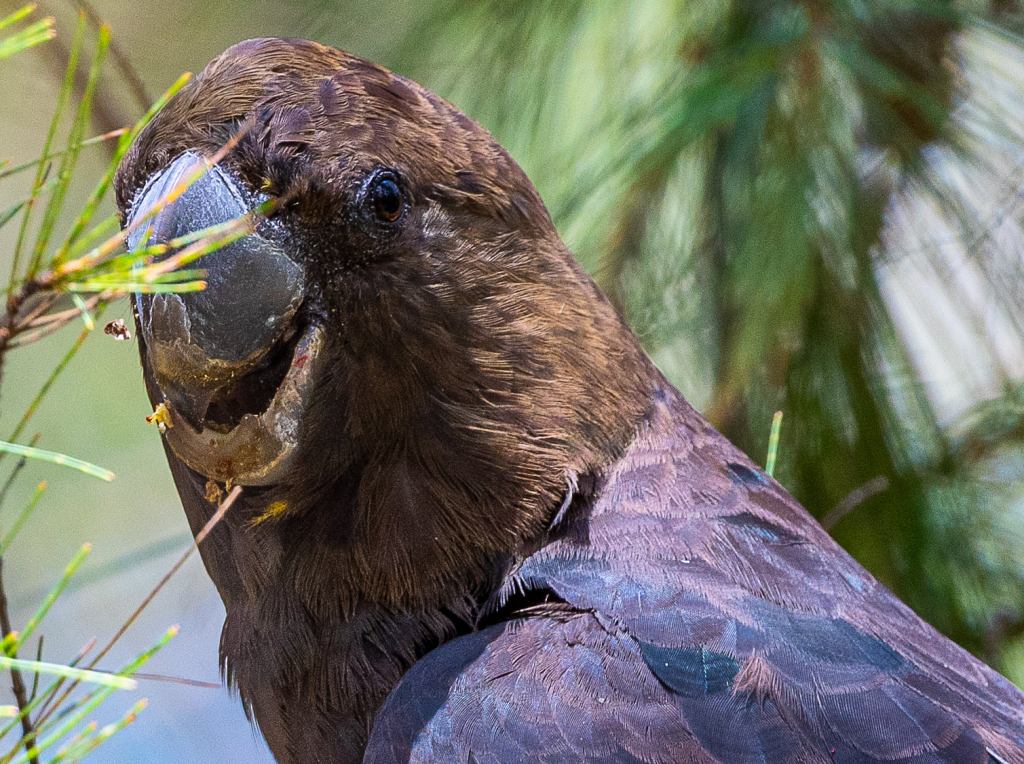
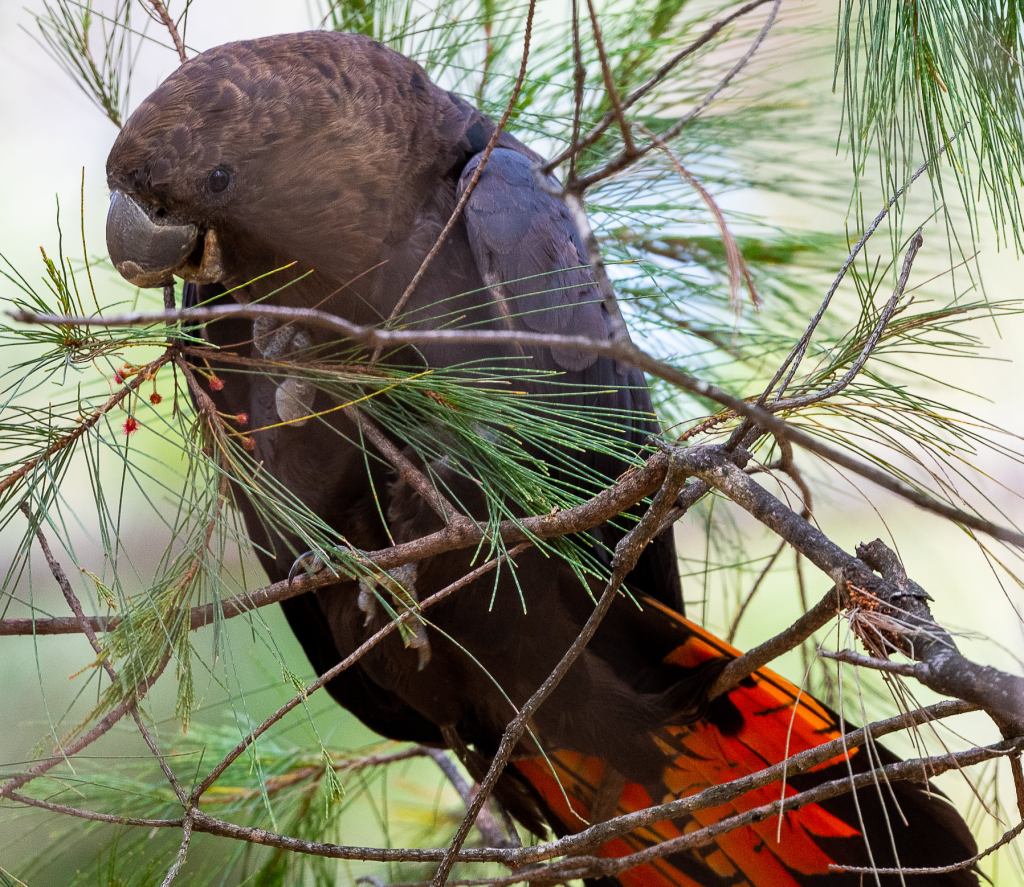
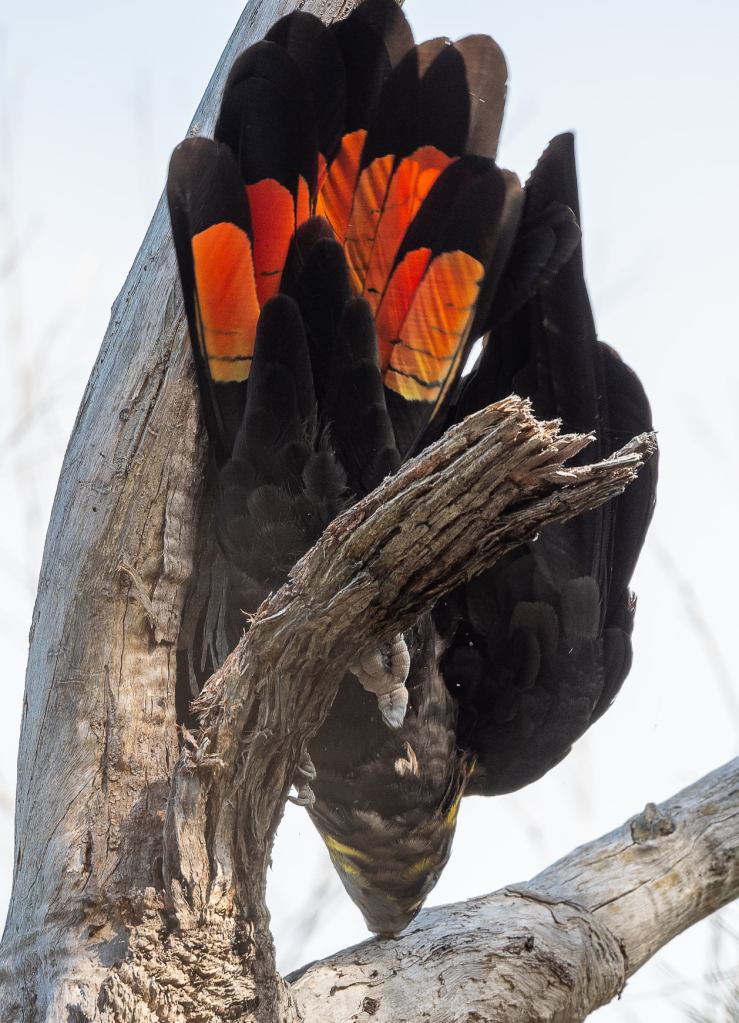
Adult males: brownish head, no yellow feathers*. Tail has a red panel that has no yellow edging. Black bars across the red decrease with age.
(*rarely an adult male has a few yellow feathers)
Adult male Glossy Black-Cockatoo East Gippsland by Rob Clay
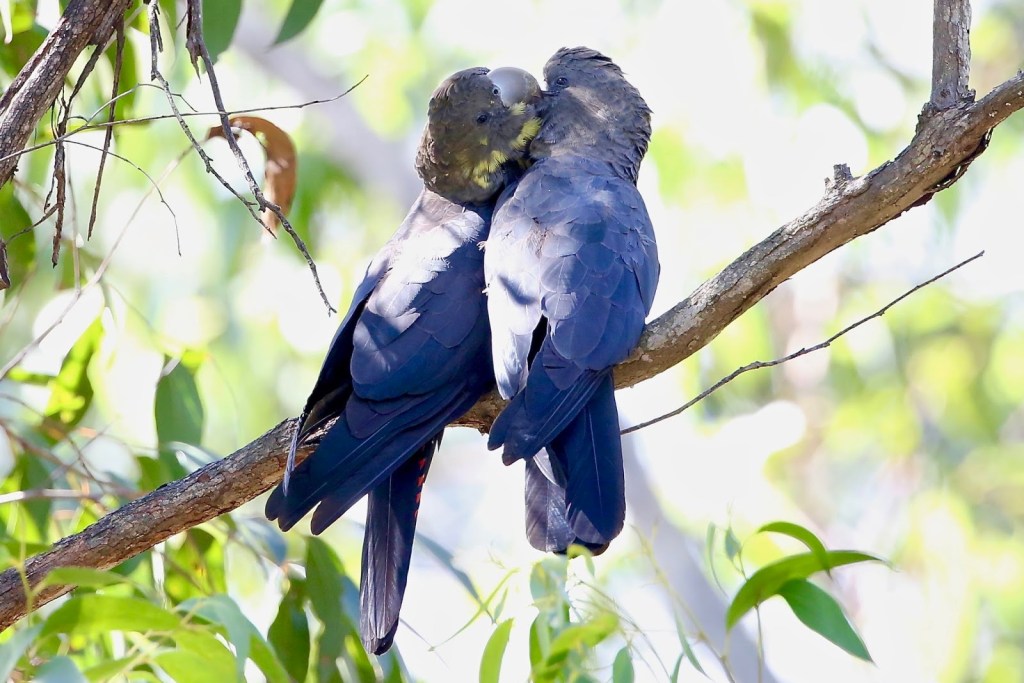
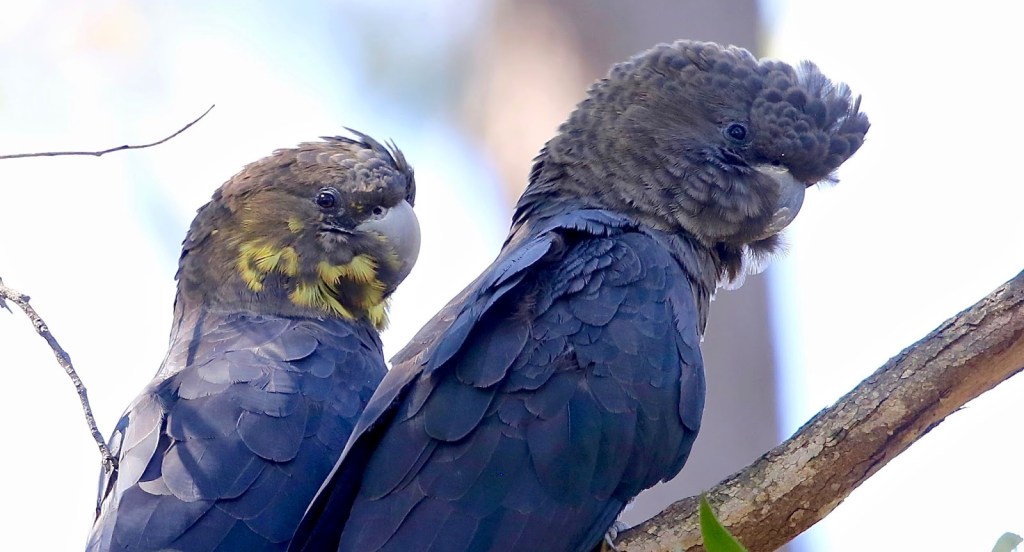
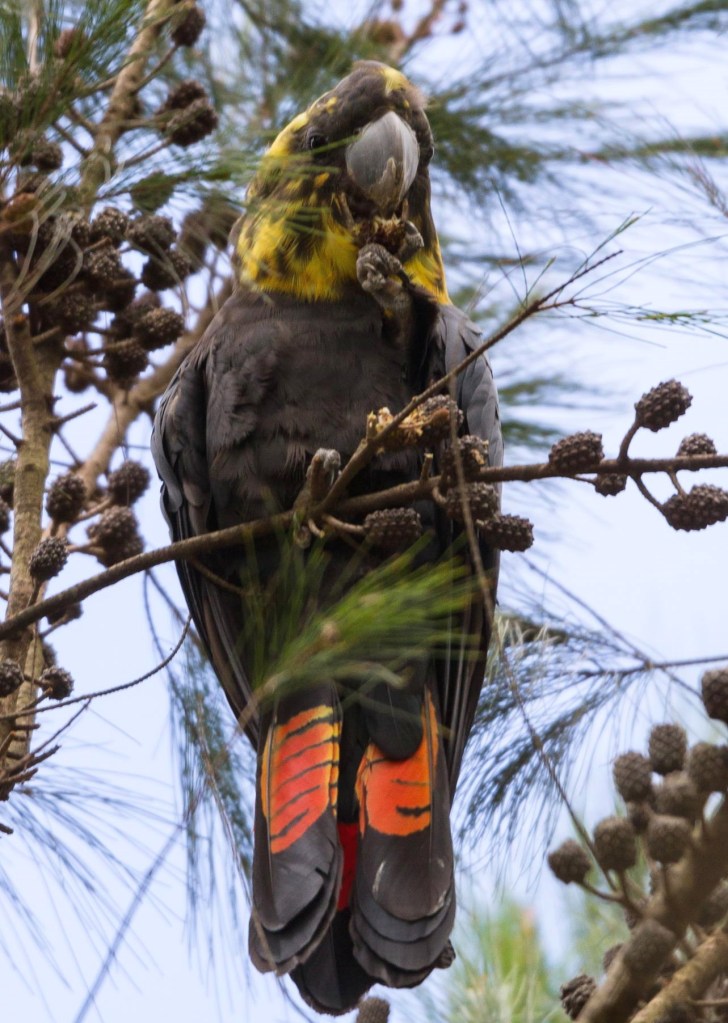
Adult females: Variable amount of yellow on head*. Tail has red panel with yellow edges. Black bars across the red decrease with age.
(*this feature increases from juvenile to immature, then decreases with age)
Glossy Black-Cockatoos, female left male right, Newmerella by John Hutchison
Juveniles: small yellow spots on ear coverts (behind eye) and wing coverts* 1(shoulder). Yellow bars on breast and belly*2. Tail panel heavily barred black. I don’t have pics of juveniles, but the Glossy Black Conservancy fact sheet does.
(*1 a few females retain some spots throughout adult life; *2 in some juvenile males this feature is sparse or absent)
Immatures: females acquire yellow feathers on the head at 1 year, this increases at 2 years, can be up to 50% of head area, but highly variable in extent.
Glossy Black-Cockatoo, young female, Genoa Peak by Karen Weil. Note barring on tail and extensive yellow on head
Location: eastern Australia, from central QLD to eastern Victoria, with an outlying population (ssp halmaturinus) on Kangaroo Island, SA. Our subspecies lathami from eastern Vic to south-east QLD.
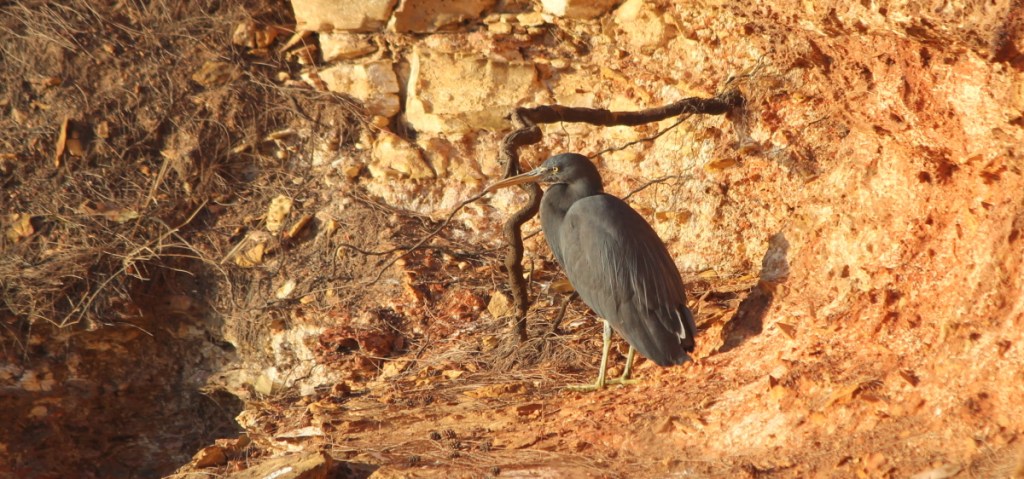
Bird of the Week: Eastern Reef Egret 19 February 2021
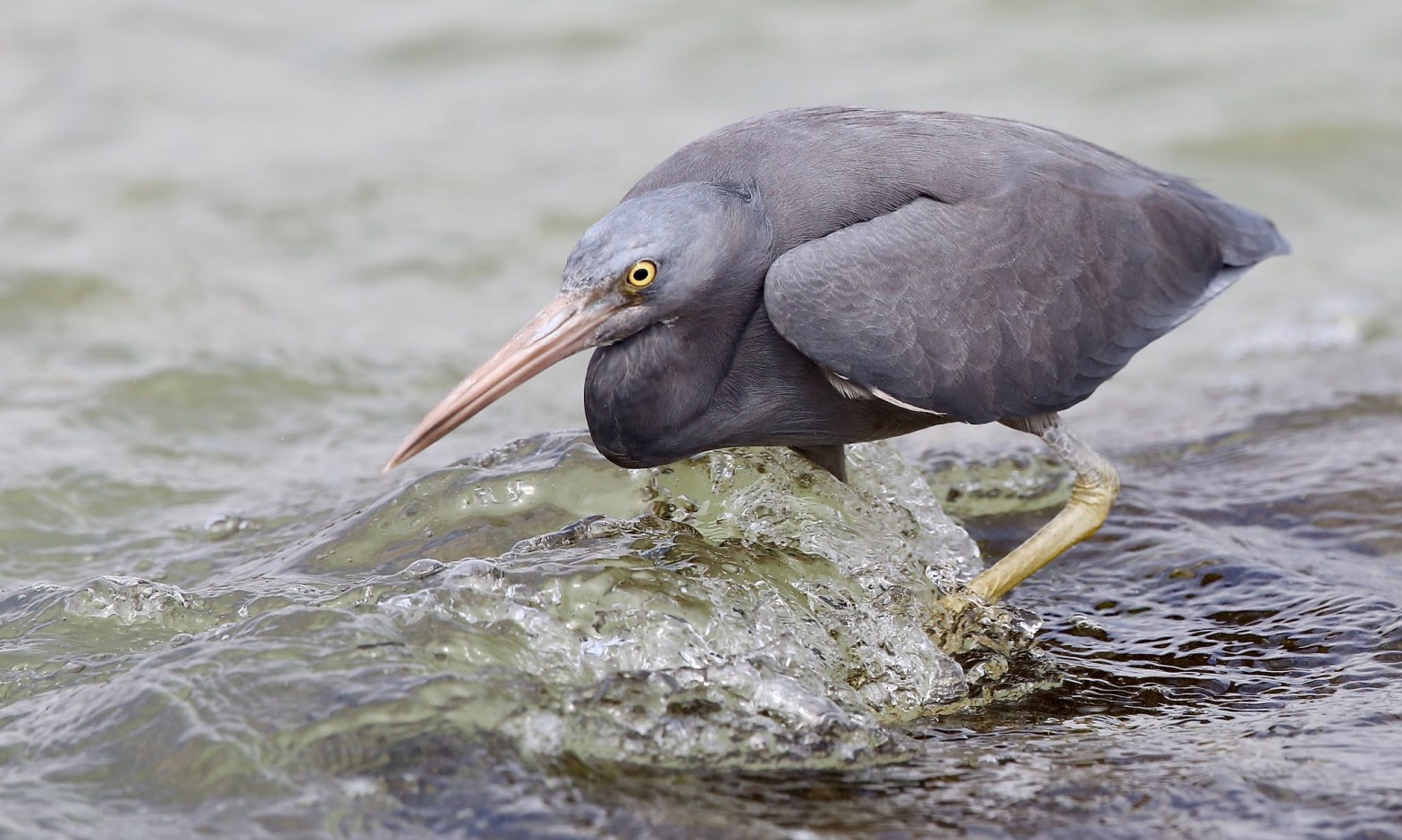
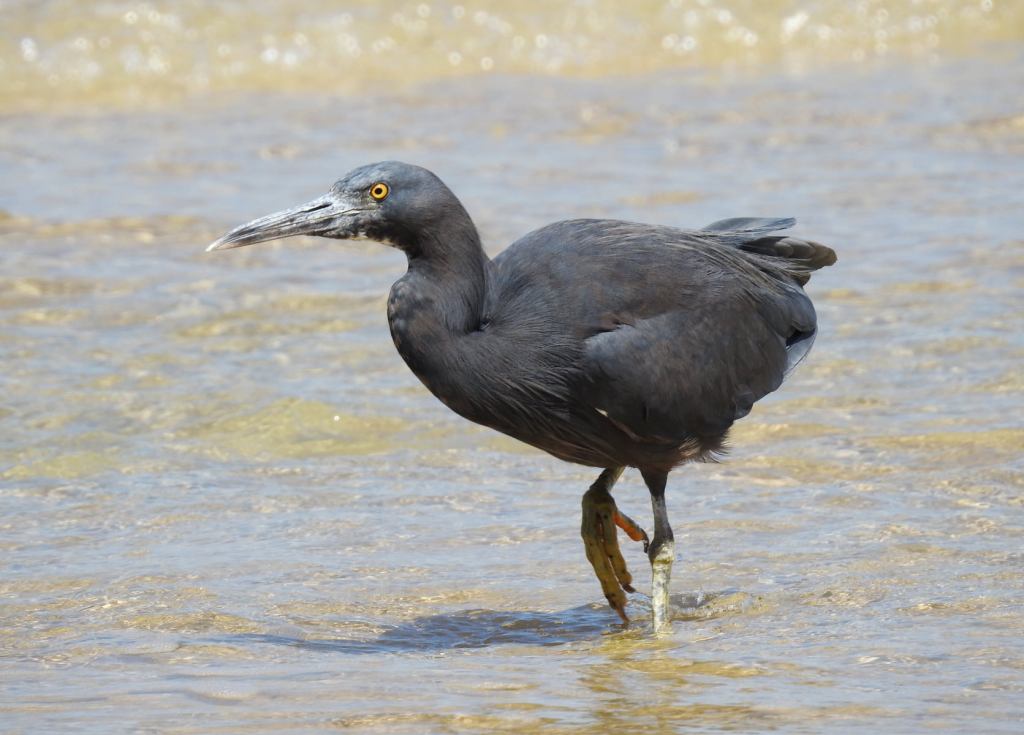
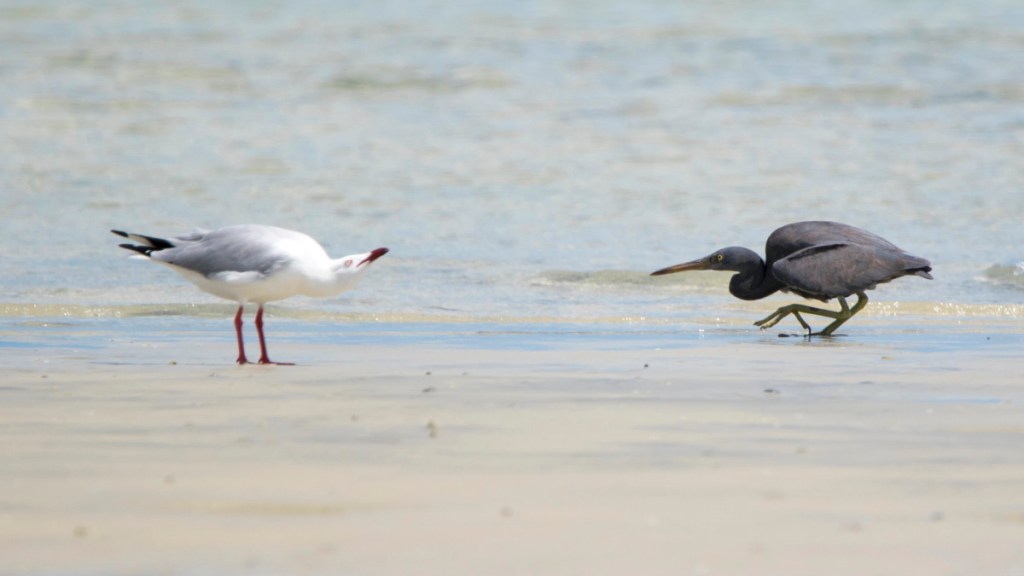
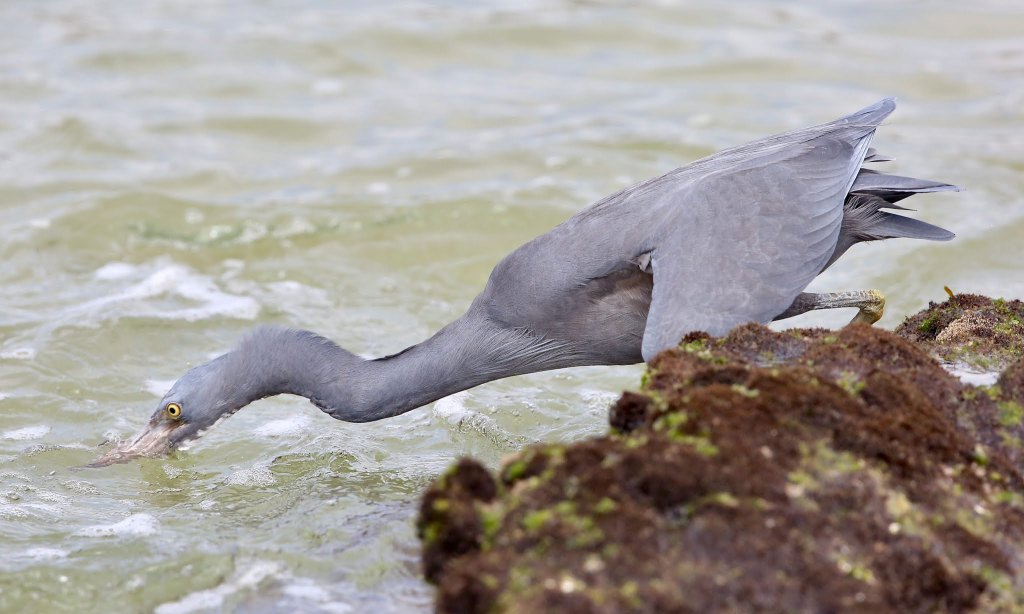
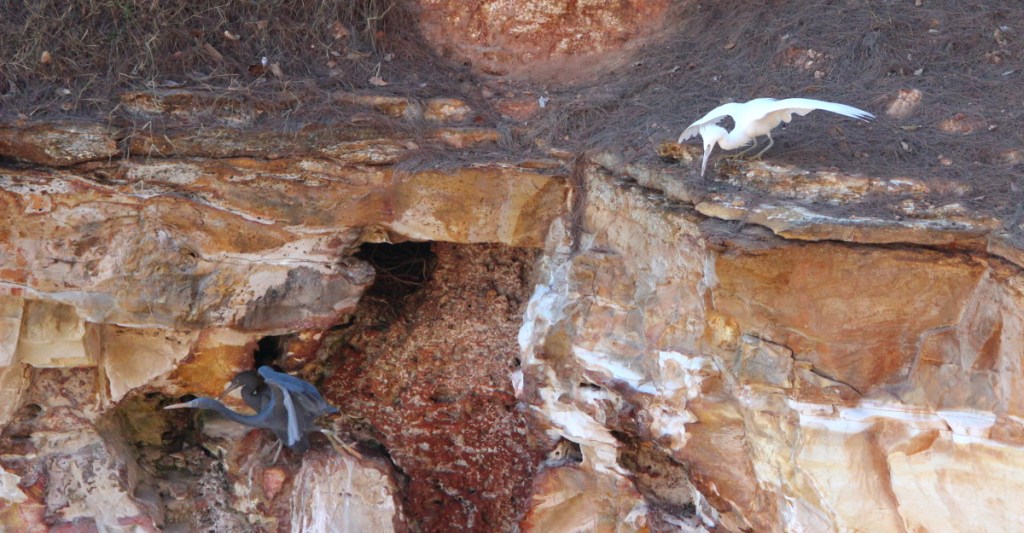
This bird is amazing in several ways. First, because the birds we see at Mallacoota are the great adventurers of their kind – they are at their extreme Australian southern limit here. Basically, hardly any Eastern Reef Egrets ever go much further south than Mallacoota. There have been a few records at Tamboon, Cape Conran, Marlo and Lakes Entrance, and 3 around Wilsons Prom, and one at Westernport Bay.
Eastern Reef Egret Mallacoota by Caroline Jones
It makes me wonder if they are the same birds visiting different sites every year, or if there’s a bunch of them that check out Victorian shores opportunistically.
In New Zealand they go a bit further south, and are seen quite regularly on Stewart Island and around Dunedin, Invercargill and Resolution Island in the south west.
Eastern Reef Egret, in typical hunting posture, Chilli Beach north Qld by Jack WinterbottomEastern Reef Egret, NSW by John Hutchison
They are clearly not afraid of cold, and breed in Japan and Korea, through Asia, to Australia and New Zealand.
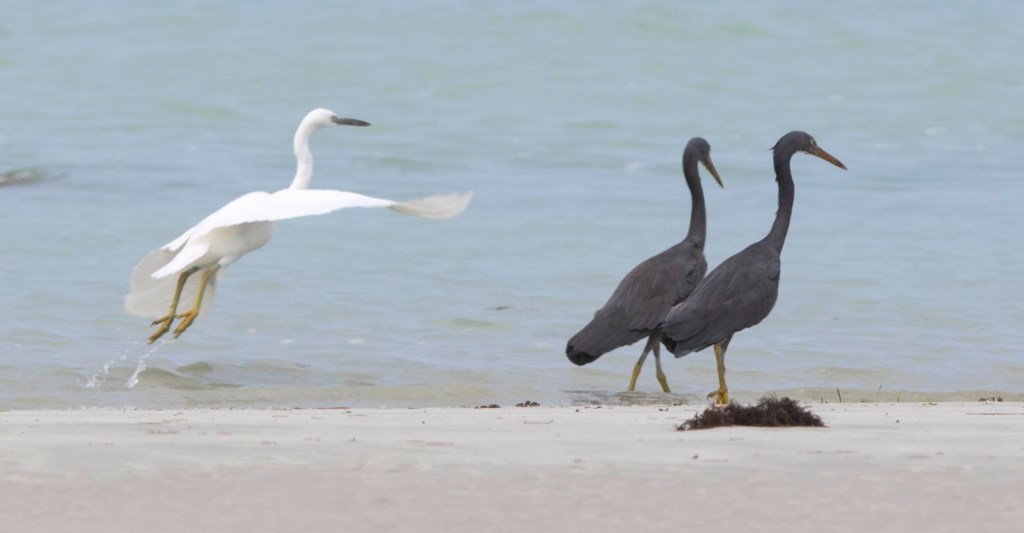
The other amazing thing about them is the colour. In the south and north extremes of their range, we only see the grey morph/phase. But in the tropics there is also a white morph. Why? Studies have been inconclusive, but there is a slight difference in habitat and feeding strategies of the two colour types: white tend to feed in the surf, grey on the reef flat. Our Mallacoota grey birds are usually seen on the rocks.
Eastern Reef Egret, 2 grey morphs at nest, white morph above, Darwin by Janine Duffy
Males are larger than females, so if you can get photos of two together it would be really interesting. They are pretty territorial, so when two are seen harmoniously together it may imply that they are a pair. Others might be able to comment on this?
Eastern Reef Egrets, white morph left with 2 grey morphs, Chilli Beach north Qld by Jack Winterbottom
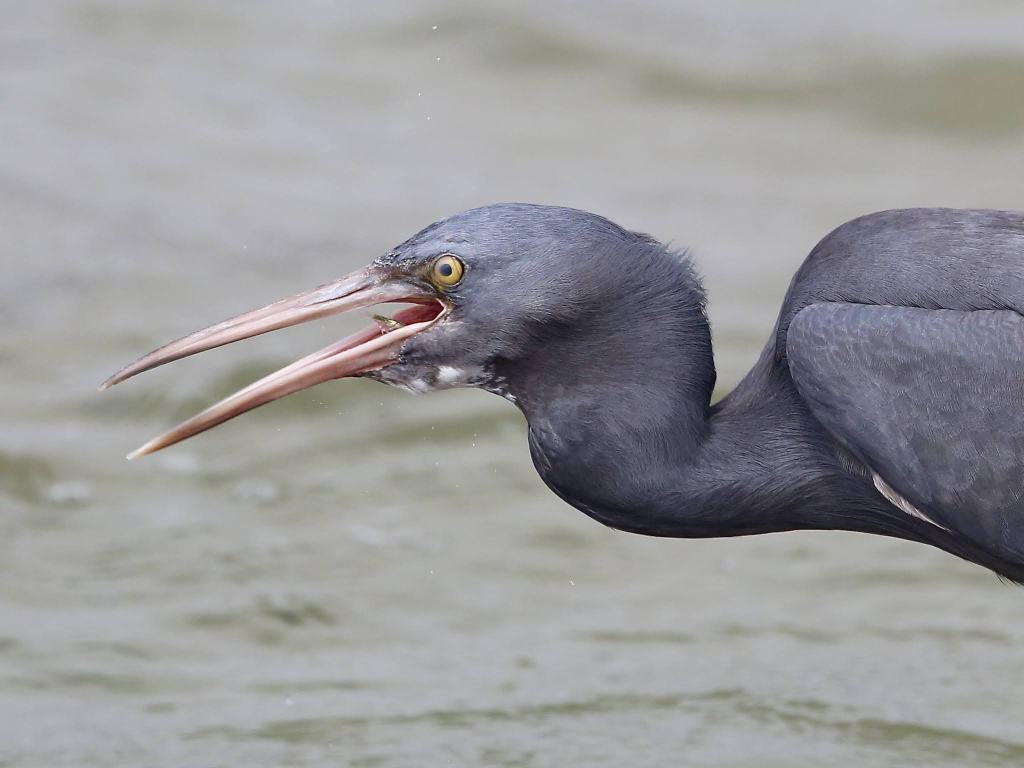
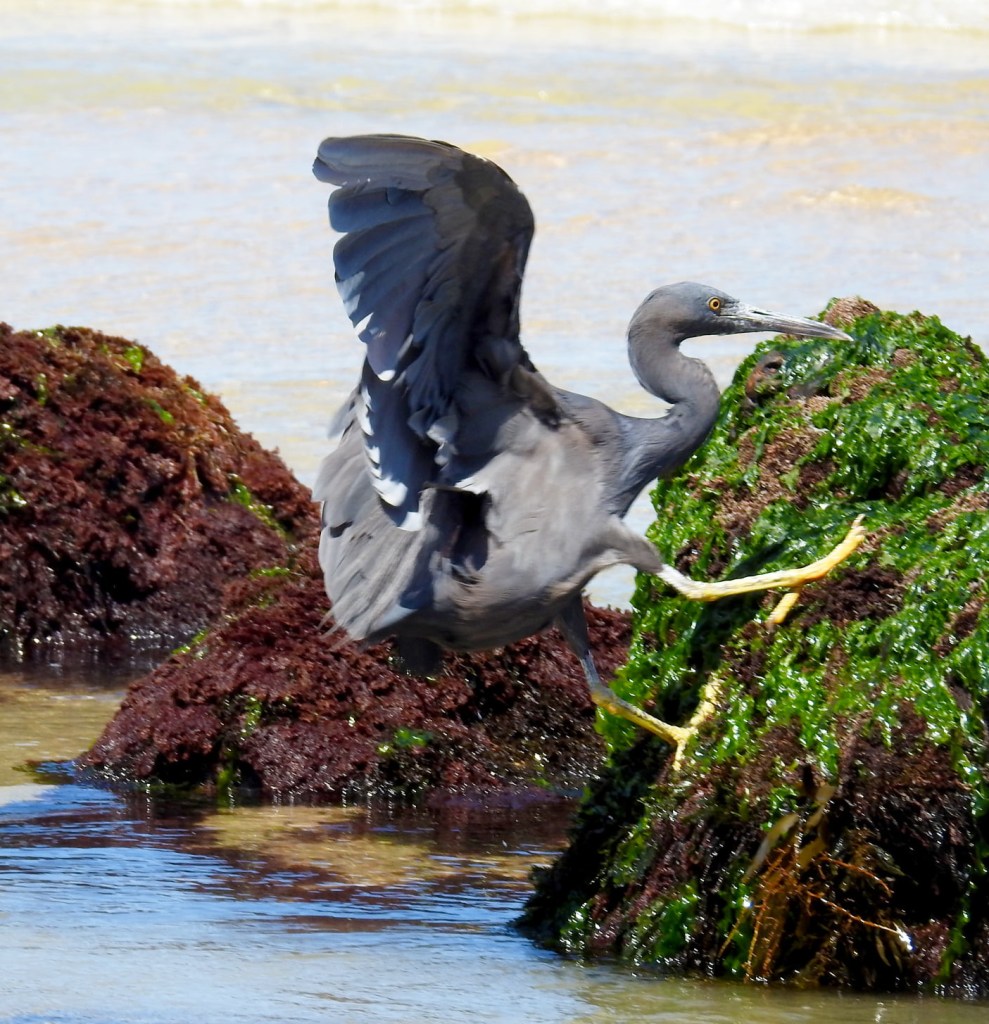
Some variation in plumage is widespread. Some adults have the white chin and throat seen in John’s picture below, others don’t. The bill can be greyish or yellowish. When breeding the bill and legs become more yellow. They all have yellow irises. The legs are usually yellowish, but can be dark in front and light behind. The soles of the feet are yellow.
Eastern Reef Egret, NSW by John HutchisonEastern Reef Egret showing yellow feet, Mallacoota by Caroline Jones
Location: North Asia, South-east Asia west to Myanmar, The Phillipines and Indonesia, New Guinea, Australia, New Zealand and east to French Polynesia & Pitcairn Island.
Suggested bird walks and drives around Mallacoota for Birders Big Weekend 5 – 9 March 2021
by Martin Butterfield, with Janine Duffy
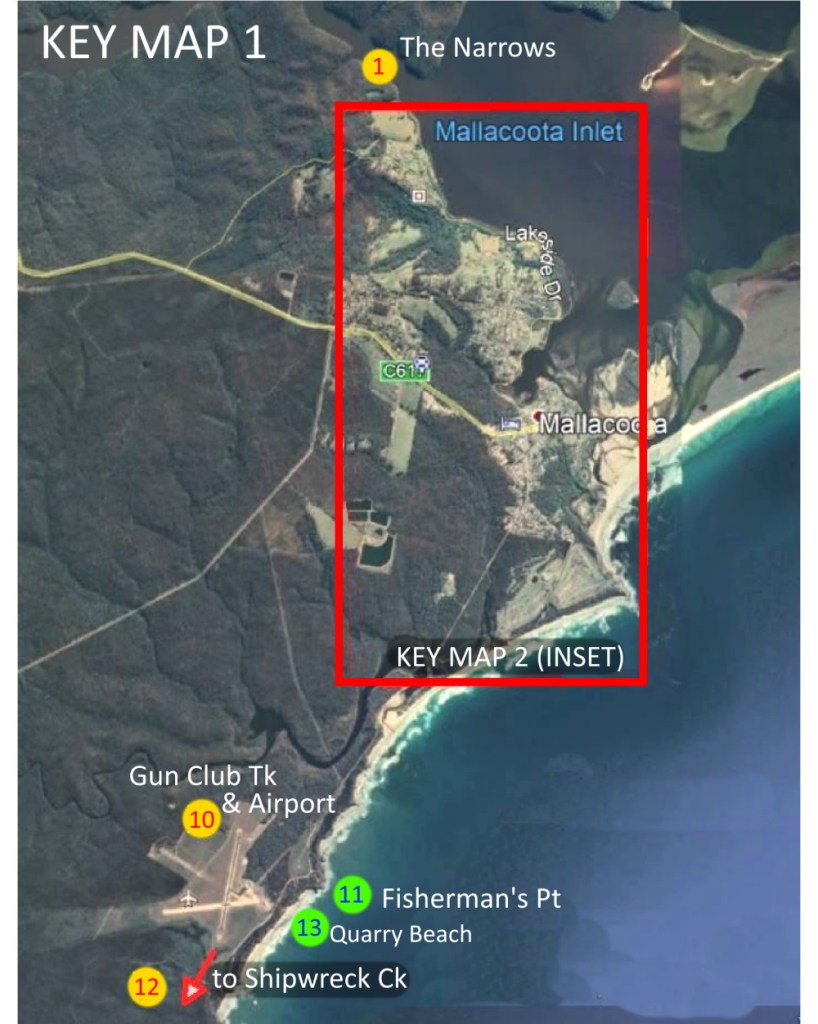
Key Map 1 showing wider Mallacoota area
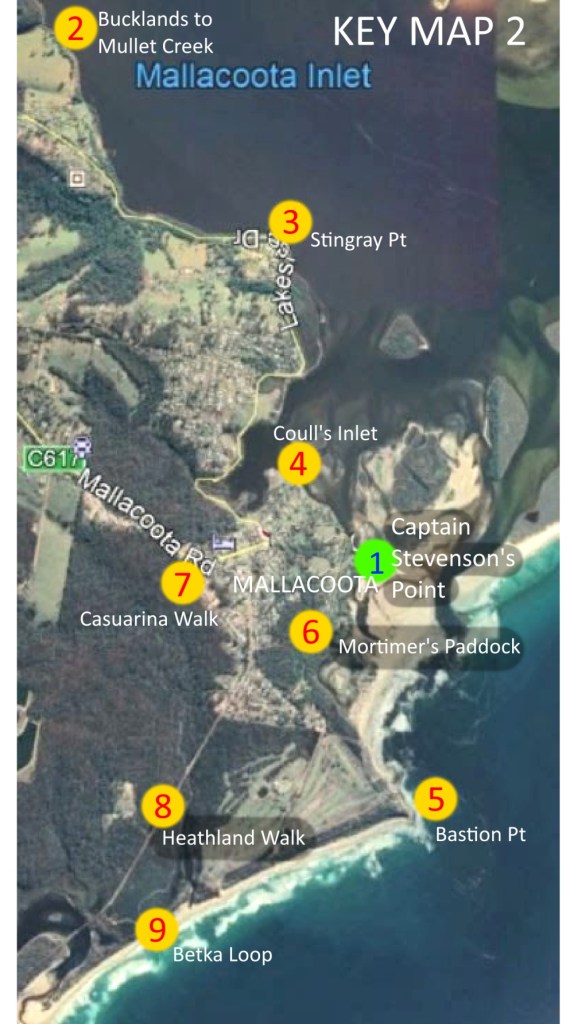
In the Key Maps above & below, the locations with an individual walk map are shown with a red number on a yellow background (Walks). A few other points shown with a blue number on a green background indicate spots at which a stationary checklist might be considered (Drive & stop).
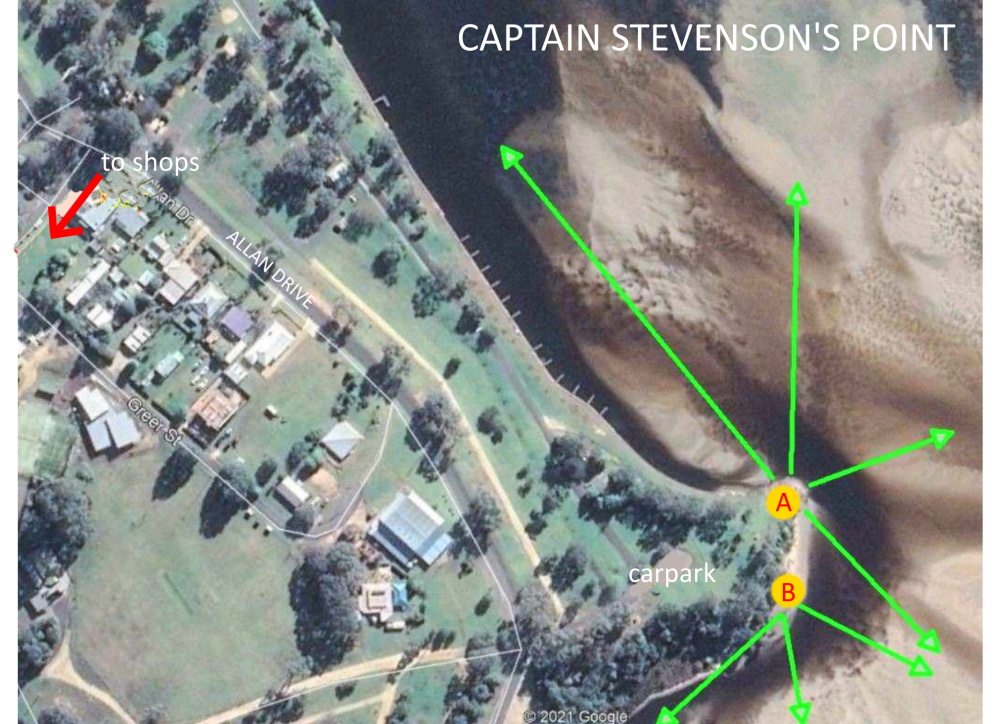
Pretty much in centre of town. Accessibility: Walk from bitumen across smooth grass. Beware of steep drop to waterline! At Point B trees restrict view unless go down steps to water level Distance: 100 m Bird notes: explore Hotspot in Ebird for full list of 129 species. At least one visit here essential. If mouth open best to visit near high tide which concentrates From point A excellent views over mouth of Inlet and ocean out towards Gabo Island. A telescope helps!! Just about any wader or waterbird or seabird possible. From point B look up Develings Inlet for herons and other marsh birds as well as some sandbars not visible from point A
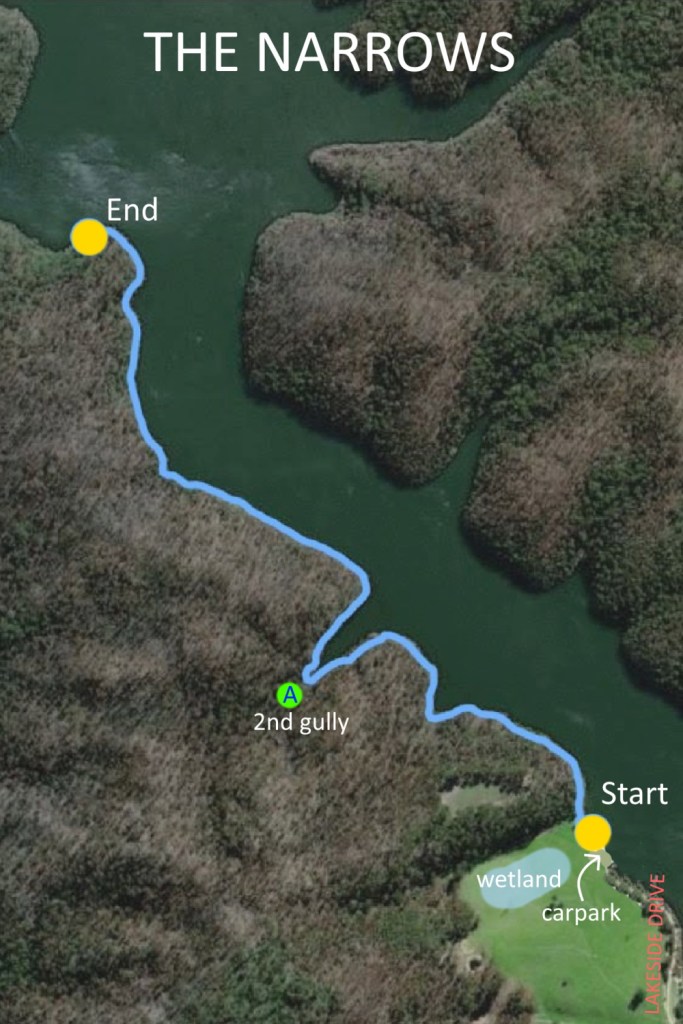
Follow signs to Bucklands Boat Hire along Lakeside Drive. Pass boat hire and park in turning circle. Accessibility: the track is flat but rather rocky in places. Not suitable for wheelchairs. Distance: 2.3 kms one way, but go as far as you like then return. Bird notes: This is one of the most accessible ‘remote’ sites close to town. Some special birds have been seen here, probably because its the most narrow point of the inlet, and a safe crossing place: Beautiful Firetail, Cicadabird, and Topknot Pigeon. There’s some nice rainforest at the 2nd gully, point A. Check Sweet Pittosporums in parking area for Nankeen Night Heron. Check farm dam for ducks and other water birds. General bush birds along track including Eastern Spinebill, lorikeets, Brown & Striated Thornbill, Black-faced Monarch and Rose Robin. Check shoreline trees for Azure Kingfisher, cormorants & herons. White-bellied Sea-Eagles and Whistling Kite fly along the water.
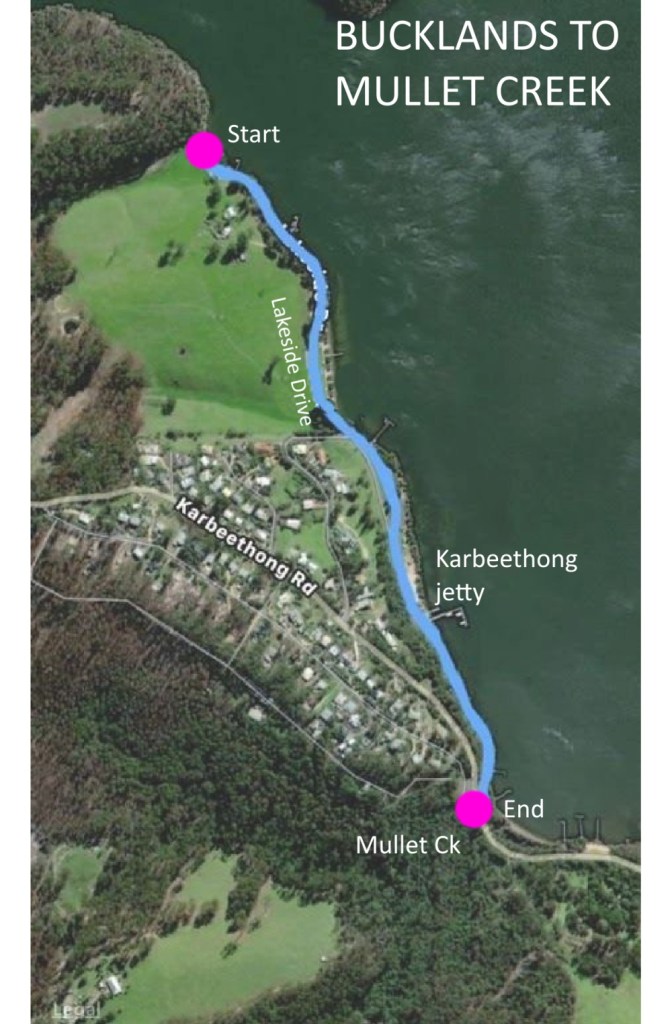
Follow signs to Bucklands Boat Hire on Lakeside Drive. Pass boat hire and park in turning circle. Accessibility: the track is flat. Some smooth gravel to begin with. OK for wheelchairs. On road walking for first 500m: be aware of traffic on bends. At Mullet Creek do not go beyond gate or out of cleared area into private property. Distance: 1.5 kms one way. Bird notes: As for walk above at start. The walk covers a wide range of habitats and 30+ species usually noted from path. Forest species (Black-faced Monarch; Rufous Fantail) and Grey Goshawk possible at Mullet Creek. Check shoreline trees and jetties for Azure Kingfisher and Pied Cormorants. White-bellied Sea-Eagles, pelicans and Whistling Kite often seen overhead.
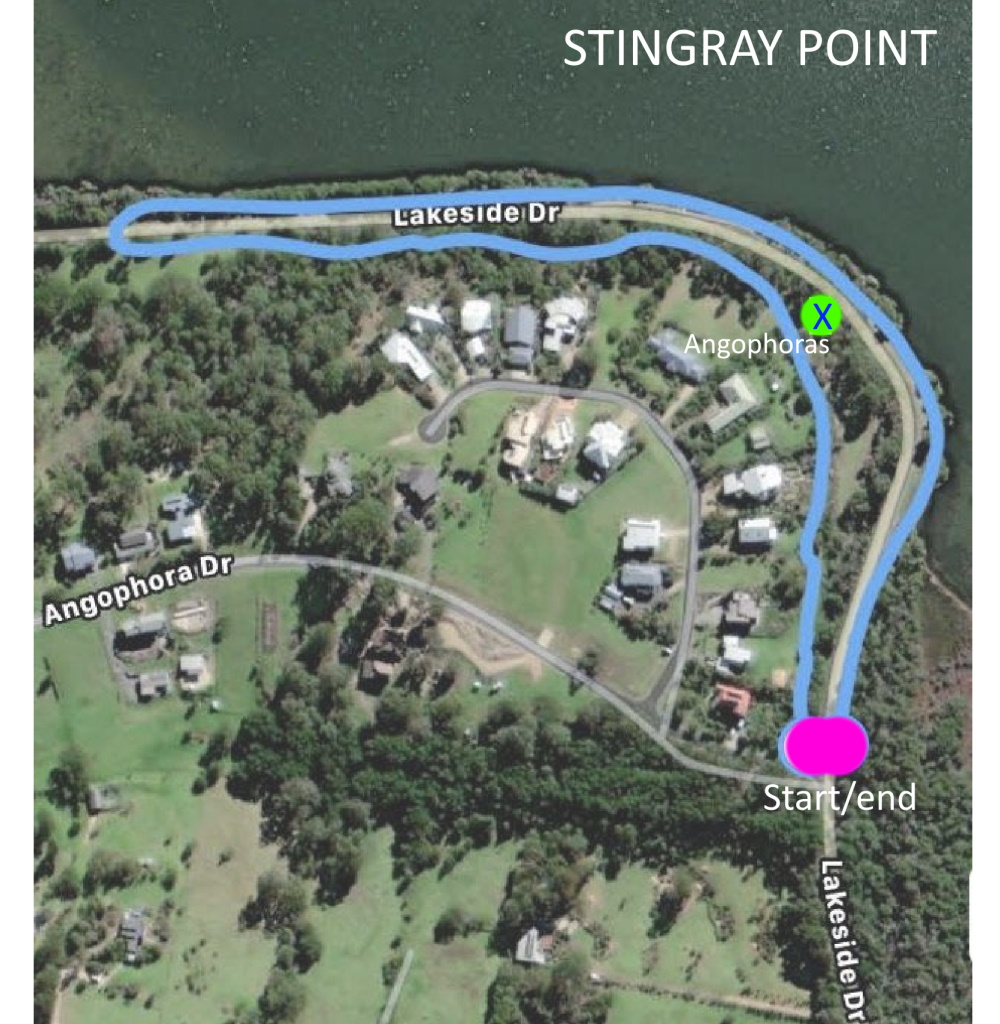
Park on verge on LHS of Angophora Dr. The walk follows the path behind the houses and returns along the shared path on Lakeside Drive. Please respect the privacy of houses in the first 300m. Accessibility: the track is quite steep on both ends of the inland loop. Be wary of traffic when crossing Lakeside Dr, Distance: 1.3 kms loop Bird notes: The large Angophoras at point X are often good for unusual species, as are the two fig trees nearby (when they have fruit). The vegetation downhill of the path is dense so can be interesting. Keep an eye open for Azure Kingfisher on Lakeside Drive. It might be worth looking in the patch of forest on the corner of Angophora Drive.
……..
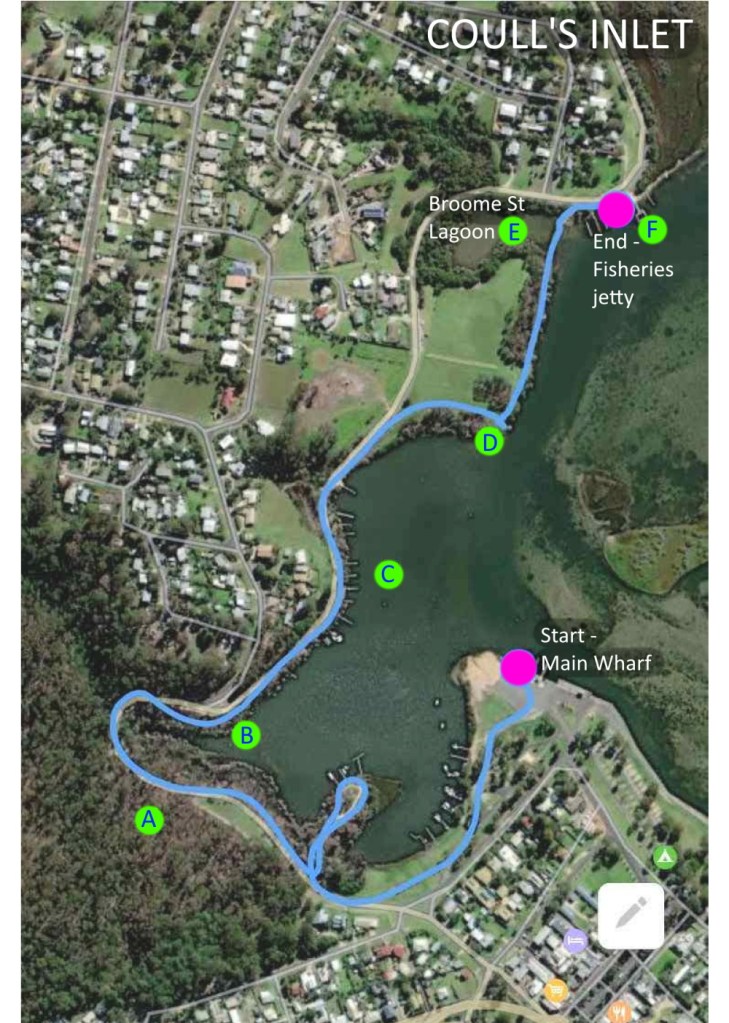
Walk 4: Coull’s Inlet
-37.5549 149.7567-37.569 eBird Hotspot: Coulls Inlet https://ebird.org/hotspot/L3498172 can be used to record the whole walk. Some people record birds seen on the Broome St Lagoon (point E) as a separate list: Inlet and Gully off Lakeside Dr at Broome St, Mallacoota https://ebird.org/hotspot/L7057573 Best conditions: good in morning and evening
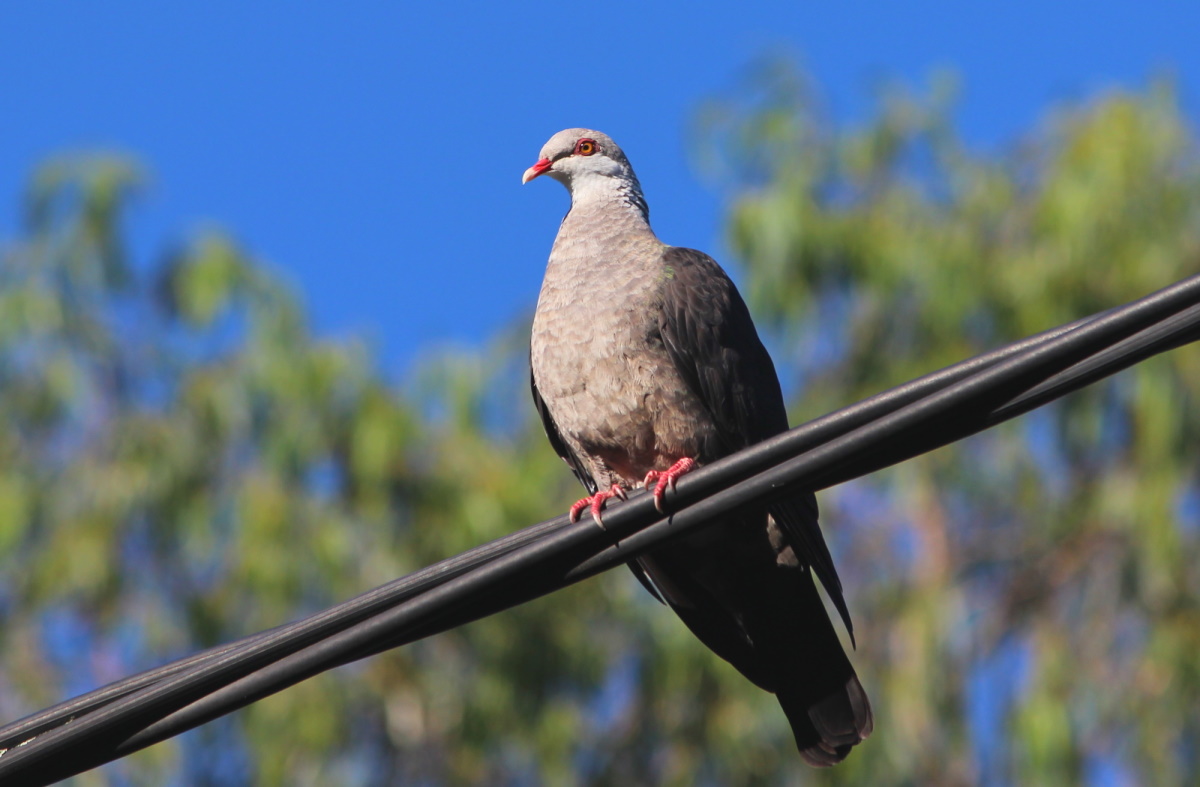
Parking is easiest at the Main Wharf, ensuring that access for vehicles launching boats is maintained. Some parking may be available at Fisheries Jetty (point F) if you wish to do a car shuffle. Accessibility: Flat, shared path. Wheelchair accessible Distance: 2.3 kms one way Bird notes: Point A – the path is opposite Shady Gully and a range of forest birds can be observed in there (dominated by the calls of Bell Miners) Point B – from the new boardwalk scan the shoreline and mud flats for ducks and waders. In cooler months Hoary-headed Grebes feed in the Inlet. Point C – Check the jetties to see what is resting. Can be good for Azure Kingfisher. Point D – Check out the small island opposite. Usually a lot of gulls and pelicans but sometimes Royal Spoonbill join them and various other waders. Swamp and Spotted Harrier may patrol the area (both rate as unusual). Point E – Check shoreline of lagoon for ducks, herons & egrets etc. A favoured roost area for Royal Spoonbills (check carefully for Yellow-billed Spoonbill, now very unusual in the area) and Australian White Ibis. A side walk along Lakeside Drive here in early morning or late evening may turn up a White-headed Pigeon or two. Point F – Fisheries Jetty worth scanning the area of saltmarsh upstream for White-fronted Chat and Little Grassbird. One of the more likely areas for Tree Martin.
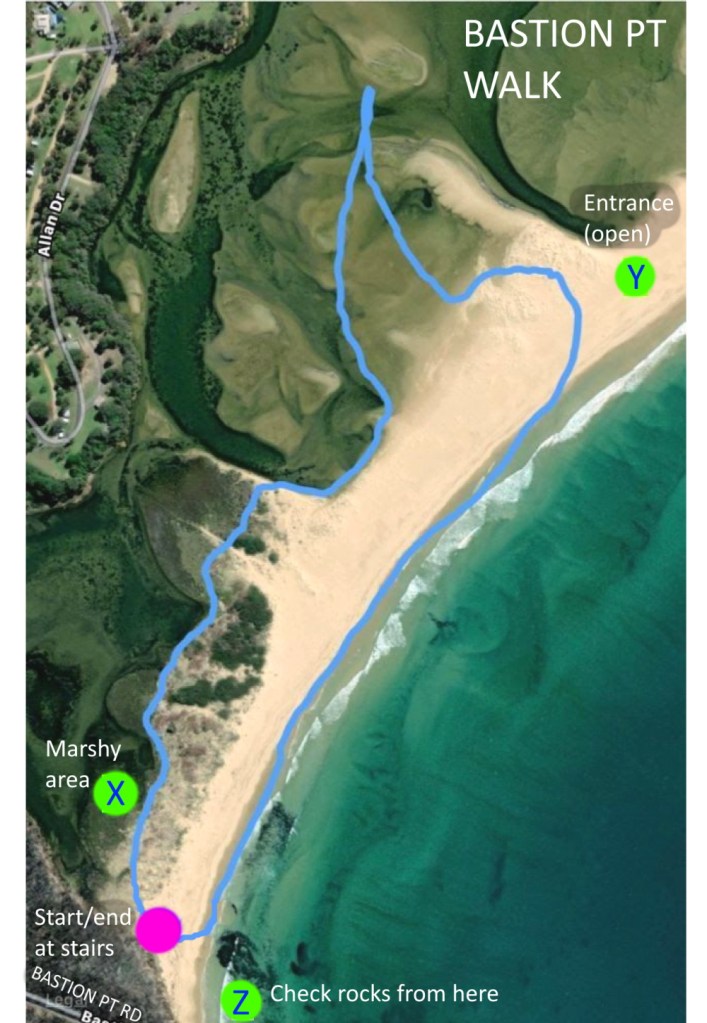
Take Betka Rd at roundabout and after Bowling Club turn left into Bastion Point Rd. Accessibility: Stairs down to beach and beach walking thereafter. Not wheelchair friendly. At time of writing (14/2/21) the entrance (Y) is open, relatively deep and fast flowing. Wading should NOT be attempted. Also, if walking through the reedy marsh be alert for Tiger Snakes. Distance: Variable but route shown is about 2.3 km. Bird notes: The best site for waders and sea birds. It is hard to predict where the birds might be so scan all sandbars within the Inlet. The accessible sandbars should be scanned for small plovers (Red-capped & Hooded likely, perhaps early returning Double-banded). Large flocks of terns will mainly be Crested with 1 or 2 Caspian – make sure you scan for less common species (Common: Little; and Whiskered are most likely. Possibly an early returning White-fronted). Check out to sea for shearwaters; gannets and albatross especially if sea is rough. The marshy area between the beach and Develings Inlet (X) can have Pipits and White-fronted Chat and there have been several recent records of Southern Emuwren.
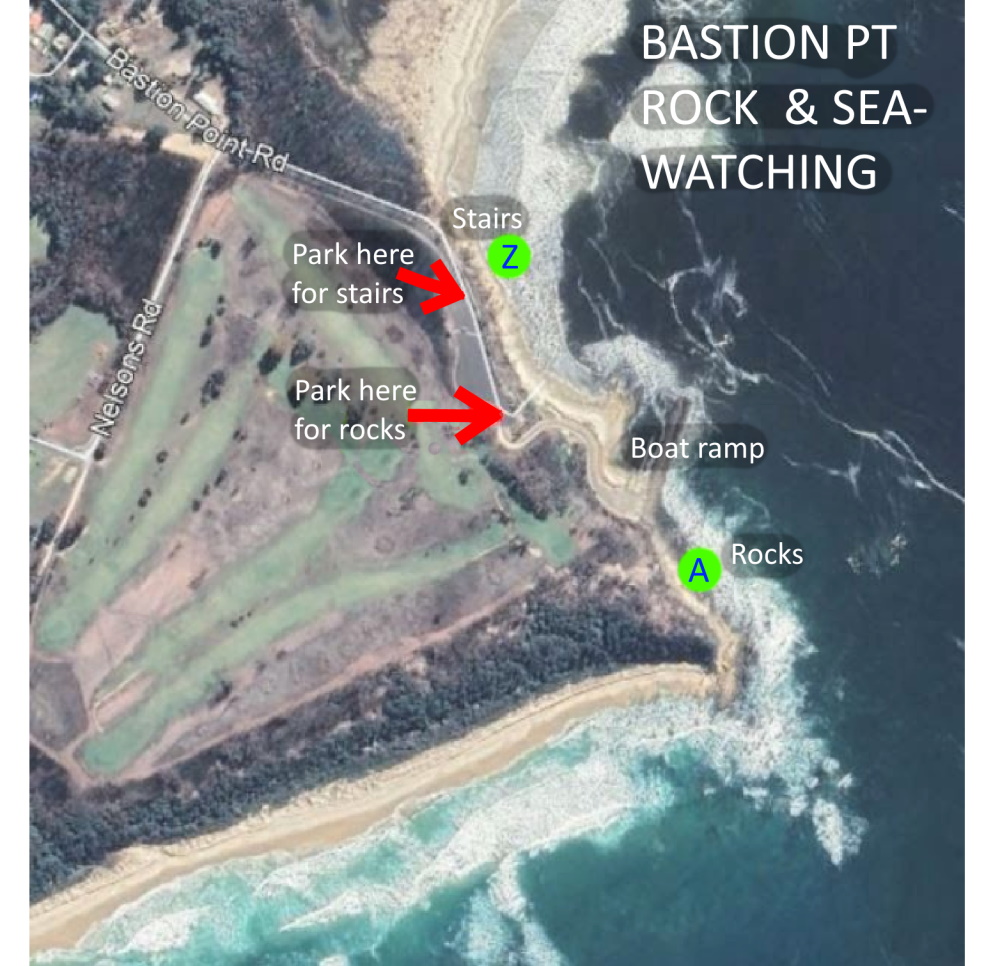
Drive all the way along Bastion Pt Rd to the carpark at the end. At low tide it is easy to check the rocks by walking down the stairs to point Z. There is very limited parking near the boat ramp: park at the top and use the stairs/ramp. Accessibility: Wooden ramp to beach – not sure about slope. Disabled Parking at beach level. Distance: Variable. If you park at top and walk to check area A its about 500m return. Bird notes: This area is a hotspot for Eastern Reef Egret and Sooty Oystercatcher. Sea watch if rough weather. ………….
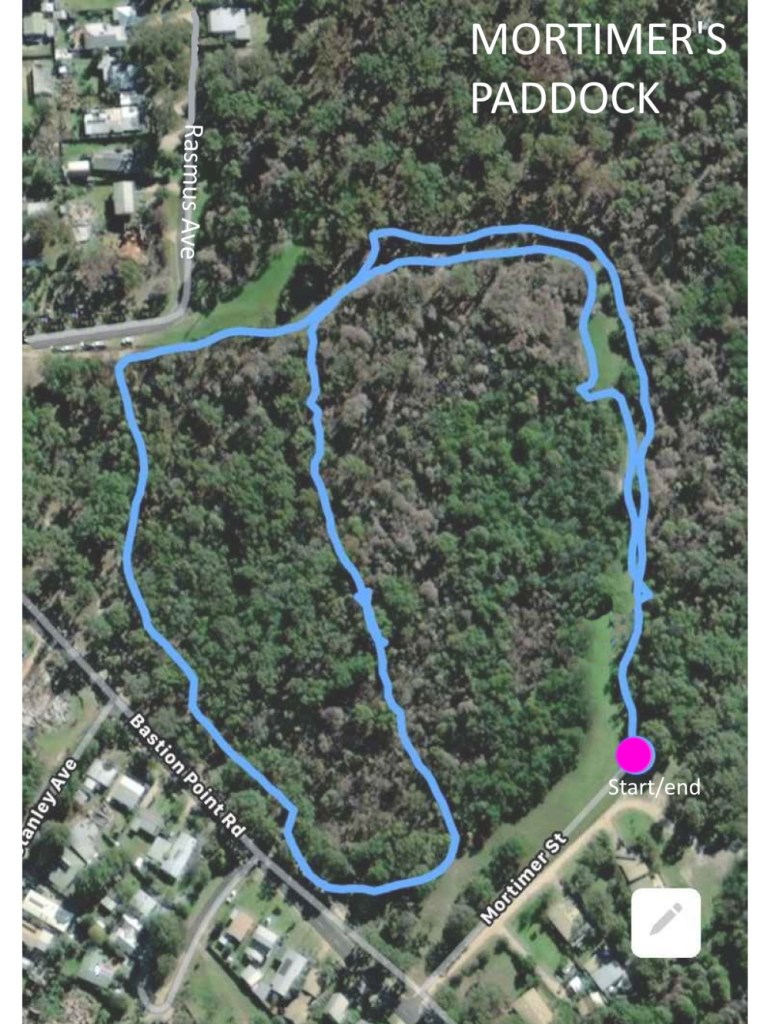
Drive along Bastion Point Rd but turn into Mortimer St.. Accessibility: Flat dirt tracks. Tracks through centre could have fallen trees etc and narrow bridge across ditch on Rasmus Ave may need diversion to Betka Rd. Distance: Route shown is ~1.5km Bird notes: Bush and forest birds, often great sightings of Superb Lyrebirds. Glossy Black-Cockatoos have fed on Allocasuarinas here and Australian Figbird, Bassian Thrush & Olive Whistler possible.
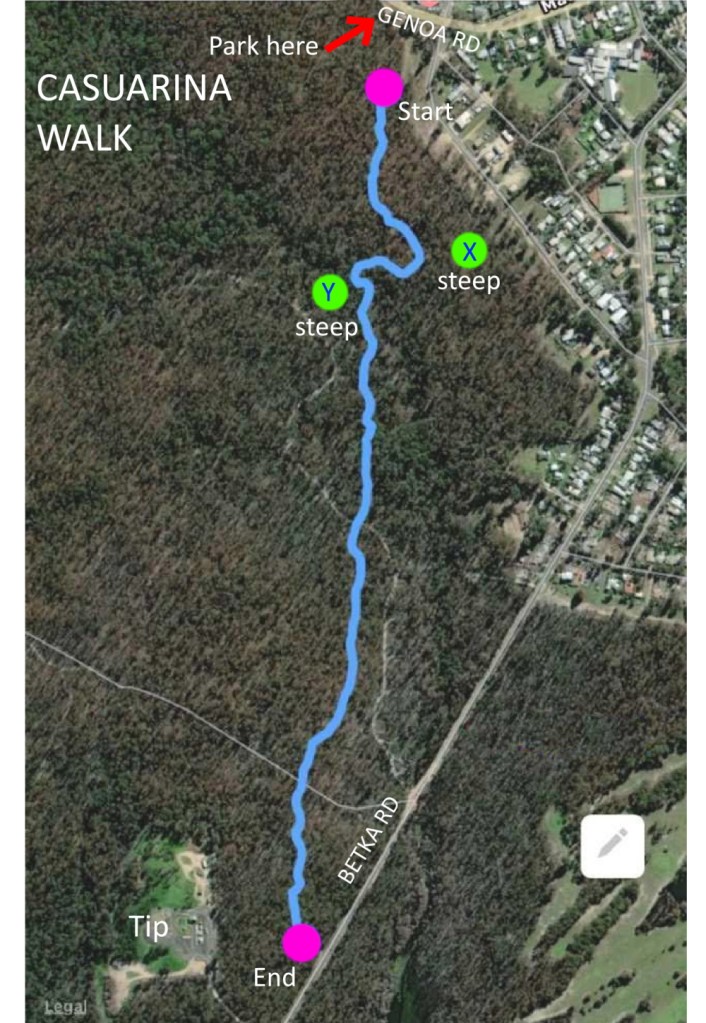
Take road towards Genoa from main central roundabout. Just past the end of the houses look on left for access point to get onto the verge and park near Walking Track signs. Accessibility: Gravel bush track. Some steep pinches going into Davis Creek (X, Y). I am told by a wheelchair user it is navigable. Distance: ~2km one way. Car shuffle possible. Bird notes: Badly burnt area with luxuriant regrowth. Bush and forest birds. Powerful Owl seen here before fire and Whistling Kite nested in Spring 2020, possible area for Glossy Black-cockatoos.
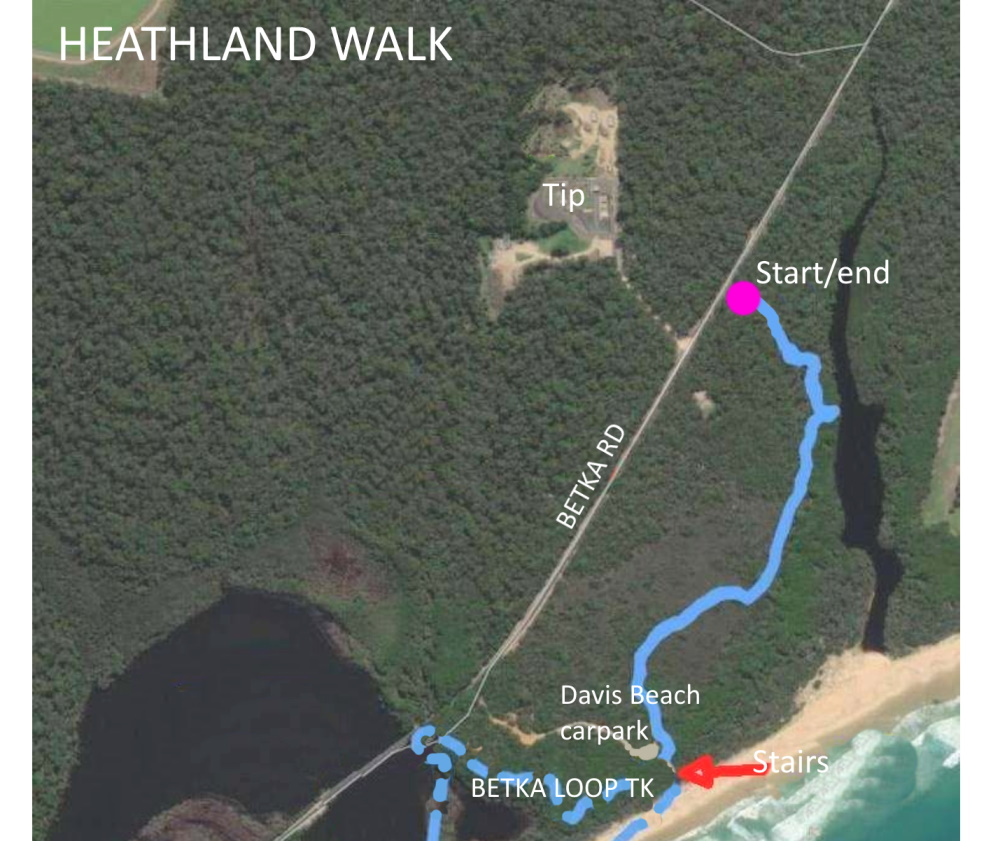
Take Betka road out of town, down and cross Davis Creek. Near top of hill note railings for entrance to track on left. If parking space full park near entrance to Tip ~200 m further on. Accessibility: Gravel bush track for about 1km is wheelchair accessible, stairs, beach and Chip Track are not. Distance: ~4km for loop Bird notes: Badly burnt area. First 500m mainly downhill through eucalypt woodland. Check creek for waterbirds. Then 100m of heathland, originally Allocasuarina paludosa (which is regenerating). Few birds in heath at present but worth checking. For beach and Chip Track sections see next Betka estuary site.
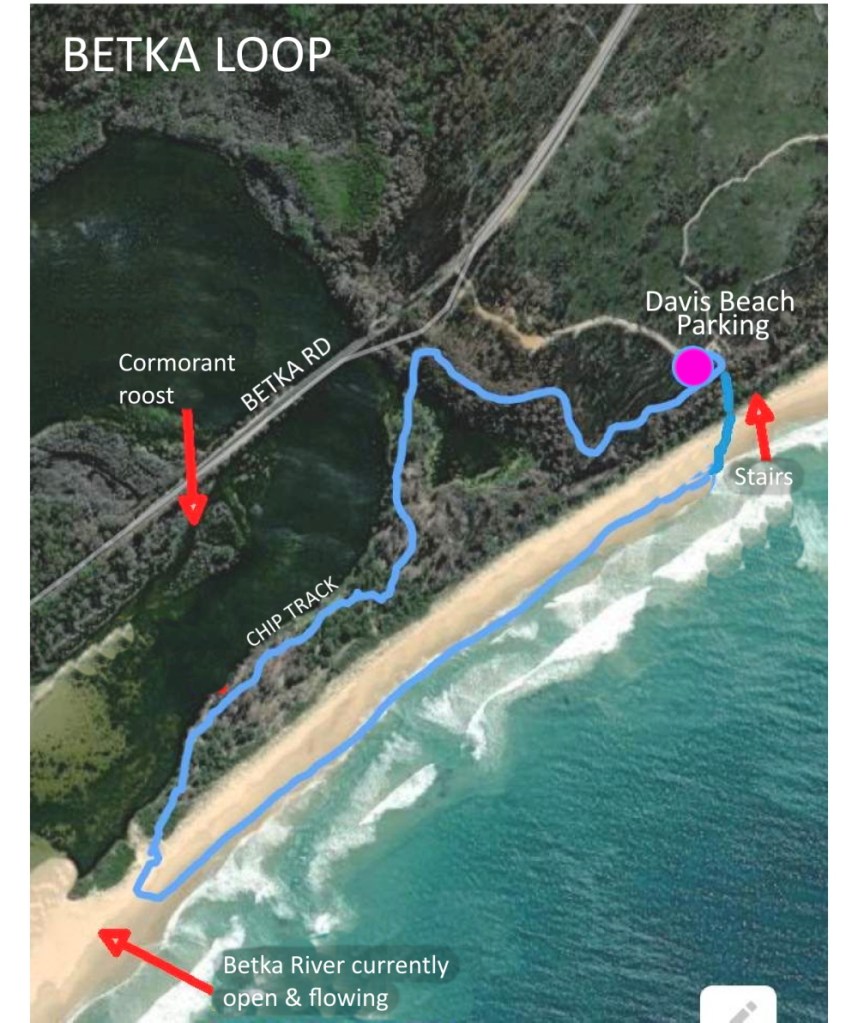
Take Betka road out of town, past Tip. On downhill just before Betka River, turn left signed to Davis Beach. Park neatly as the area is popular with surfers and fisherpersons. Accessibility: Stairs and very soft sand. Not wheelchair accessible. Distance: ~2km loop Bird notes: The highlight is the Hooded Plovers at the mouth of the Betka River. Terns and gulls also at the mouth. Herons and ducks in the River. Check the cormorants on the roost for Pied and Black-faced Cormorants.
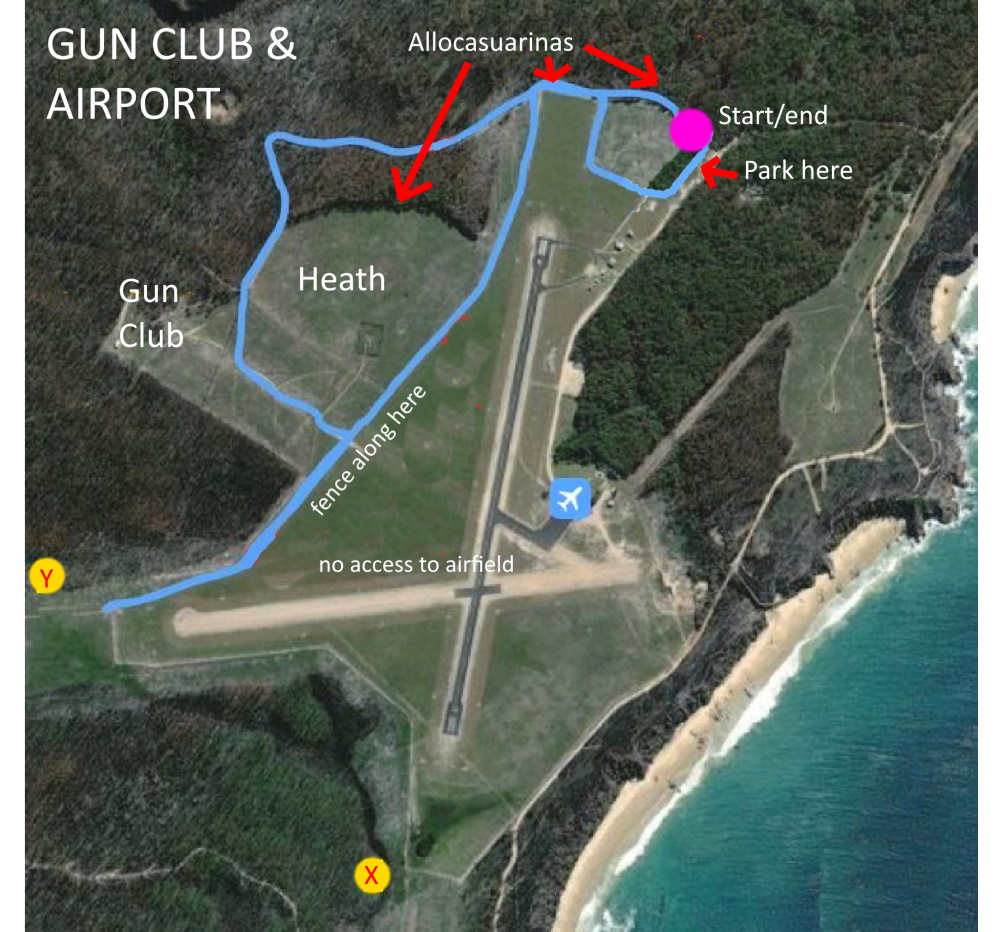
Take Betka road out of town, past Betka picnic area. Turn right on to dirt road to Airport. After sharp bend turn right towards FGA gun club. Accessibility: Flat but bumpy dirt track. Probably OK for off-road wheelchair unless wet. Can be driven, but slippery when wet. Track at Y big potholes and at X a rutted bog: don’t go there. Distance: ~4km loop Bird notes: Very variable for birds. Sometimes not a bird observed . Heath can be good for Tawny-crowned Honeyeater and Ground Parrot (both reported since fire). Fence line, Aust Pipits, Jacky Winter and other insect eaters. Best site in area for Stubble Quail and Eurasian Skylark
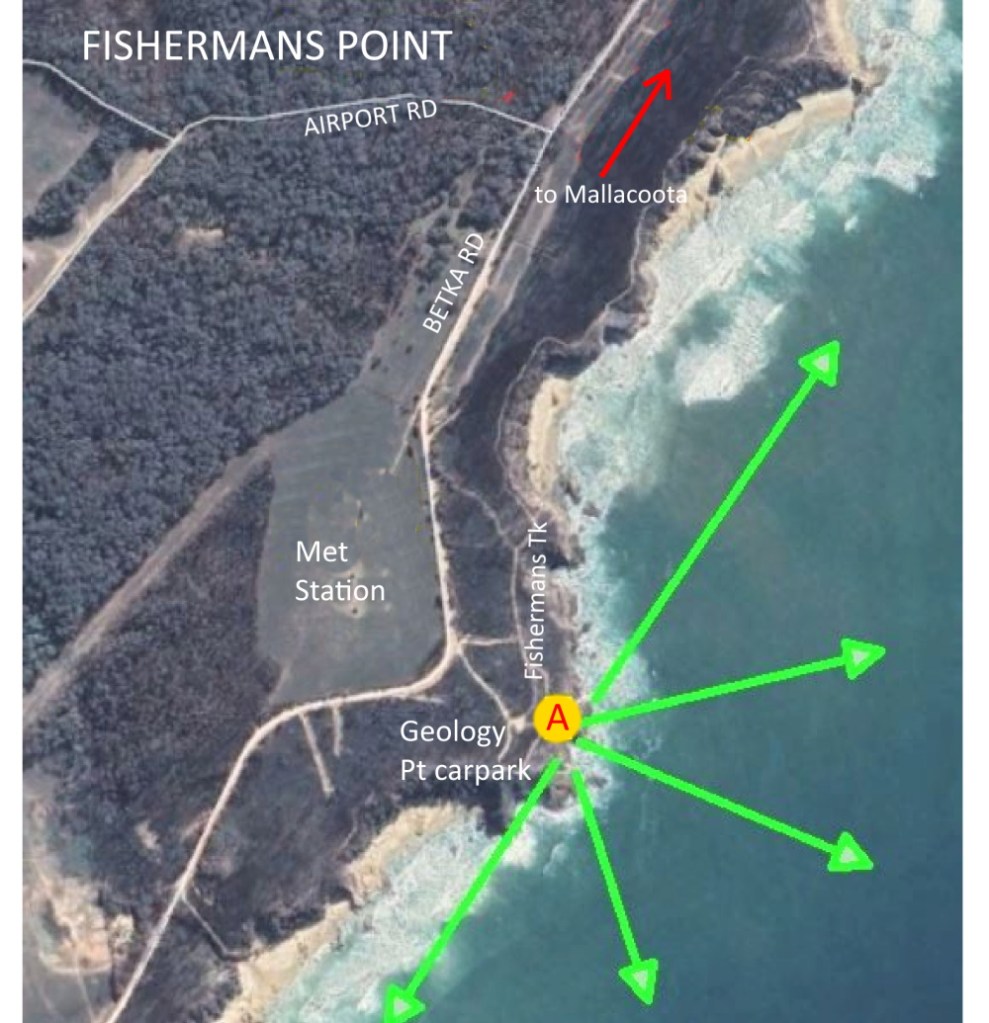
Head out of town past turnoff to airport. About 500m after start of dirt road on left marked to Geology Point. At end of track park and walk ~50 to lookout. Accessibility: Wheelchair accessible, but rail on lookout may restrict view if seated. Distance: 100 m Bird notes: Has view to horizon for 125 degrees. In rough weather has potential for great sea-watching site if one knows seabirds (and has a telescope) .
…………….
Walk 12: Shipwreck Creek
-37.6455 149.6985 eBird Hotspot: Croajingolong National Park – Shipwreck Creek https://ebird.org/hotspot/L2041682 Best conditions: very early morning, or maybe late evening
This site is ~15km out of town and the last 12 km are dirt road that can be badly potholed and corrugated if not recently graded. If strong winds recently high probability of fallen trees needing diversion off-road. You have been warned. Go towards airport but stay on road marked to Shipwreck Creek. Road becomes dirt just after Airport turnoff. After a few km enter National Park. At the campground follow signs to Day Use Area. Track to beach is marked from dunny/notice board. Accessibility: Steep rough track to beach, soft sand on beach, narrow rough track through heath, gate onto Betka Rd. Not wheelchair accessible, Distance: ~4km loop Bird notes: Main attraction is heathland. Incinerated in fire so heathland species greatly reduced. Ground Parrot seen in area since fire (suggest early morning ~0700 for best chance). Southern Emuwren, Tawny-crowned Honeyeater not seen since fire. Waders possible on beach, check ocean for seabirds.
………..
Drive & stop 13: Quarry Beach
-37.600814, 149.727730 eBird Hotspot: Quarry Beach https://ebird.org/hotspot/L3708050 Best conditions: probably low tide Accessibility: Short run of stairs to beach. Bird notes: Eastern Reef Egret sometimes seen here at low tide. Not much else to see here usually.
..
Notes from Martin Butterfield:
In the Key Maps above, the locations with an individual map are shown with a red number on a yellow background. A few other points shown with a blue number on a green background indicate spots at which a stationary checklist might be considered. The maps are basically shown in a North-South order and there is no priority implied by the number. If other sites are added later they will be given the next available number. The commentary on the maps may assist in deciding which areas to visit.
The walk maps are generally derived from the tracking option offered by eBird and show the routes I have followed when birding in an area. There may well be opportunities for side tracks etc but hopefully there will be enough in these route maps to get you to the start of the track and back to where you started. I suggest you refer to a Map app on your phone in navigating to the start point or use this Google Map extract https://tinyurl.com/y6mbn2me.
I have given the decimal latitude and longitude coordinates (derived from Google Earth) of the start points to assist in navigating to those points. Note that this may or may not be the latitude or longitude of the locality as listed in eBird.
Note that the information shown for each map includes the name of the appropriate eBird Hotspot for the area. PLEASE record your birds against that hotspot rather than starting a new personal location.
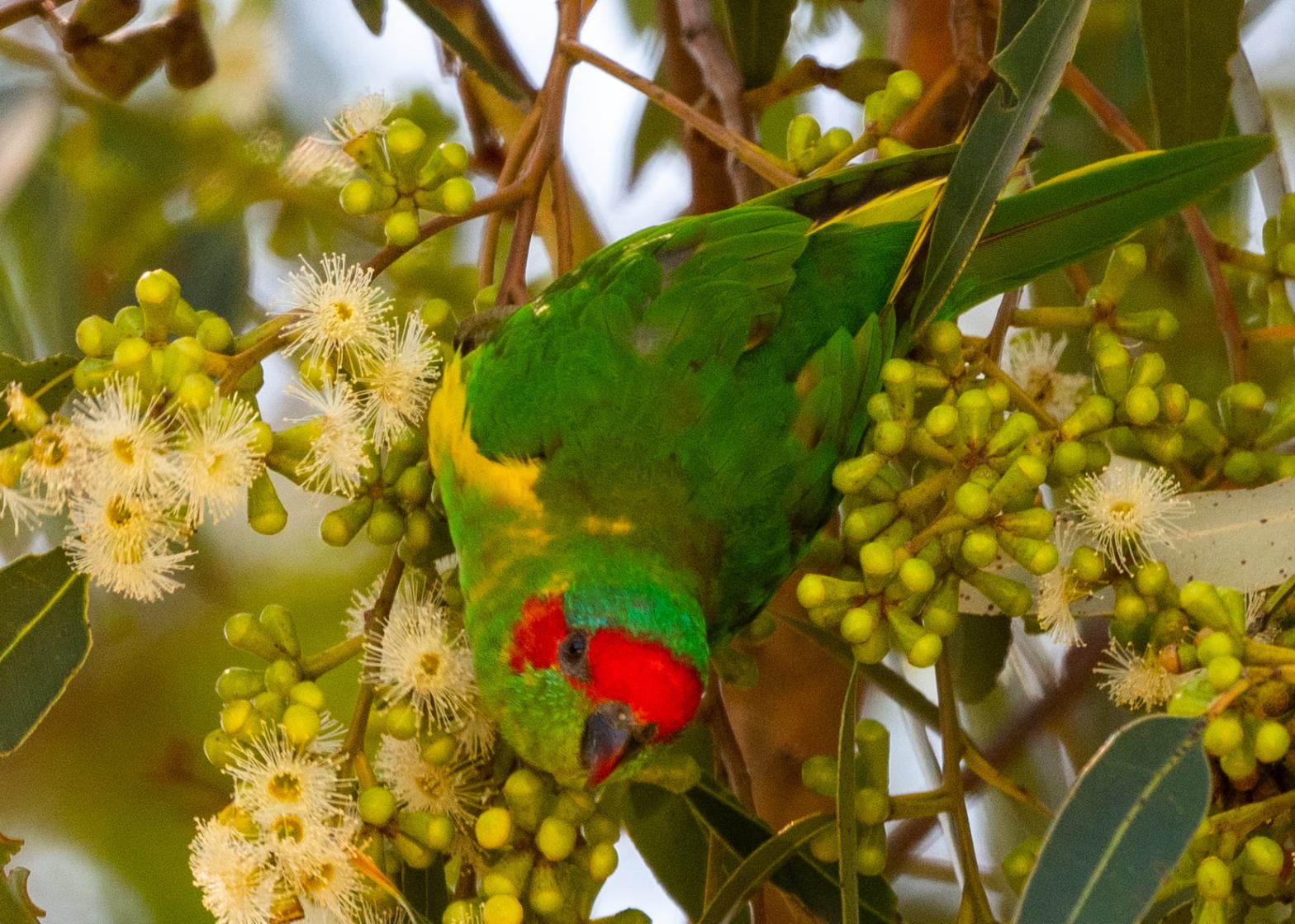
For some reason lorikeets, though brilliantly-coloured and noisy, can be hard to see. When you hear a cacophony of lorikeets in a big flowering eucalypt, you look up, expecting to see dozens. But you see none. Then, a movement – you focus your binoculars on the spot. Its a wattlebird!
You can do this ten times before you find one of the lorikeets. Then suddenly the flock flies out of the tree, and briefly you see 20 or 30 flashes of bright green… then they’re gone.
Lorikeets have a way of moving through a tree surreptitiously.
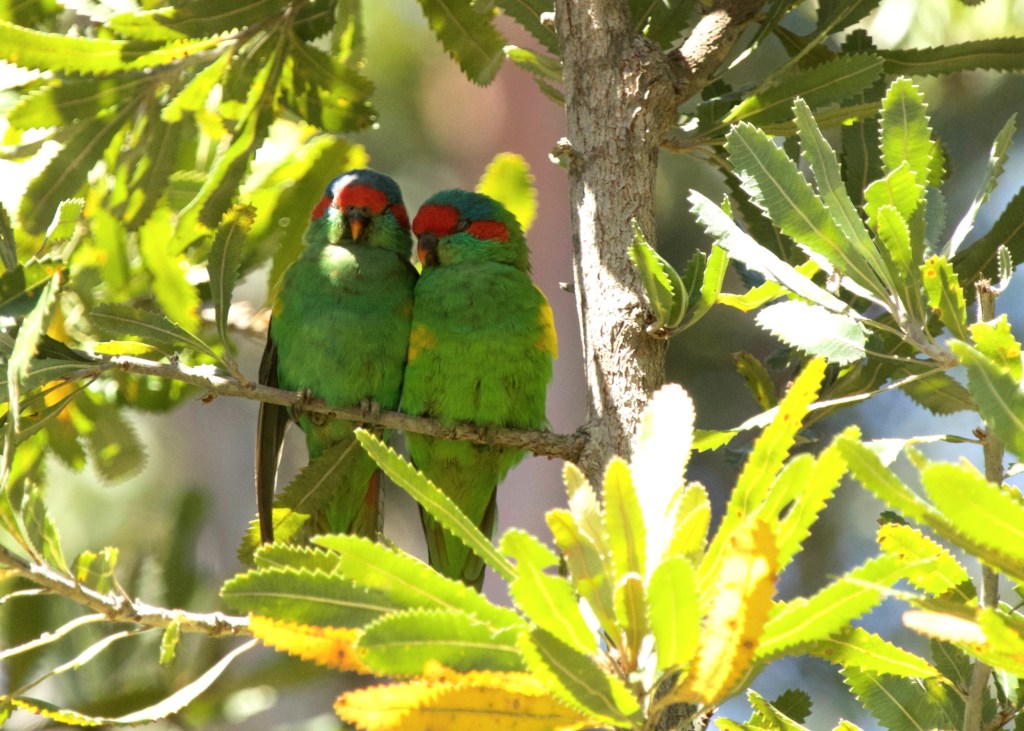
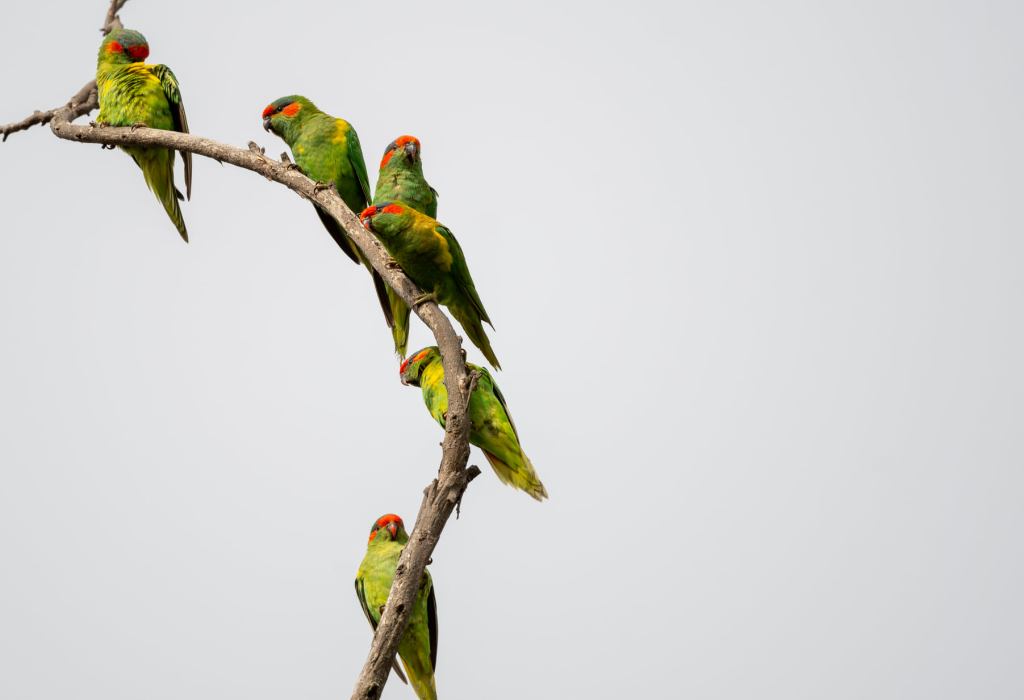
Musk Lorikeets roosting in the shade, East Gippsland by Martin Maderthaner
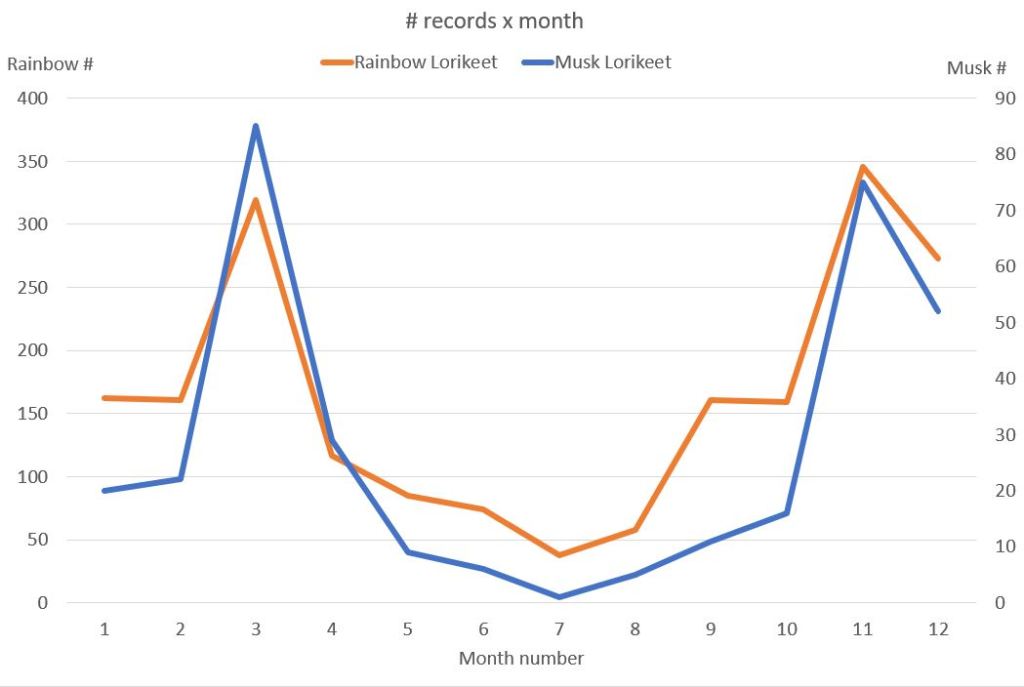
As a result, I think small lorikeets are recorded less often than they occur. Rainbow Lorikeets are big and more inclined to feed low on garden shrubs, so are well known. But medium-sized Musk Lorikeets, and very small Little Lorikeets, also occur in East Gippsland but are less known.
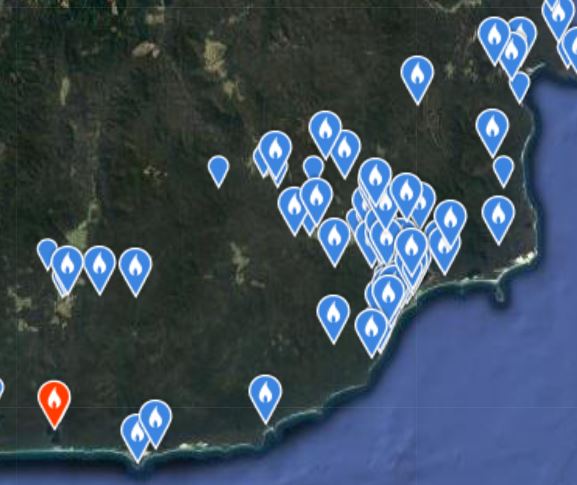
Martin Butterfield has provided this handy map of sightings:
Musk Lorikeet observations around Mallacoota
…and a graph showing the observations, compared to Rainbow Lorikeet. Note the different scales – although the pattern is similar, the numbers of birds is far far fewer for Muskies:
Chart showing Rainbow and Musk Lorikeet sightings and numbers around MallacootaMusk Lorikeet flock in the open, East Gippsland by Rob Clay
Tips to find them which have worked for me:
watch out for mass flowering of eucalypts, or Grass-trees (Xanthorrhea).
If you hear lorikeets, don’t assume they are all Rainbows. They often feed together. Look at each one.
Rather than watching for movement in the whole tree, focus on a few prominent bunches of flowers and wait.
Look also at shady branches at the top of the tree. They often roost there, and will sit quietly for ages.
Their call is different to a Rainbow Lorikeet – higher pitched, with more of a bell-like quality. Get to know the call and you’ll find the bird
Does anyone else have any tips?
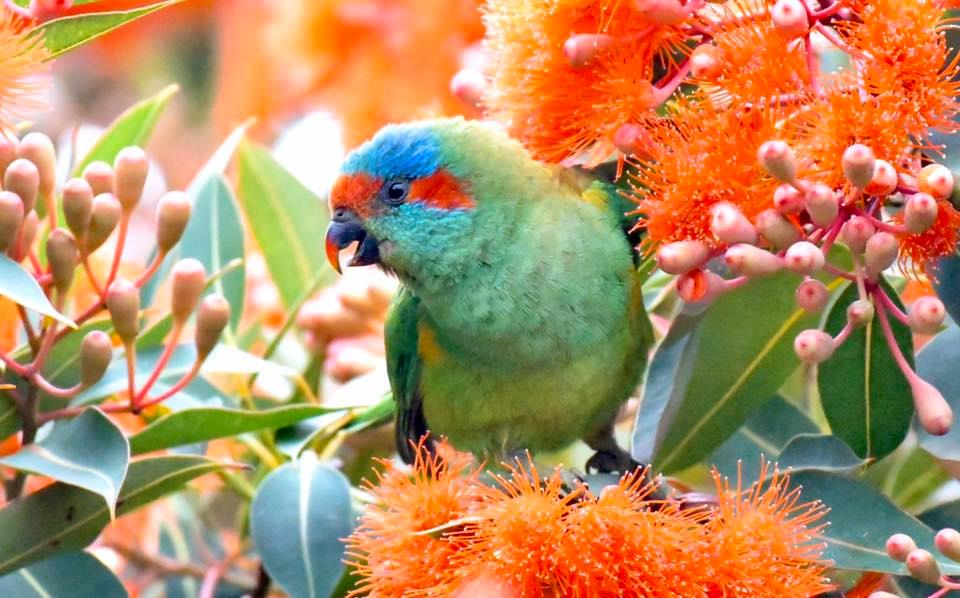
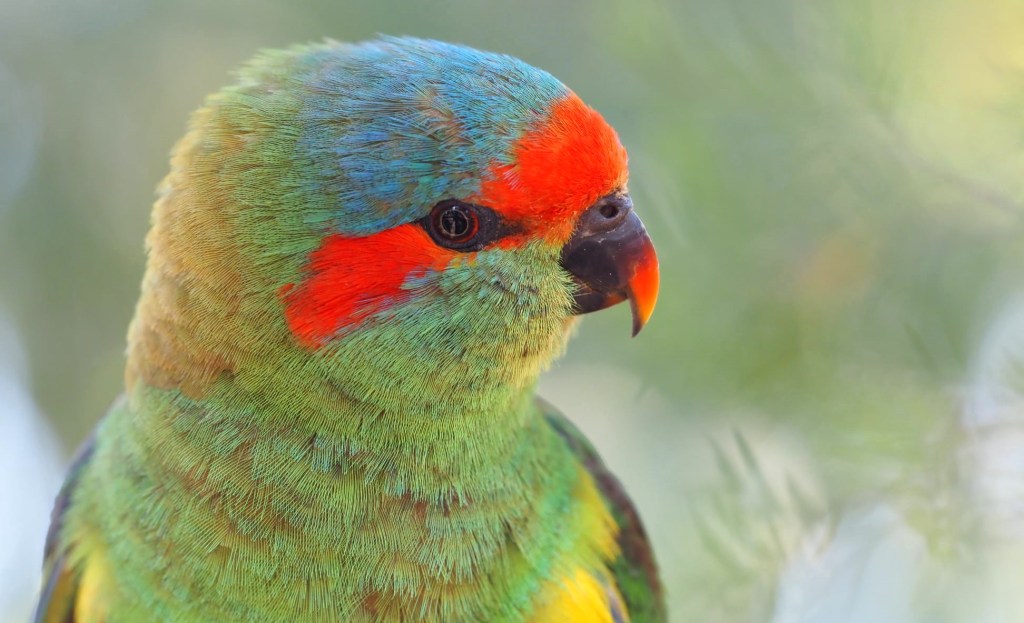
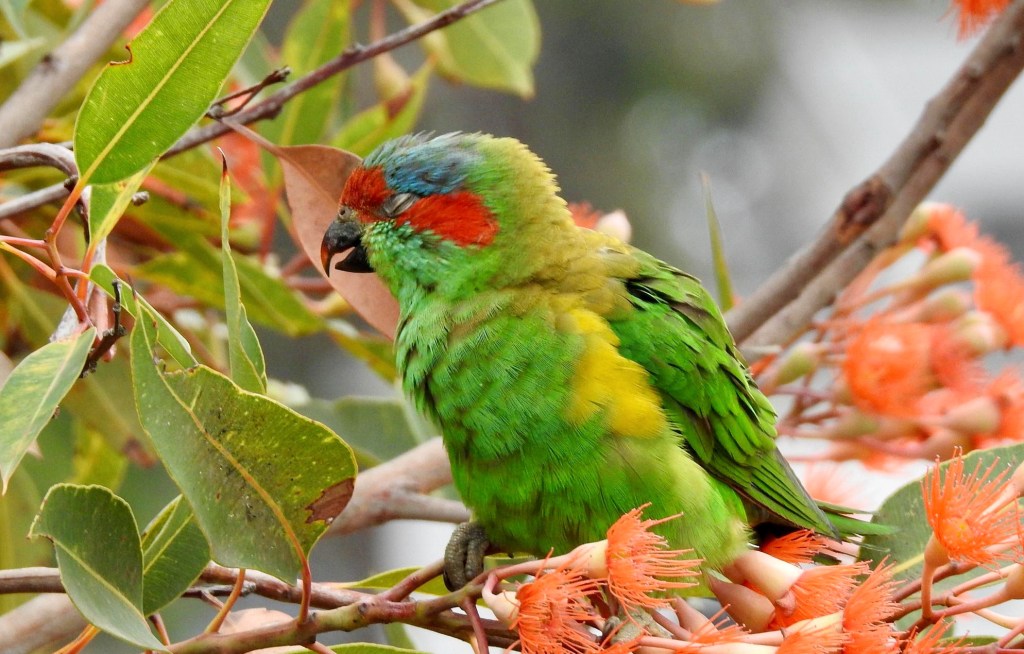
Adult males have teal-blue on the crown and cheeks, and a bit of a bluish wash on the throat and belly. Eye colour is brown or red. Bill is dark with a reddish-orange tip.
Adult male Musk Lorikeet East Gippsland by Martin MaderthanerAdult male Musk Lorikeet East Gippsland by Rob Clay
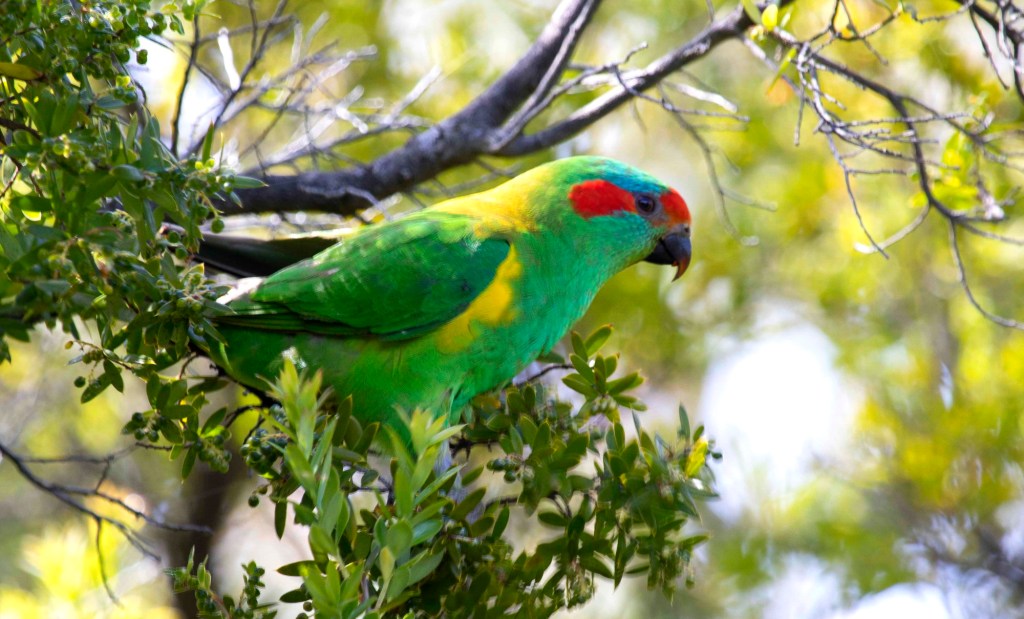
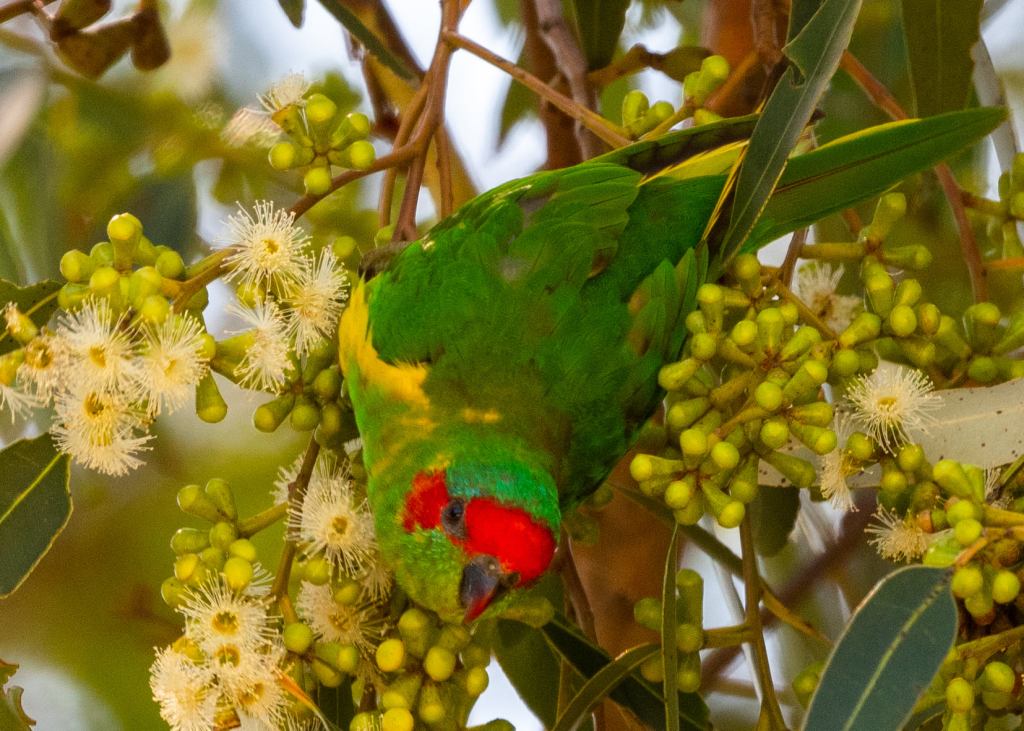
Adult females have less blue on the crown, and all green throat and belly. Bill and eye like male.
Adult female Musk Lorikeet Ballarat by Michael Barnett
Juveniles are duller than adults, with green all over except for red forehead and ear area, and small yellow flash beside closed wing. Eyes pale brown, bill brown.
Juvenile Musk Lorikeet East Gippsland by Rob ClayJuvenile Musk Lorikeet flying East Gippsland by Rob Clay
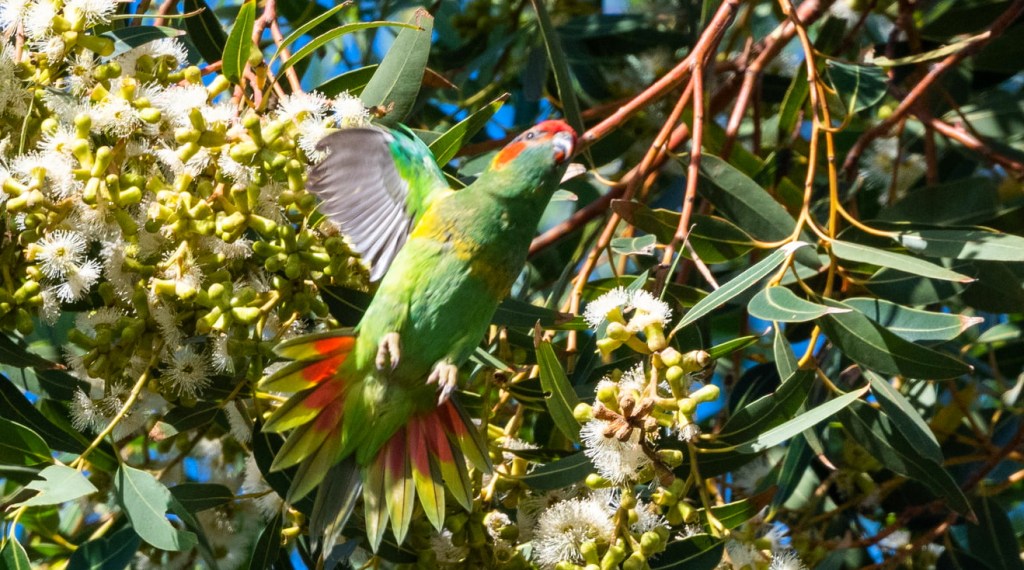
Note: they don’t have a red flash under their wing when they fly. Rainbows & Scaly-breasted Lorikeets do, Swift Parrots do. Musk & Little Lorikeets have green & grey-brownish underwings.
Thanks to Martin Butterfield, Caroline Jones, Michael Barnett, Rob Clay and Martin Maderthaner for your wonderful pics and videos.
Young adult female ? Musk Lorikeet Mallacoota by Caroline Jones. This picture was taken just after the 2019-2020 bushfires, and this bird looks stressed. Fingers crossed she survived.
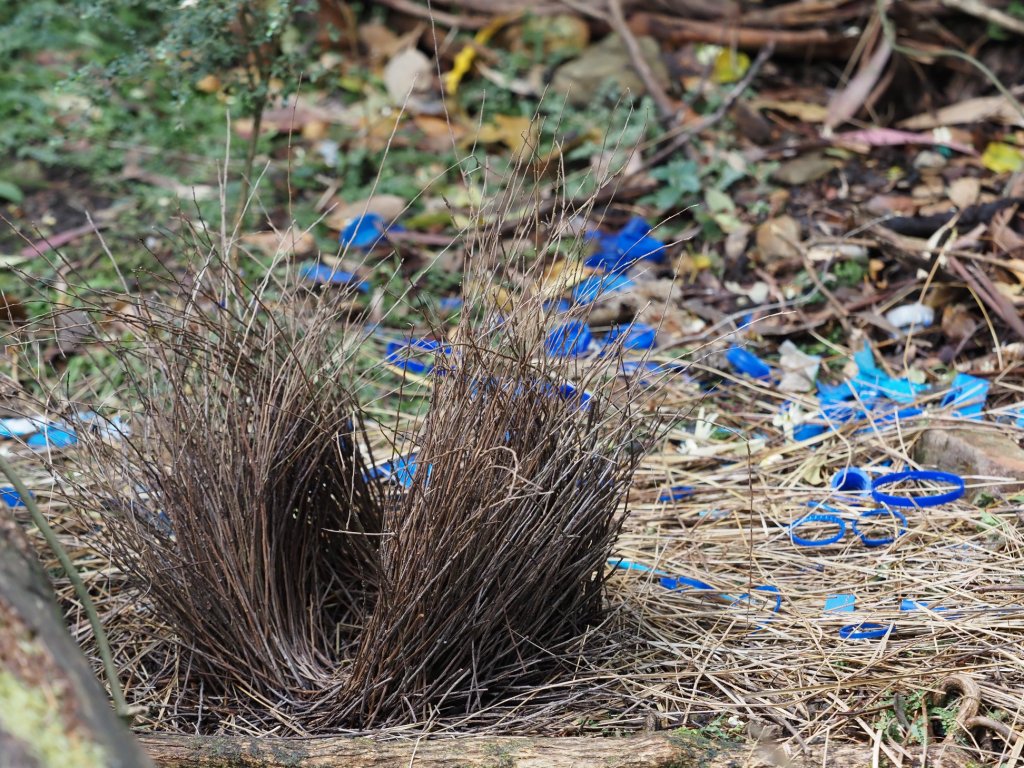
There are a few occasions in The Bush when coming across a sign made by an animal is as much fun as finding the animal itself. Finding a Satin Bowerbird bower is like that.
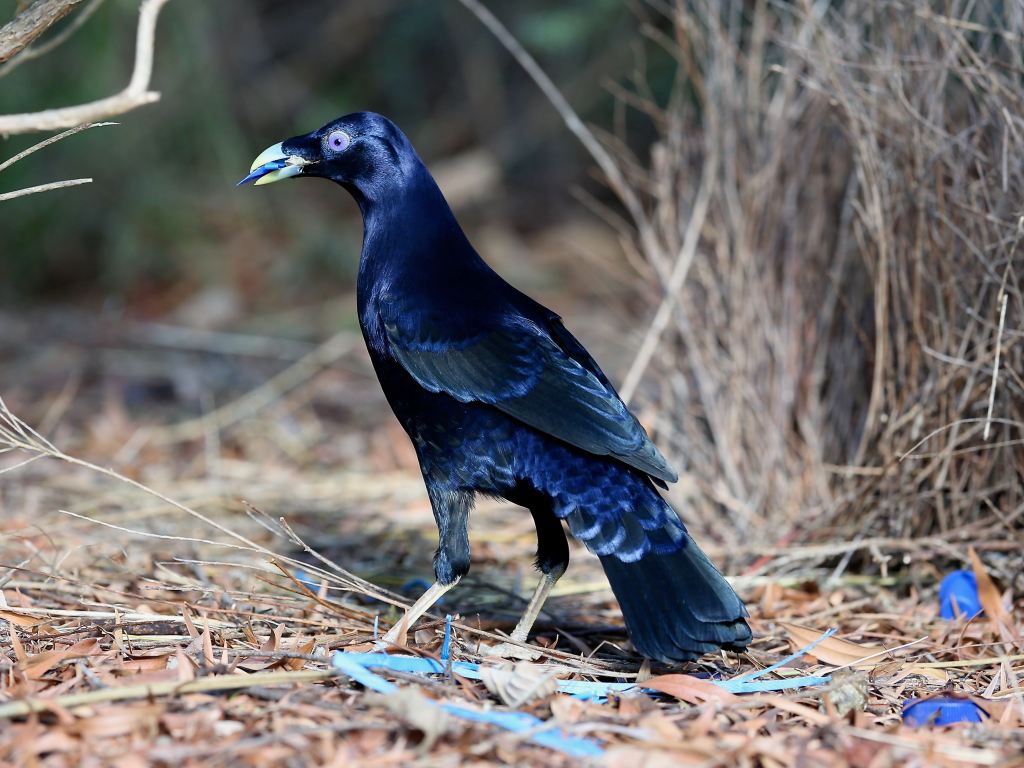
These structures are simply wondrous. Often well-hidden, with slightly-curved reddish walls of grass & sticks, like a little avenue. Out of each end electric blue objects spill, as though scattered by a messy passer-by.
Satin Bowerbird bower, Mallacoota by Michael Barnett
We are very lucky to have this great architect of the bird world amongst us. Very few animals create such elaborate and large structures, and even fewer create them purely for mating.
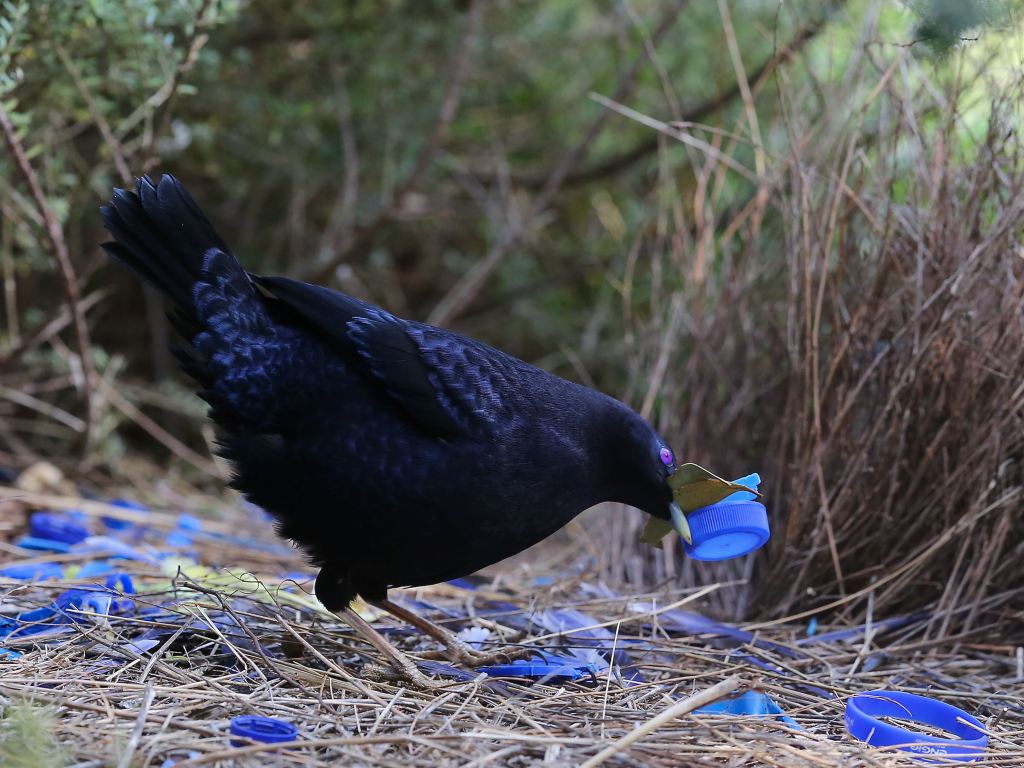
The blue objects are almost always a deep electric blue that is almost purple. The colour of the tail feathers of a Crimson Rosella (an item that is often part of the display). The colour of the berries of a Dianella flax-lily, also often in the bower. Also, sadly, the colour of many blue pen lids, milk bottle tops, and clothes pegs.
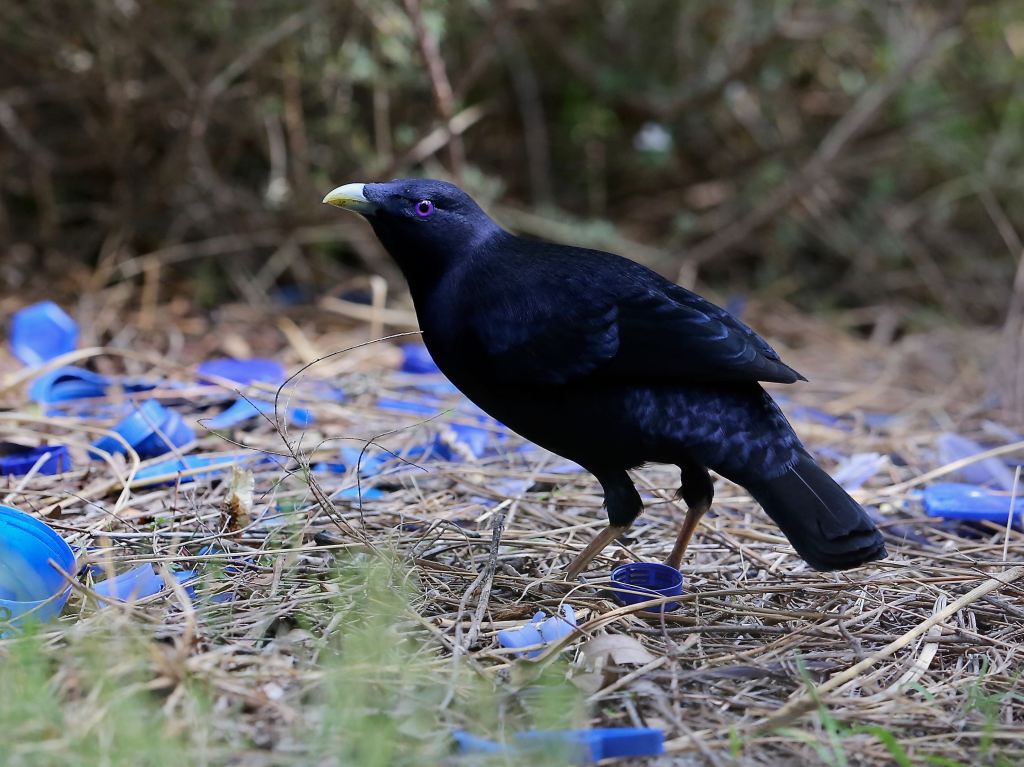
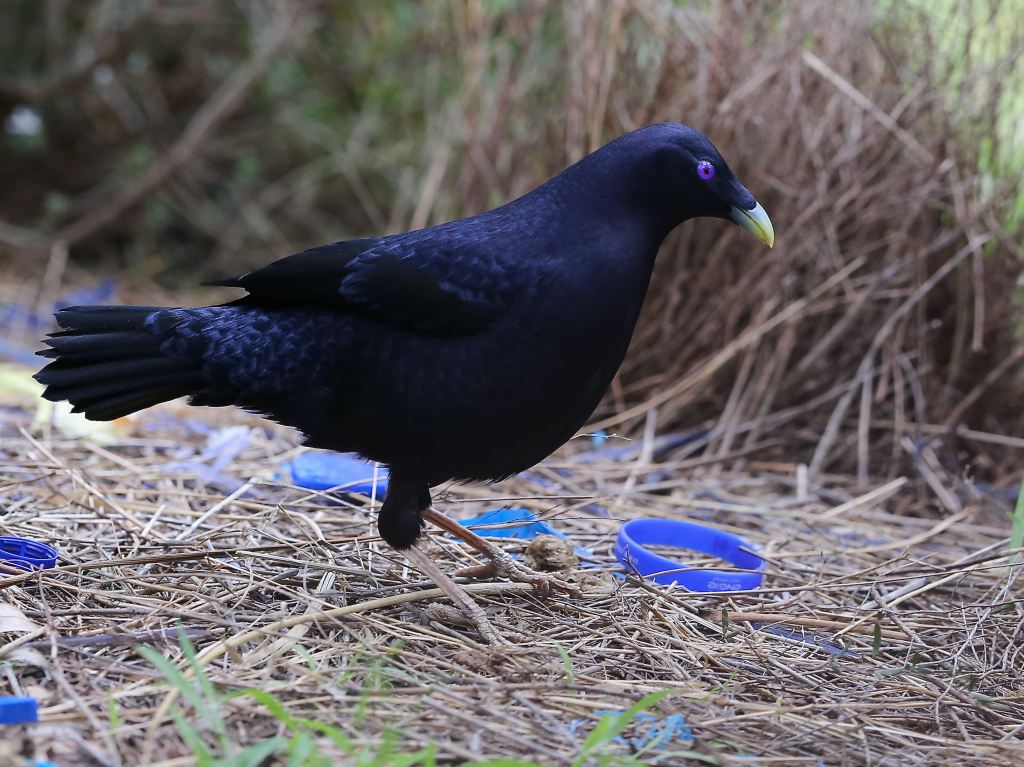
Adult male Satin Bowerbird at bower, East Gippsland by John Hutchison Satin Bowerbird East Gippsland by John Hutchison – note the pale yellow-green bill
Please, if you love bowerbirds, snip the rings from bottles before binning them. They sometimes get caught around the bird’s head, with fatal consequences.
A study by Endler (2010) found that Great Bowerbirds use ‘forced perspective’ in their bower design to make themselves seem larger. Great Bowerbirds also build avenue bowers very similar in design to the Satin’s, but their decorations are white, grey with splashes of green or red.
The marvellous inky blue-black plumage of adult males is only achieved at about 5-7 years of age. Until then, males look like females.
Adult male Satin Bowerbird East Gippsland by John Hutchison Immature male Satin Bowerbird, East Gippsland by Janine Duffy. Note pale bill.
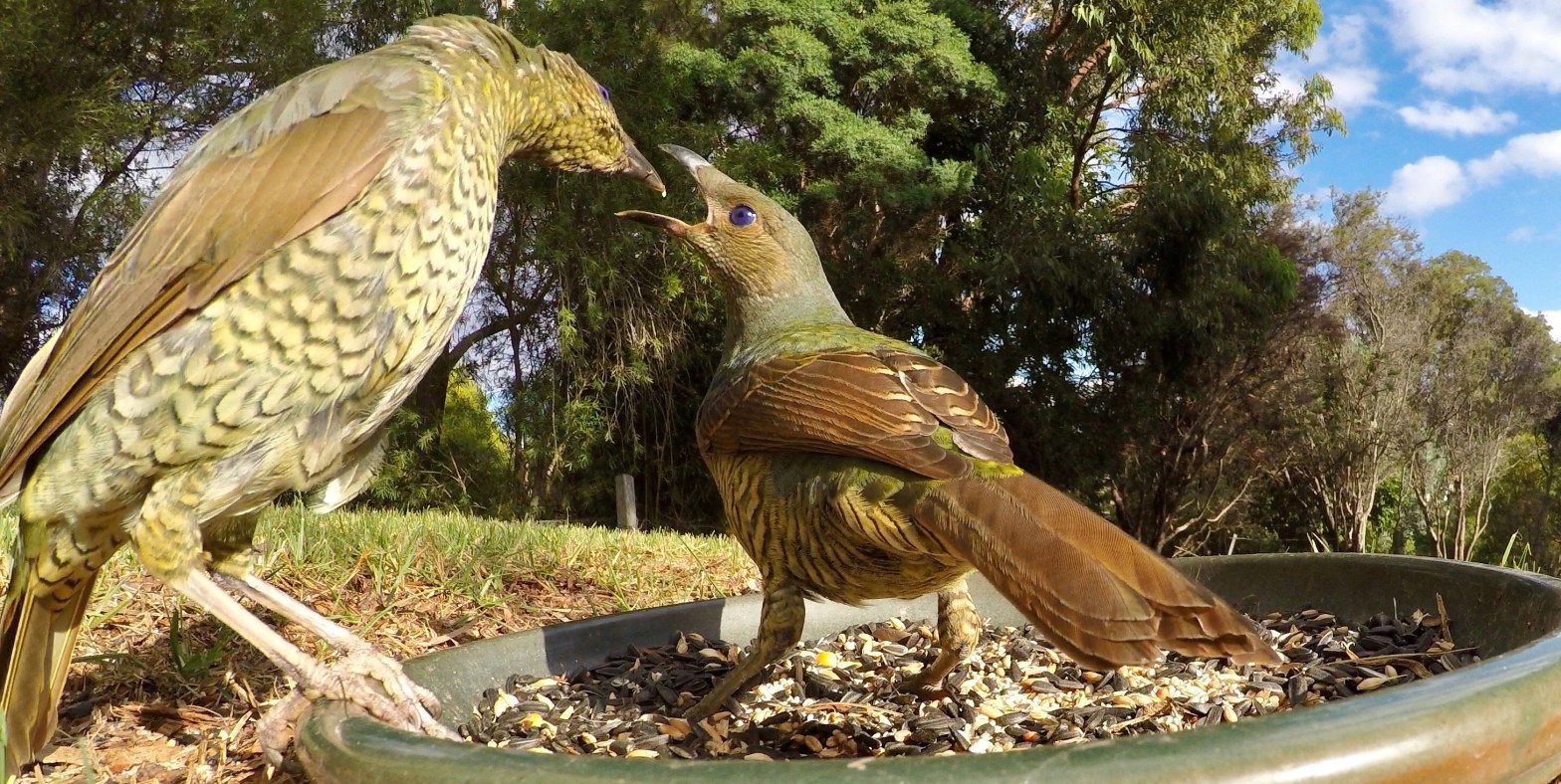
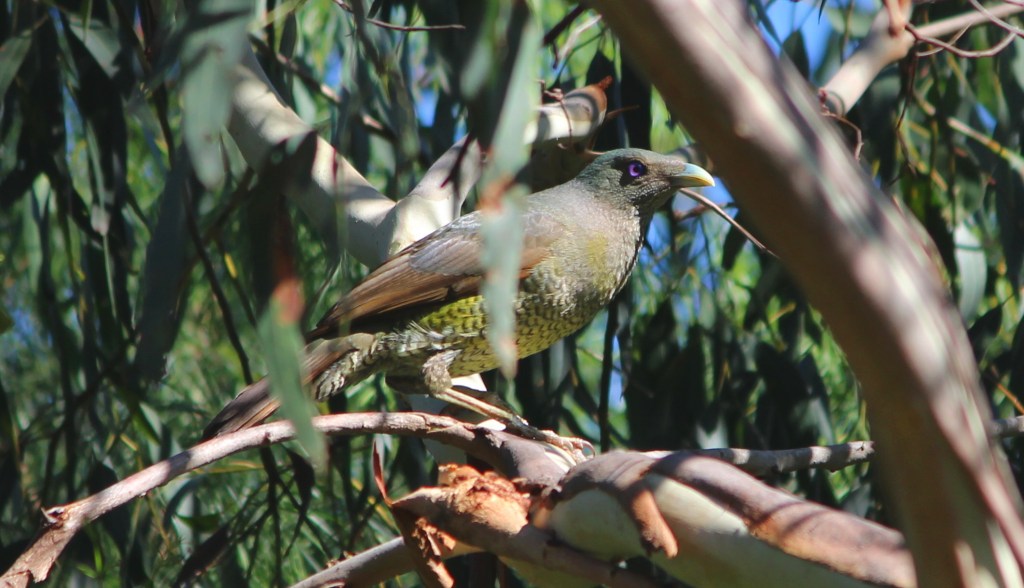
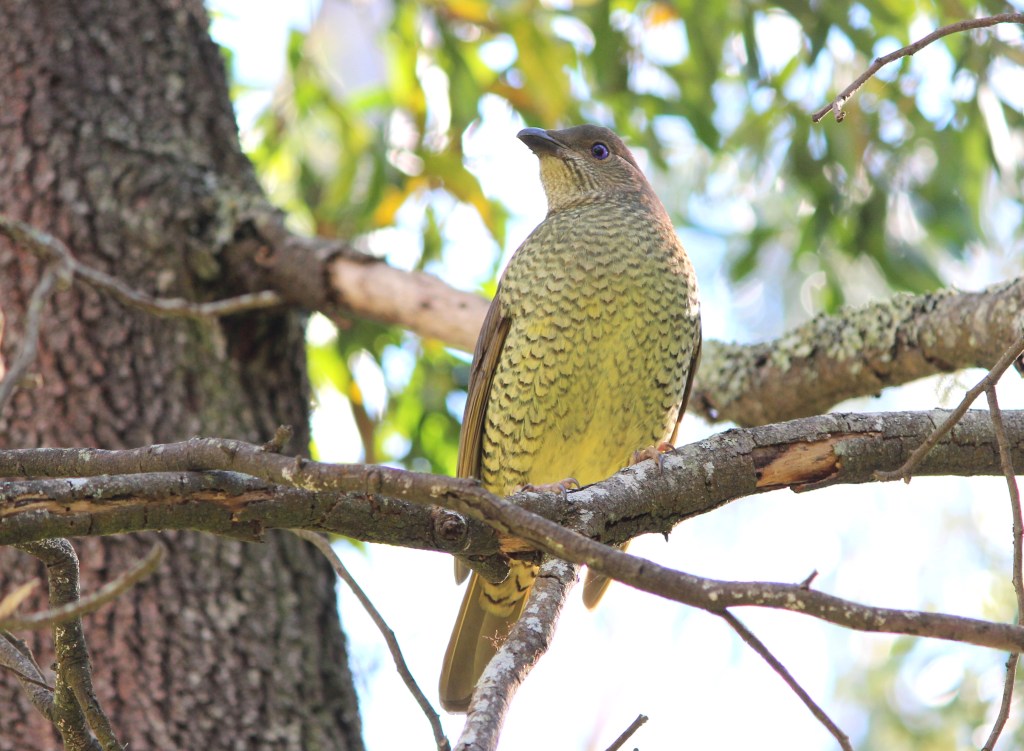
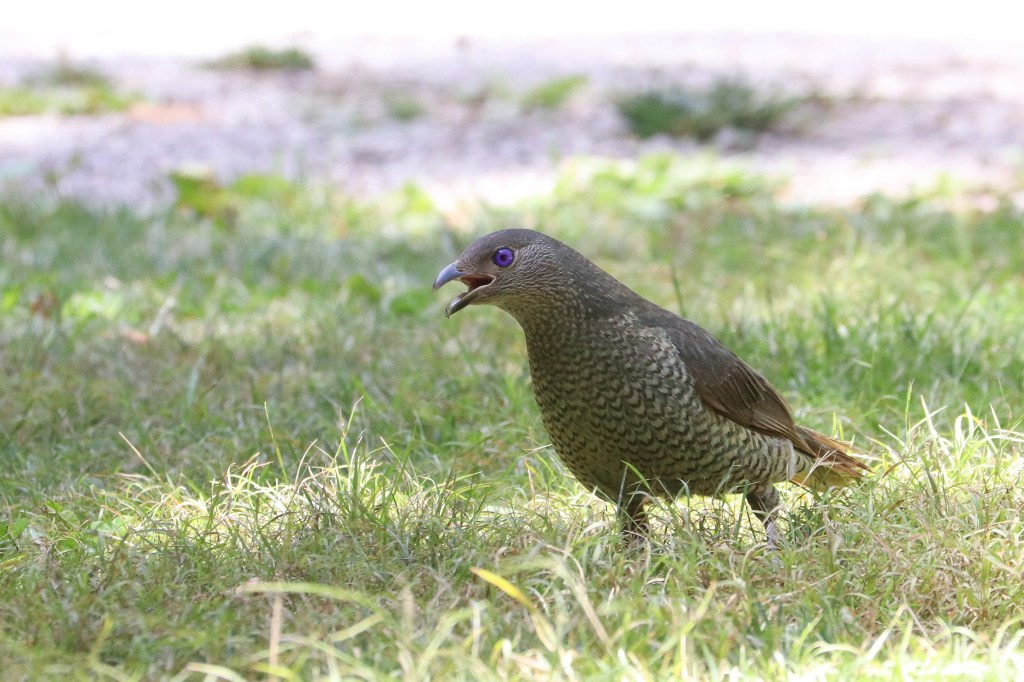
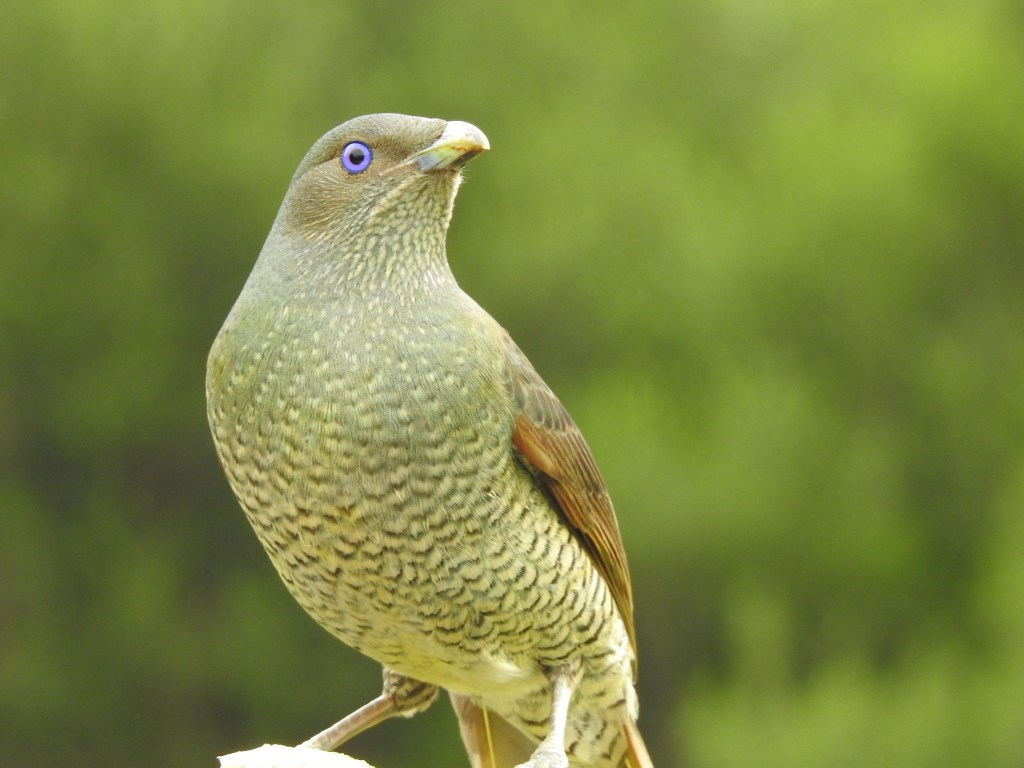
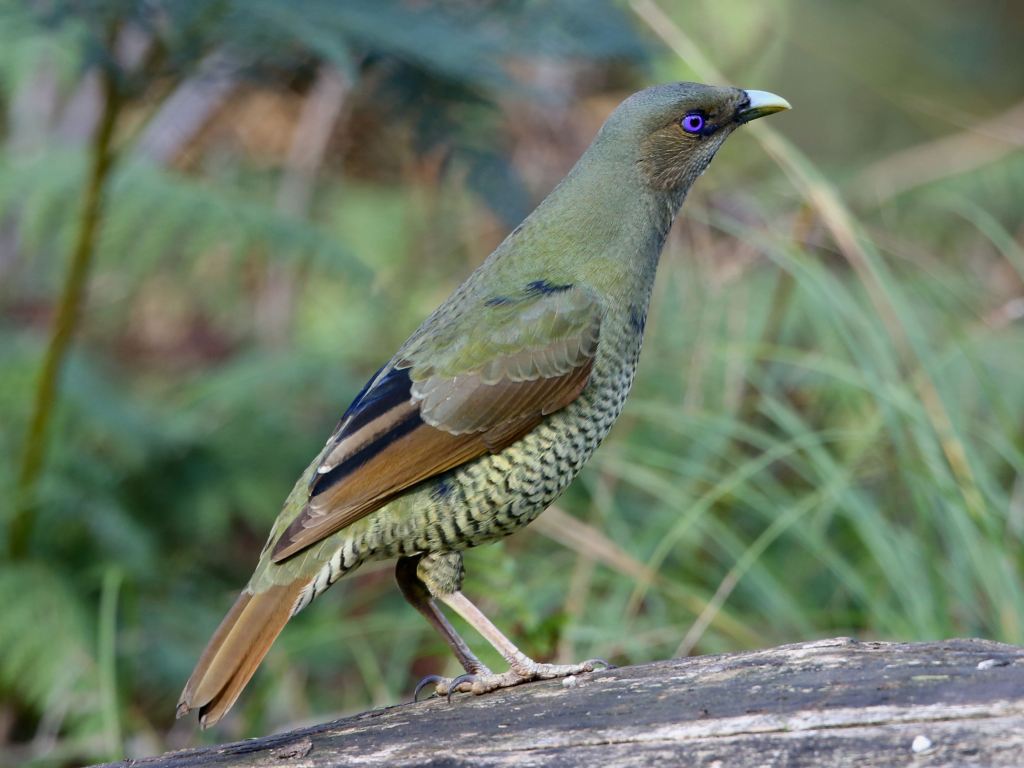
Females are green above with orange-brown wings and tail. Underneath they have yellow feathers with dark chevrons. Black bill.
Adult female or immature male Satin Bowerbird Buchan, East Gippsland by Janine DuffyFemale or immature male Satin Bowerbird, Buchan, by James Cornelius
Juvenile birds have more brown on their heads, but otherwise like females. They also have whitish streaks and edges on their upper wing feathers.
Immature male Satin Bowerbird Mallacoota by Caroline Jones – note the pale bill
Immature males by about 3-4 years old are developing the pale bill, have more green on their throat than females, and may start to get some black body feathers.
Male Satin Bowerbird probably over 3-4 years old, approaching full adult plumage, East Gippsland by John Hutchison
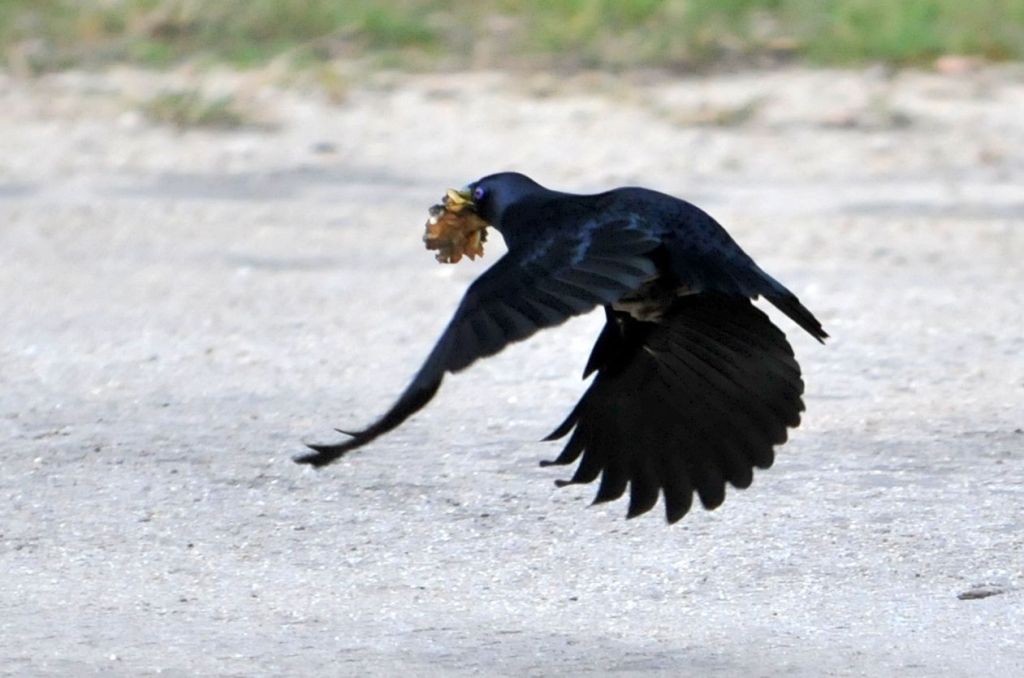
Adult male Satin Bowerbird flying with leaf, Mallacoota by Michael Barnett
Thanks to Michael Barnett, Caroline Jones, James Cornelius, Phil Johnstone, John Hutchison, Jack Winterbottom & Rob Clay for your wonderful pics and videos.
Bird of the Week: Red-capped Plover 22 January 2021
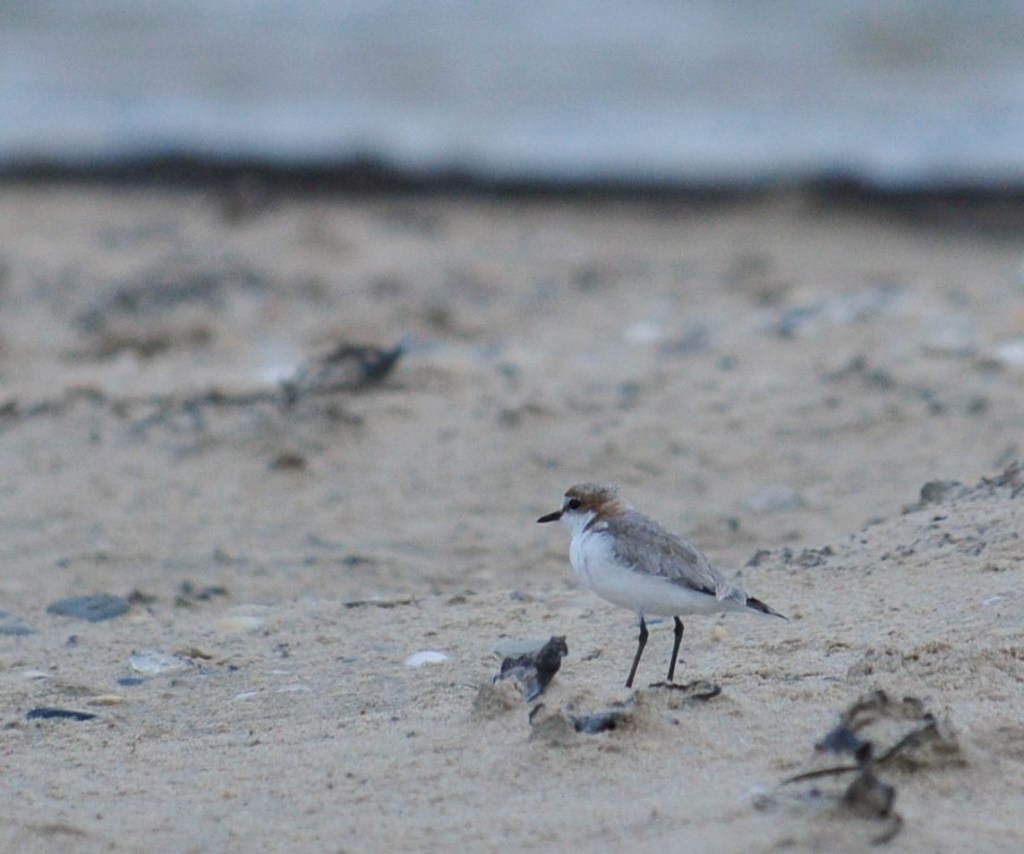
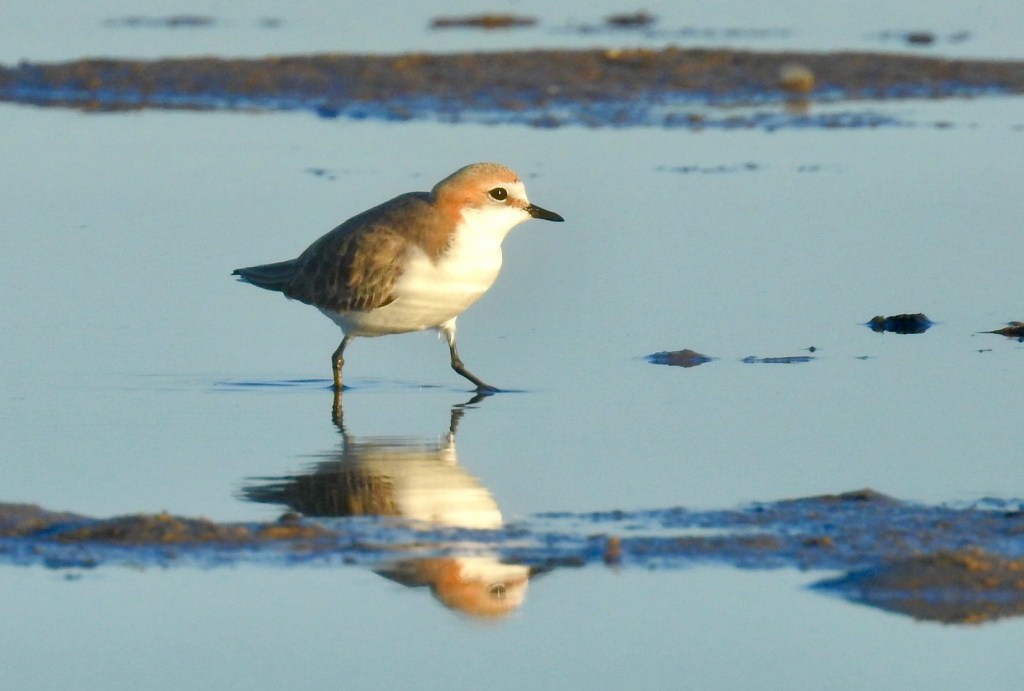
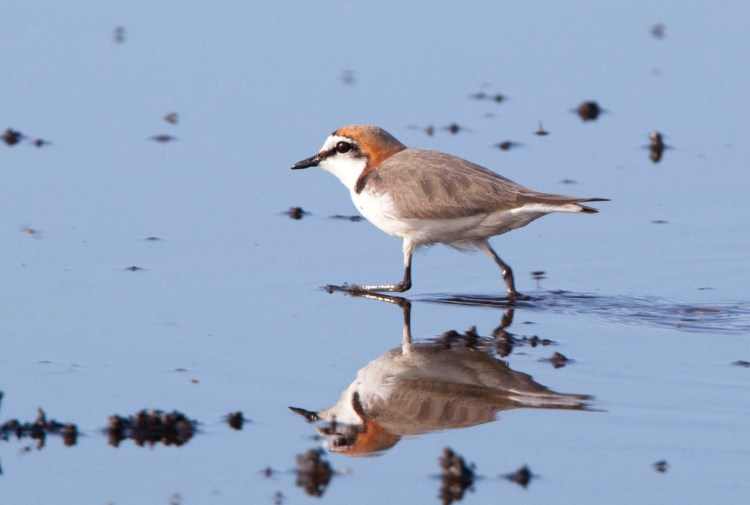
They dash across the beaches of East Gippsland, so small, pale and feather-light they could almost be dragonflies. I think many beachgoers probably don’t even notice them. But they are always around.
Female Red-capped Plover East Gippsland by Rob Clay
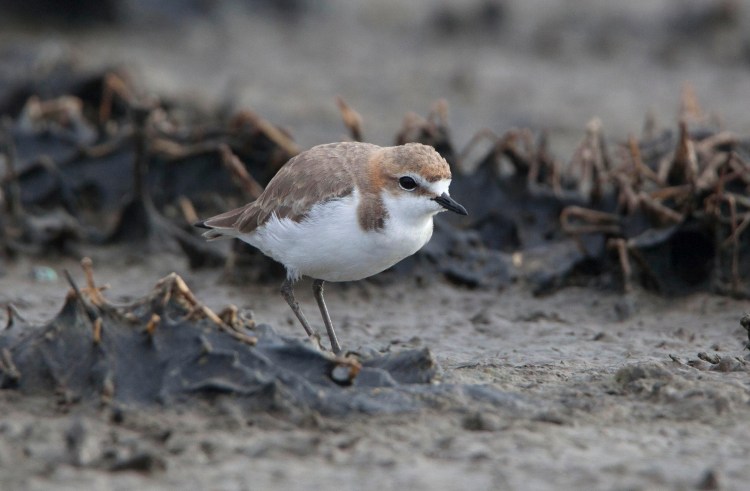
It’s hard to believe that a tiny creature, so delicate, could live in such a harsh, windswept environment. But the bare beaches and unvegetated wetland edges are their place – where they feed and breed.
Female Red-capped Plover East Gippsland by Jack WinterbottomFemale Red-capped Plover Jones Bay, East Gippsland by John HutchisonFemale Red-capped Plover Mallacoota by Michael Barnett
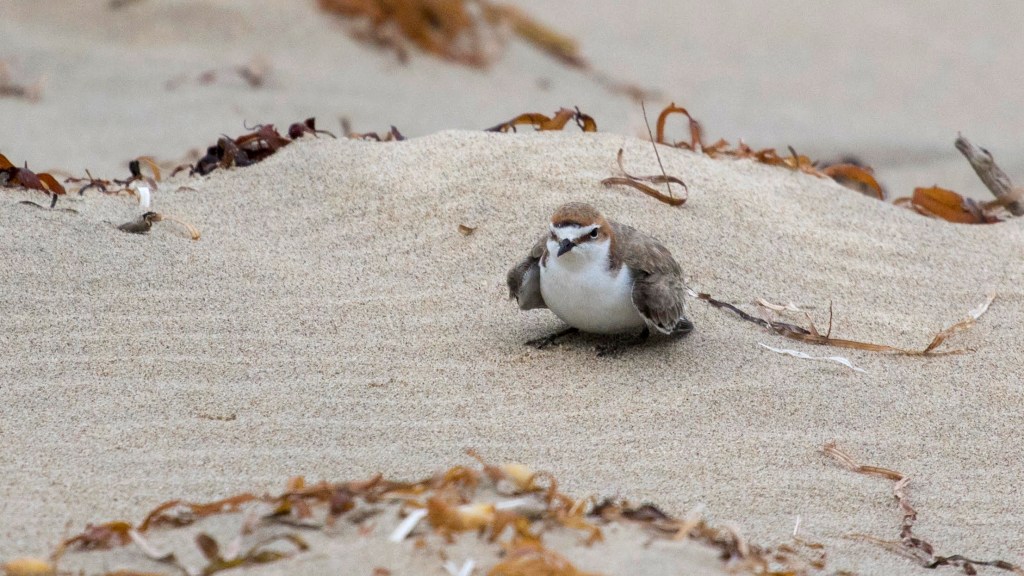
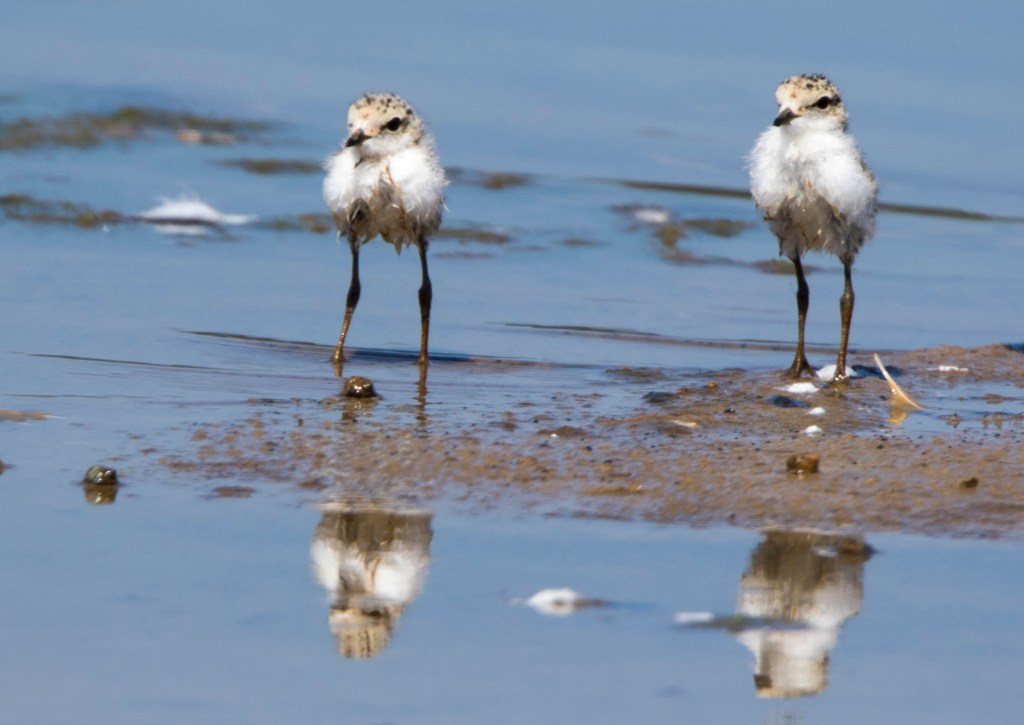
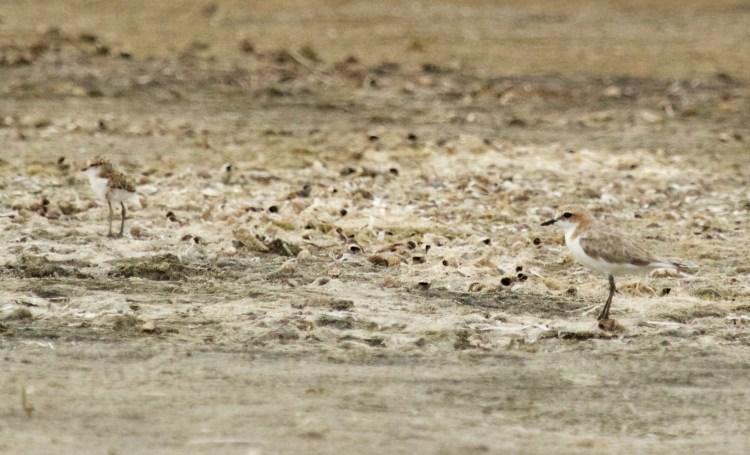
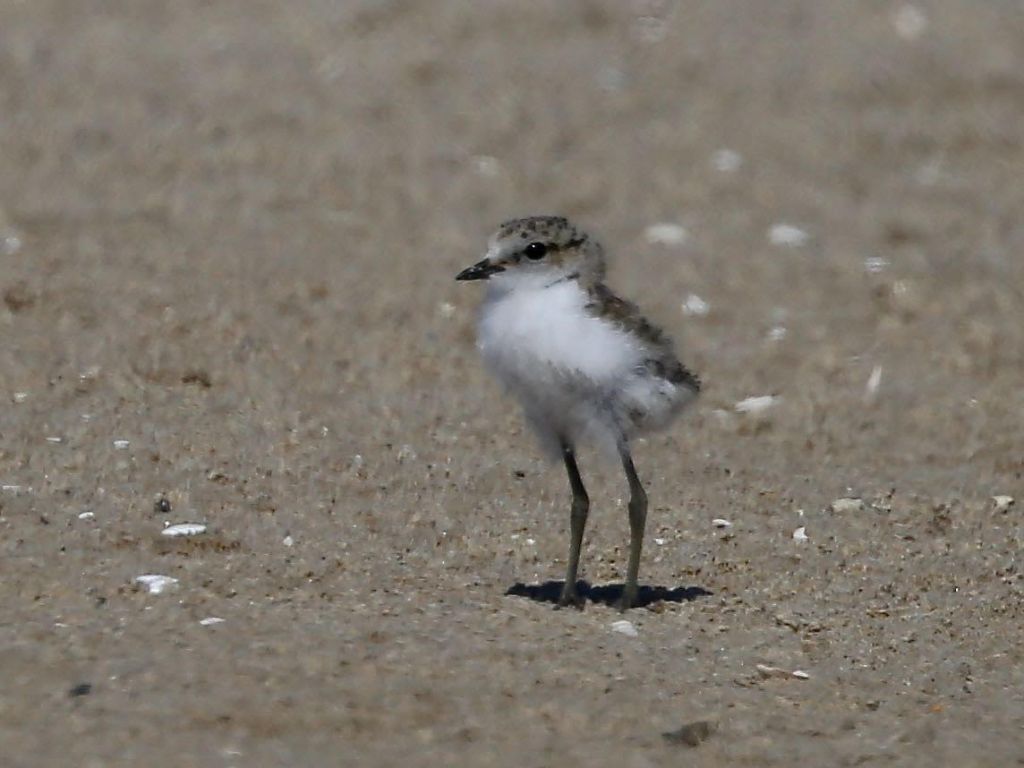
Their tiny fluffball-on-legs chicks are raised in the wind and unrelenting sun of these bare places. A scrap of flotsam or jetsam on the beach is their only cover.
Now this is important, and I know some of this might be upsetting or inconvenient. But an East Gippsland beach without birds is not an East Gippsland beach, and so it’s time to get serious about protecting all beach-nesting birds from us.
Female Red-capped Plover Mallacoota by Caroline Jones
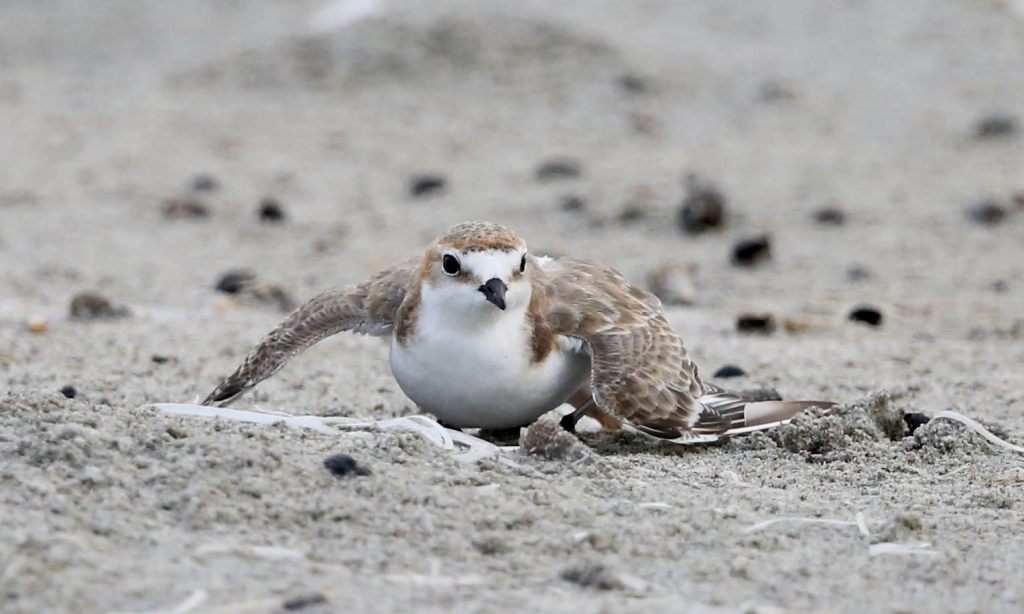
If you ever see a Red-capped Plover being obvious, running in front of you then stopping to run back to you, before running away again, or even dragging a wing, follow her. She is trying to attract you. Away from her babies, which are close. Don’t try to find them. Step carefully, and go immediately in the direction she takes you until she loses interest.
If you have a dog, put it on a lead straight away (or better still, have it on the lead at all times on the beach).
Female Red-capped Plover doing broken wing display, East Gippsland by Jack WinterbottomTwo Red-capped Plover chicks, East Gippsland by Jack Winterbottom
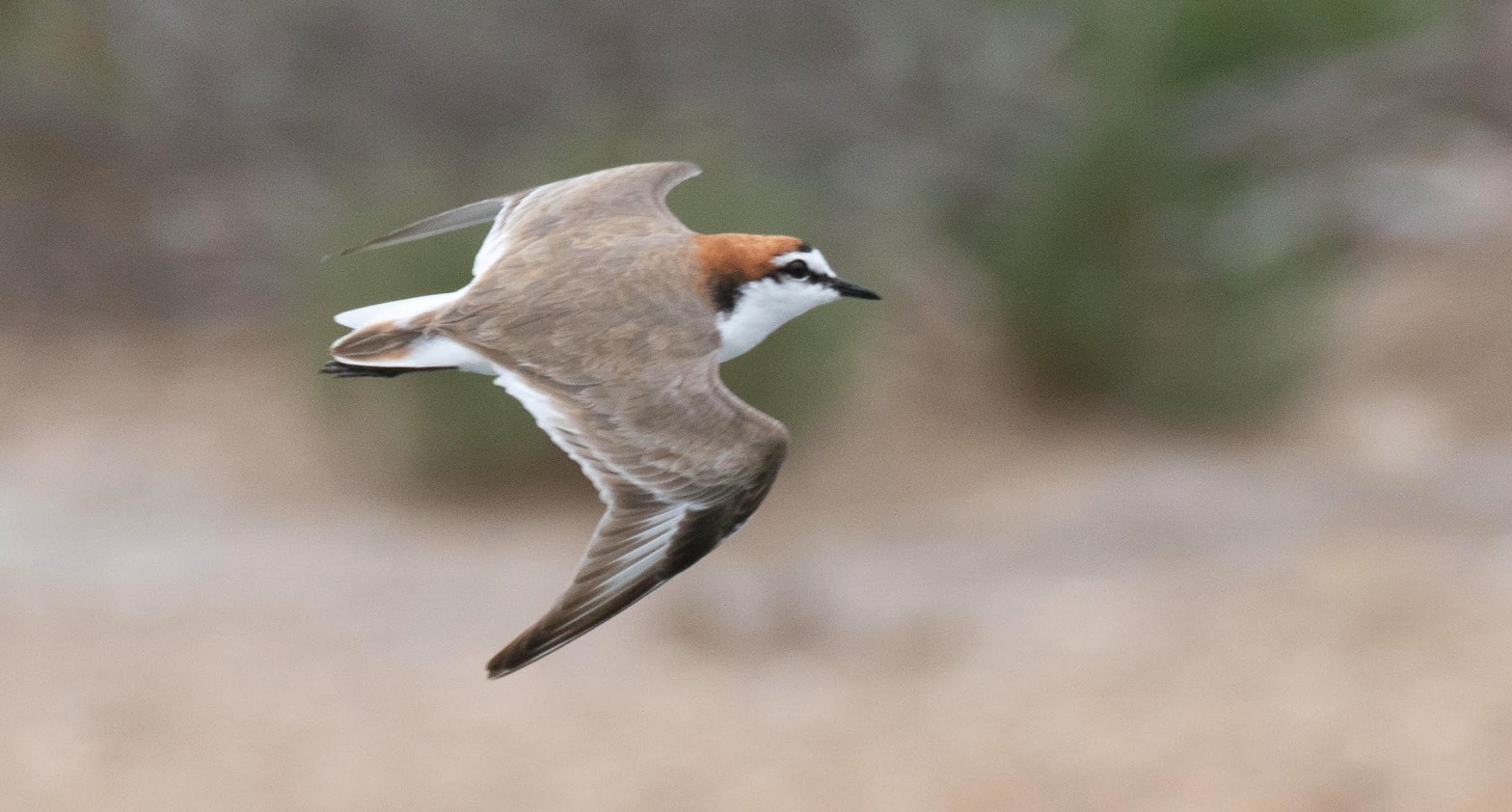
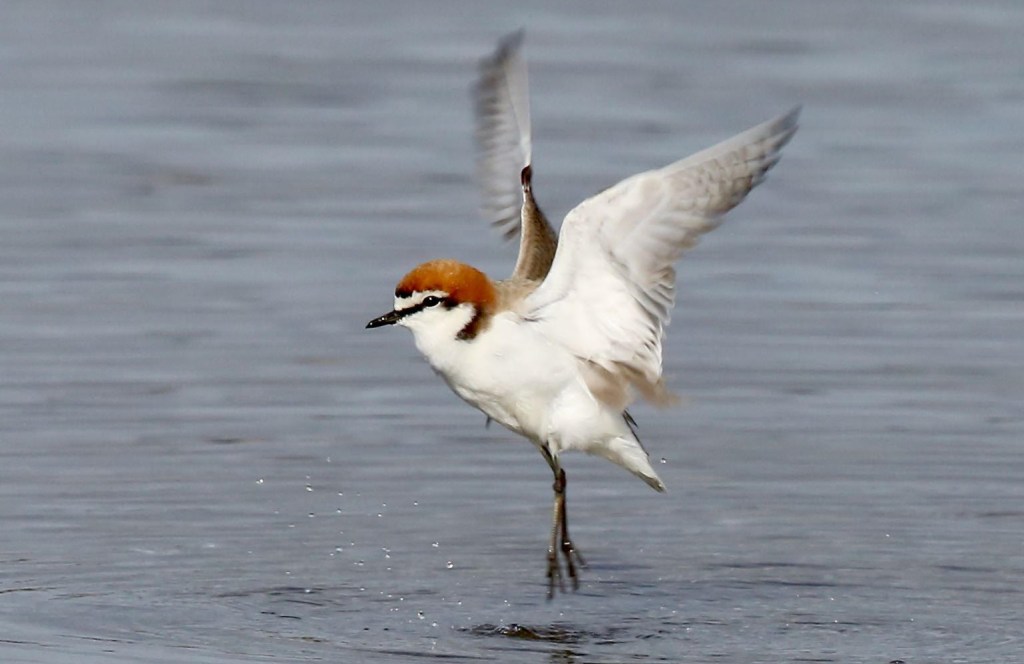
Adult males have a bright orange-red head (sometimes with grey crown), black lores and black half-collar.
Red-capped Plover adult male, East Gippsland by Jack Winterbottom
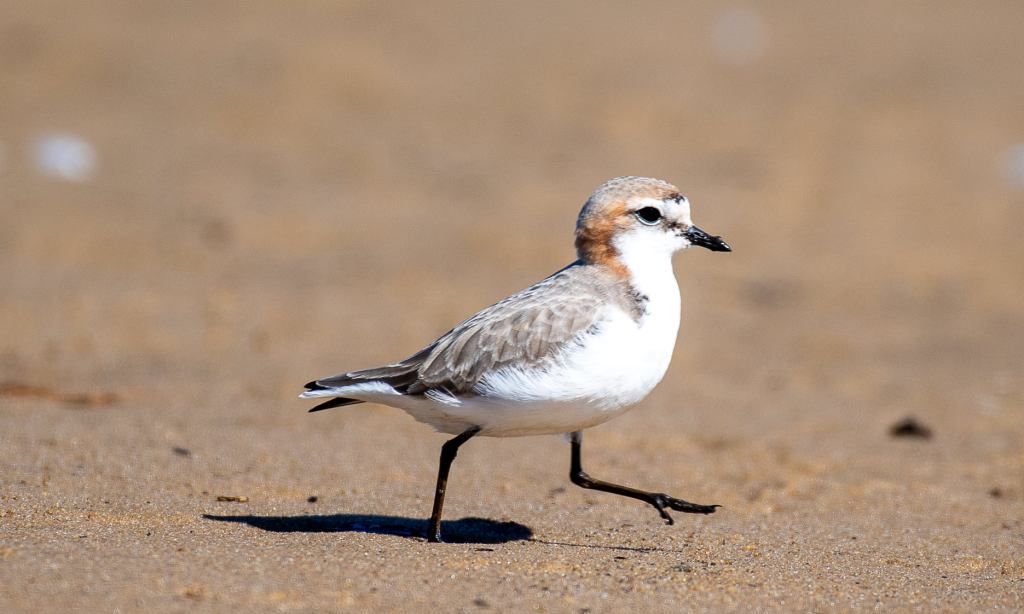
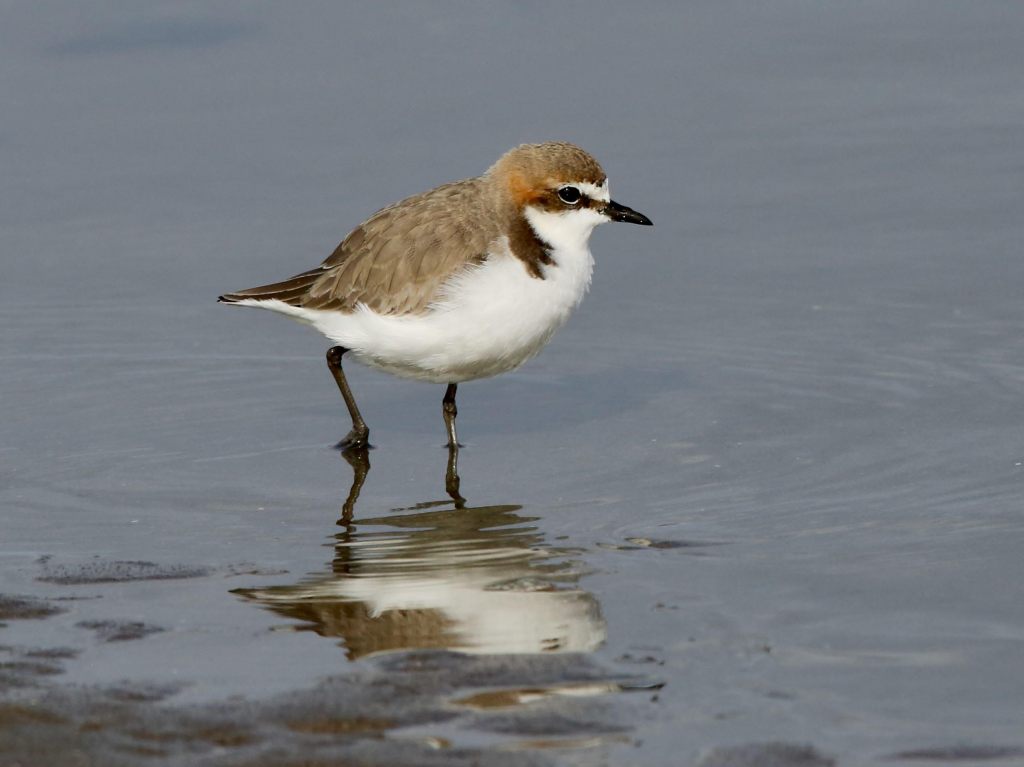
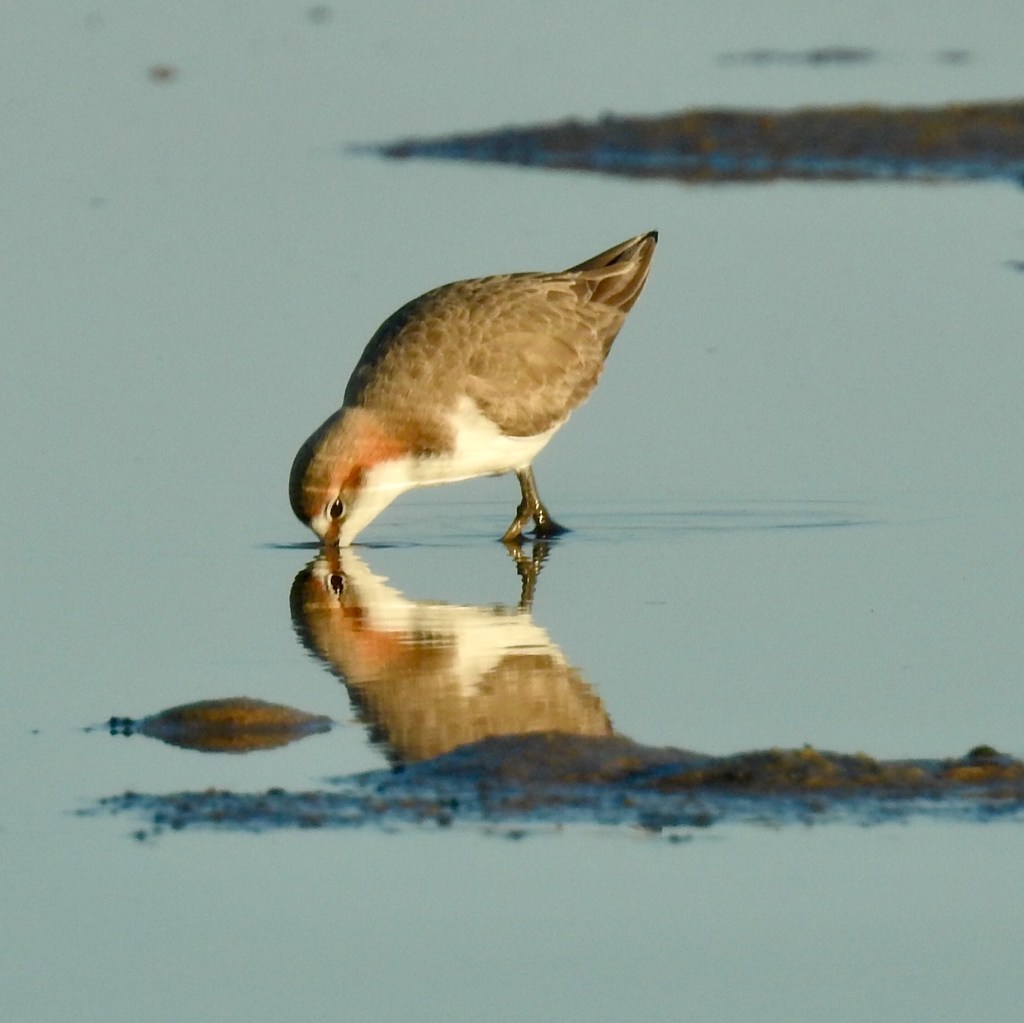
Adult females have a bit of orange around the face and head, but not as much as the males. Most of their head is grey. They have brownish lores, and not much of a half-collar.
Adult female Red-capped Plover East Gippsland by Jack WinterbottomRed-capped Plover female with well-camouflaged chick, East Gippsland by Martin Maderthaner
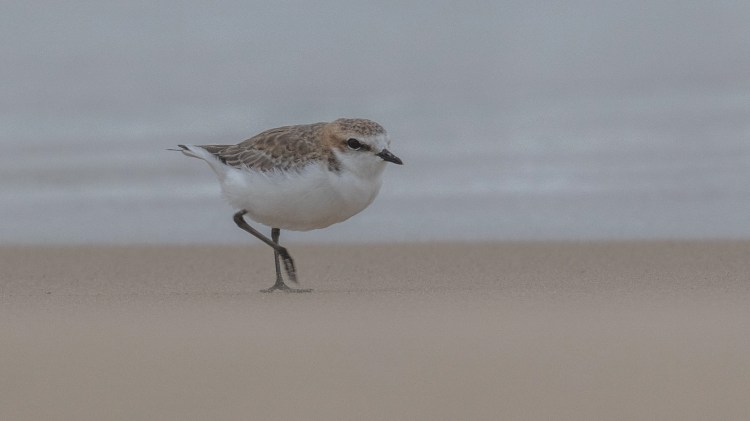
Juveniles start out quite speckled, then develop the orange points around the face. But their crown remains streaked, and the grey feathers on their back/upperwings have pale fringes, making them look more streaky/scalloped all over.
Red-capped Plover juvenile, East Gippsland by Jack WinterbottomRed-capped Plover tiny chick Gippsland Lakes by John Hutchison
Other names are Red-capped Dotterel, Red-necked Plover and Sand Lark!
They are different to the vulnerable Hooded Plover who usually has a black head. But as juveniles the head is greyish, and so they could be confused for a Red-capped Plover juvenile. But the Hooded Plover has a beak that is reddish at the base, a red eye-ring, and a complete white collar right around to the back of the neck.
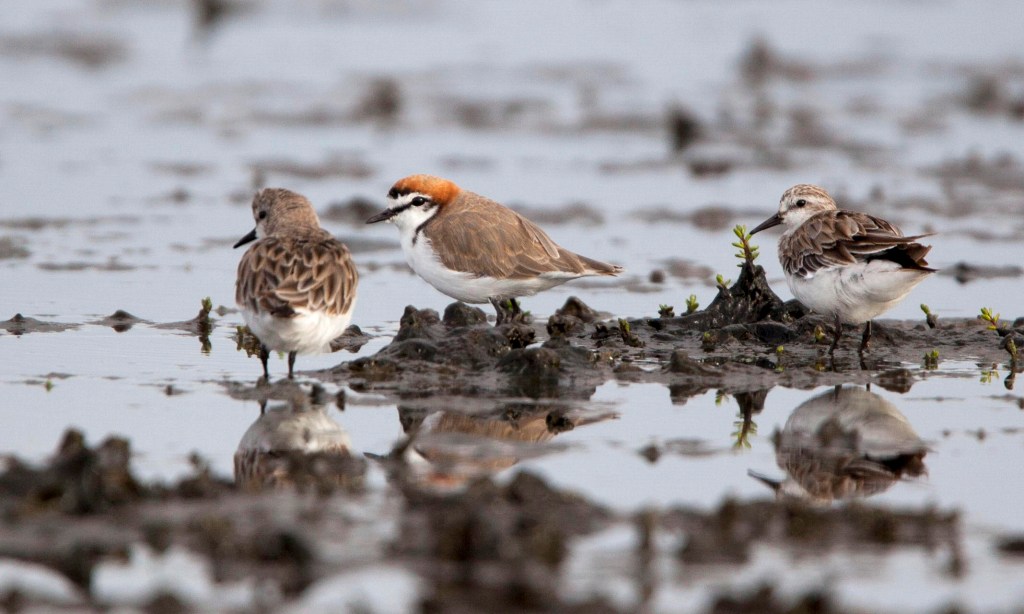
They are different to the similar-sized Red-necked Stint (see below) which has a longer bill, smaller head and more streaked plumage.
Red-capped Plover (centre) with Red-necked Stints, East Gippsland by Jack Winterbottom
Most Mallacootians would know this bird from the monotonous, repetitive, unending “Whoop whoop whoop whoop whoop whoop whoop whoop whoop….” that starts in Spring and only tails off in late Summer.
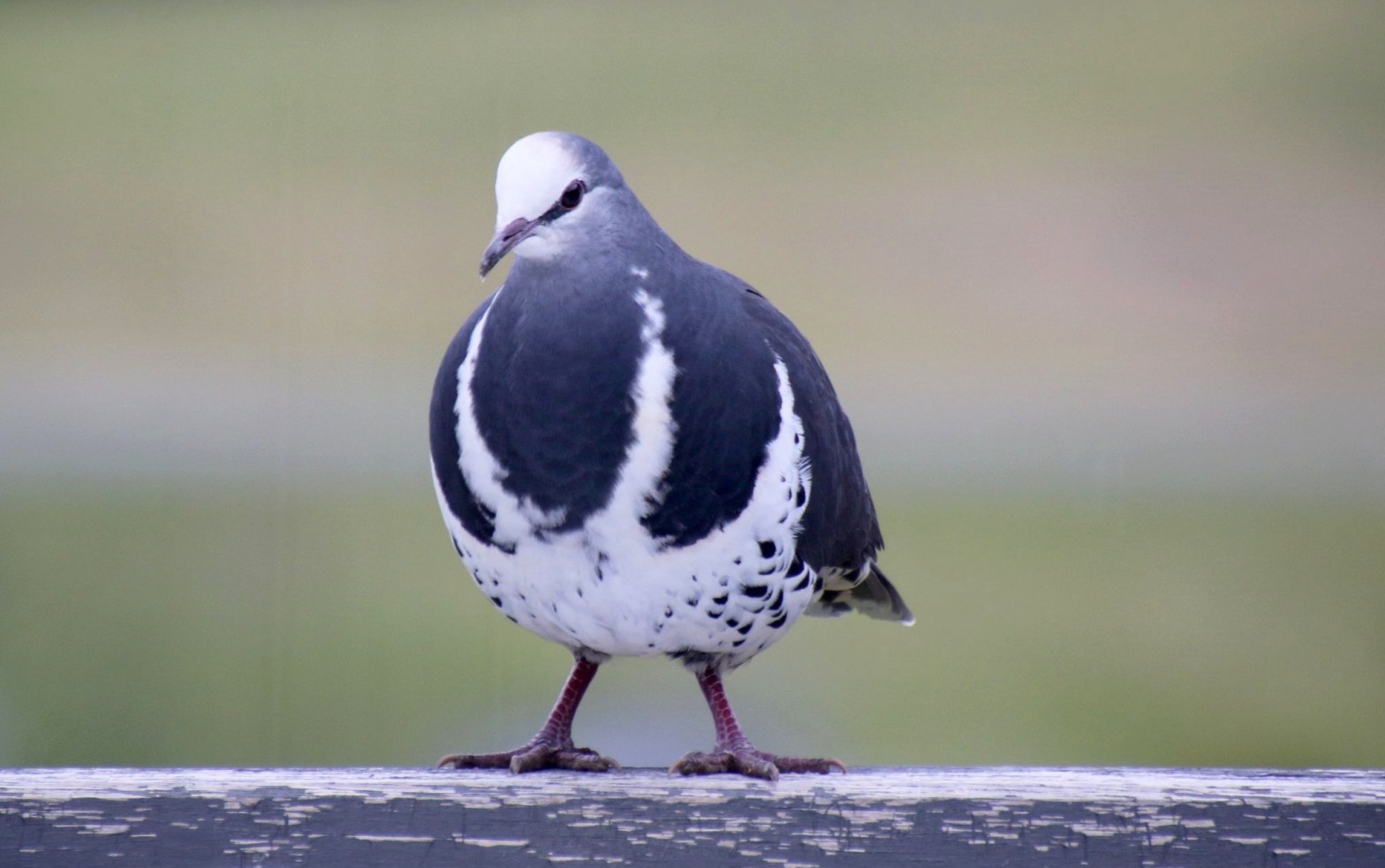
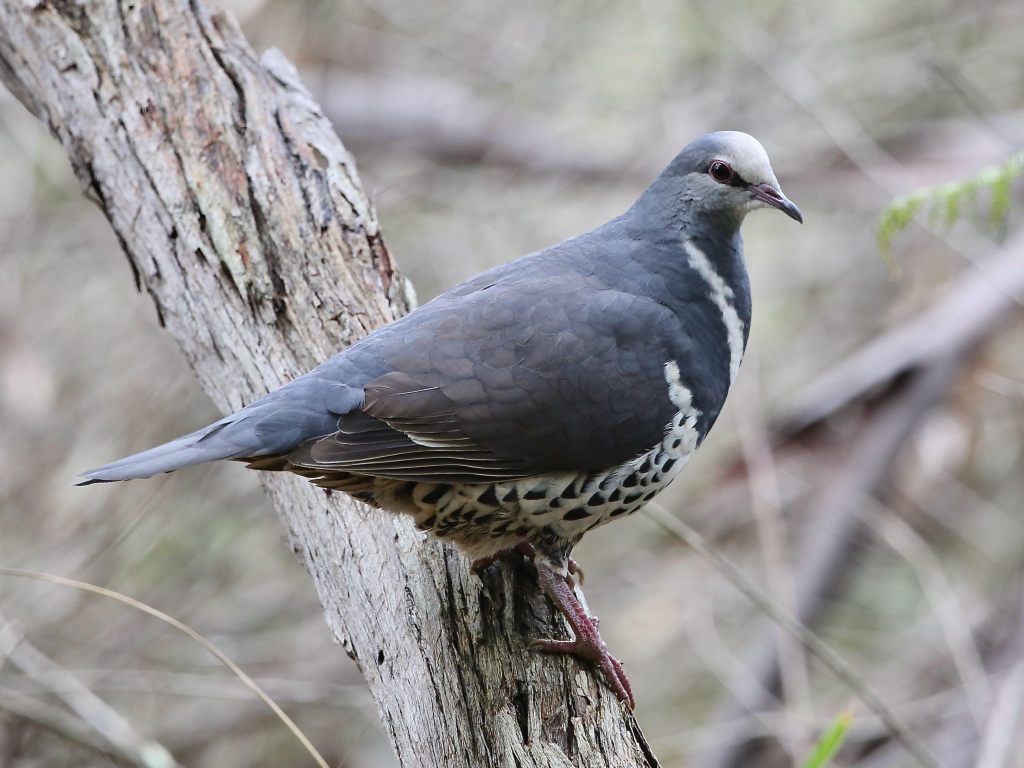
Wonga Pigeon East Gippsland by John Hutchison
But we all get used to it eventually, like city dwellers get used to the hum of traffic, sirens and dogs barking. I think any bird sound is preferable to any of those!
They are a handsome bird, when you actually get to see them. Early mornings are a good time, and evening before dark – they tend to come out from cover at those times to forage in the open. They eat fallen fruit mostly, seeds and insects, and pretty much always forage on the ground. So next time you curse a messy Rainbow Lorikeet for taking one bite and dropping the rest of your beautiful fruit on the ground, think about the Wonga Pigeon picking it up joyfully – and how everything has a place and a purpose in nature.
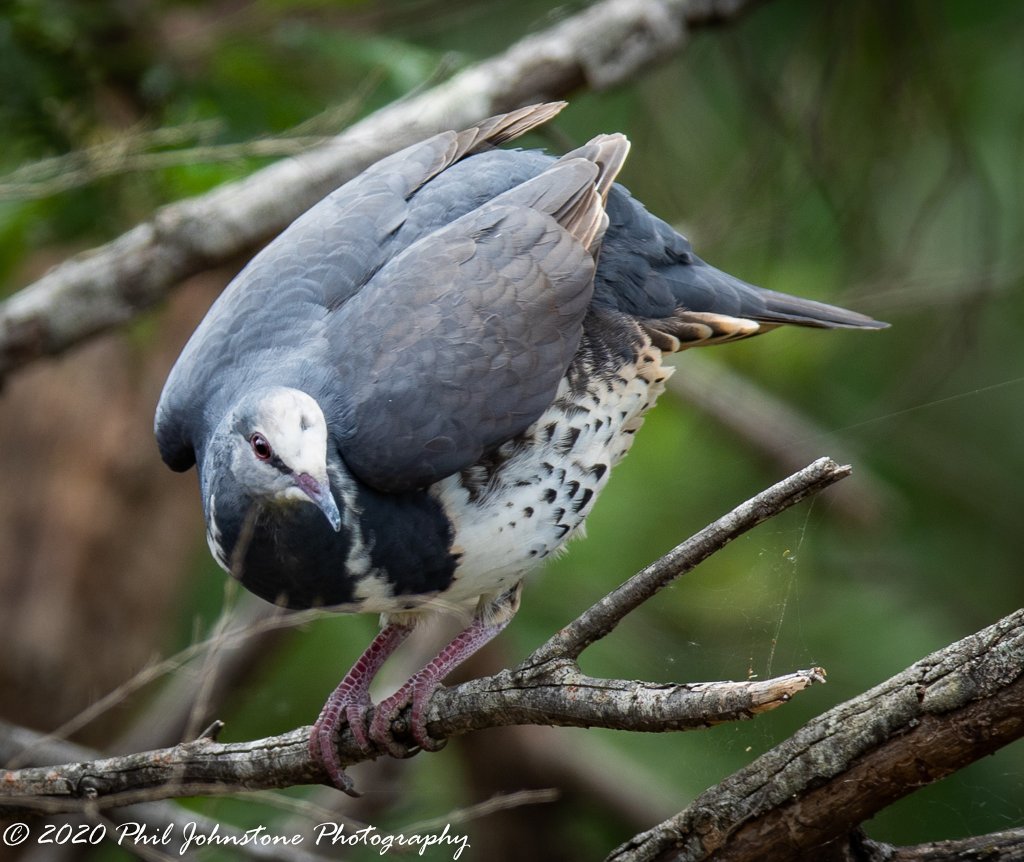
Wonga Pigeon Mallacoota by Phil Johnstone
Around Mallacoota the grassy edges in Mortimers Paddock Bushland, along Mortimer Street, are really good for seeing them in the morning. Also the edges of the bush at the lakeside caravan park.
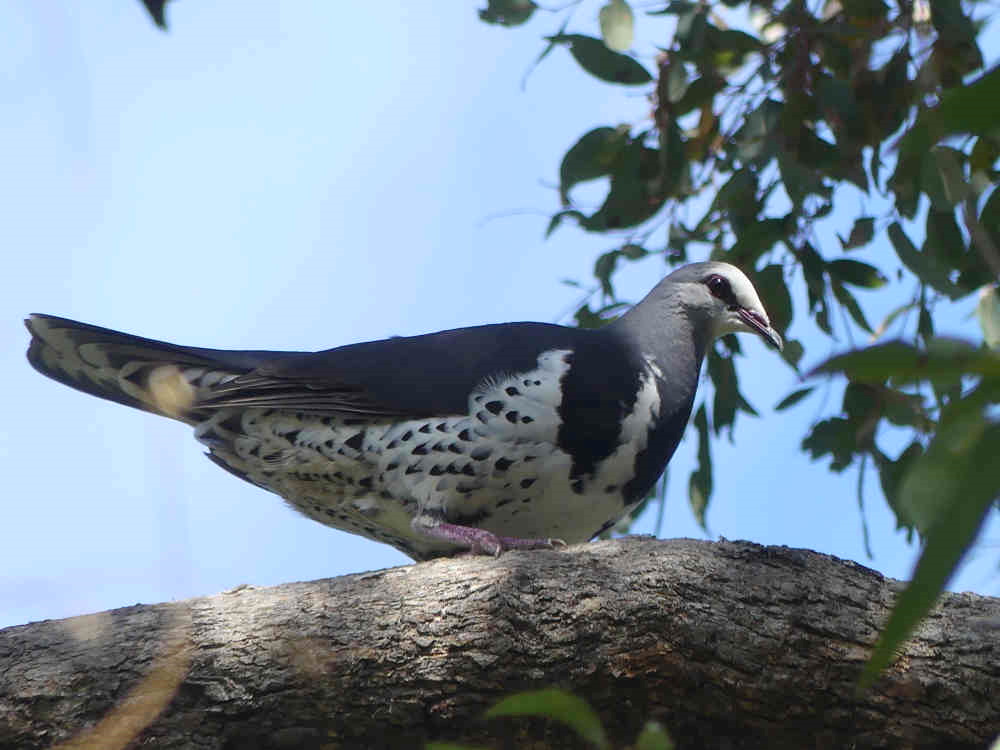
Wonga Pigeon Mallacoota by Martin Butterfield
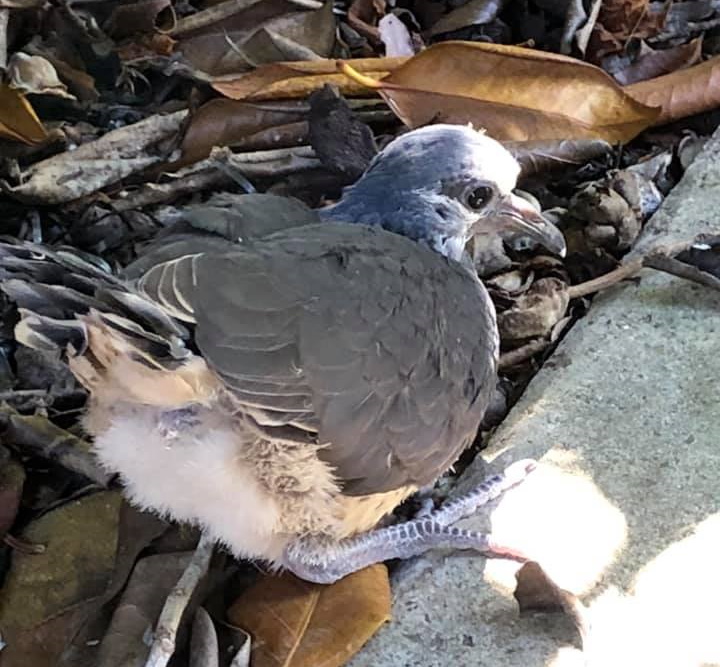
Just recently, this group helped a baby Wonga Pigeon. Member Denise Anderson found a juvenile in her garden, and asked for advice. Group members all came to the rescue, with local wildlife carer Sue Johns providing support.
Denise Anderson: “I am somewhat concerned this little bird has been in my garden in this position all day; unafraid of me, advice please”
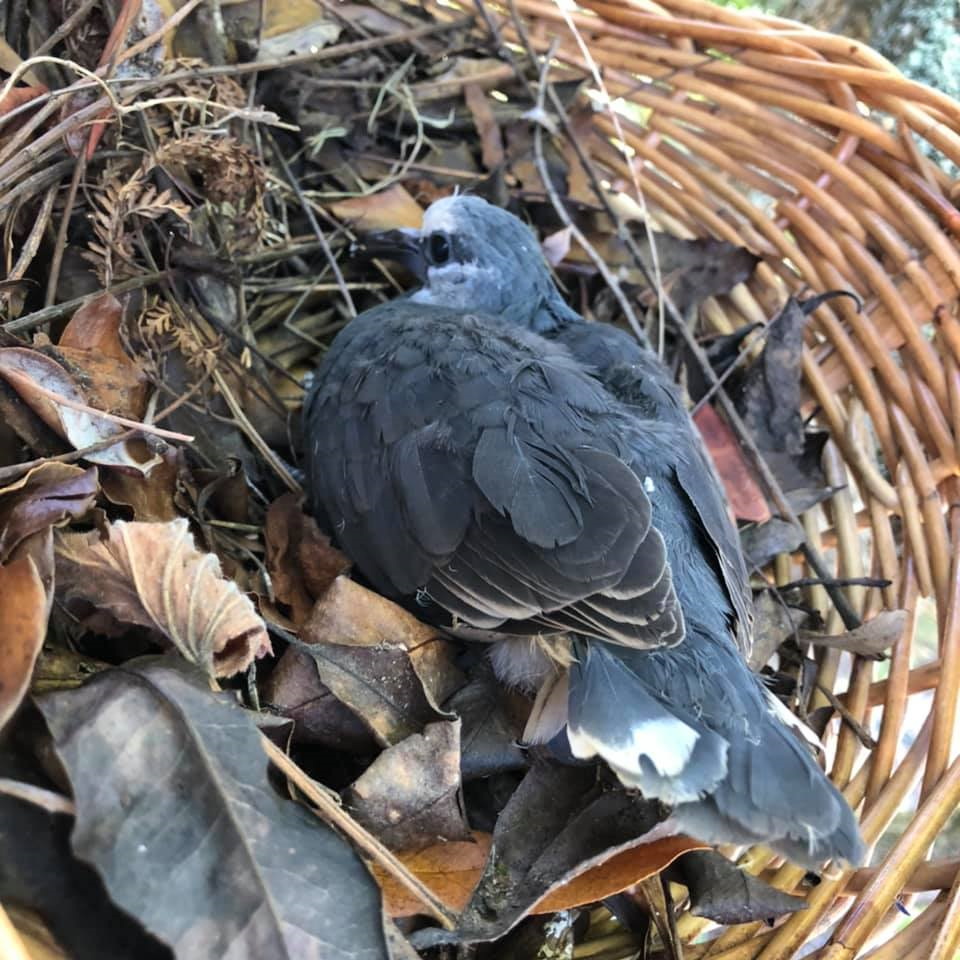
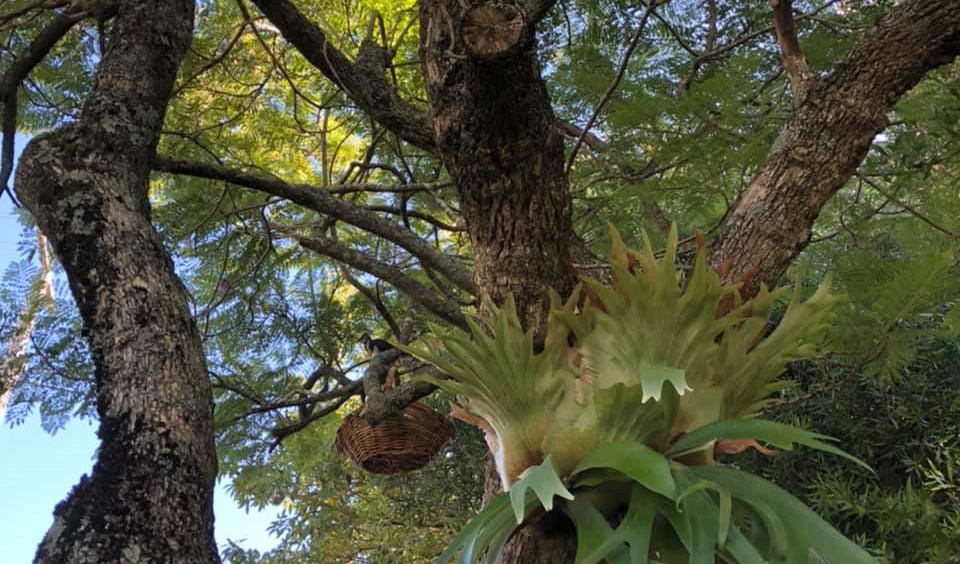
Sue Johns: It’s probably failed its first flight test. If possible get a container and nail it up as high as you can (use a ladder if possible) to the tree nearest the bird. Fill the contained with leaf matter etc and place the baby in it and leave and watch from a far distance to see if the parent birds are around. It may take a while.
Denise Anderson: Update on baby Wonga Have secured nest as high in tree as possible. Baby seems happy in new location. Have observed mature bird both in tree and on ground. Further update: 8:40 pm went quietly to check Baby Wonga, nest vacant no ‘parents’ in sight. Checked the garden thoroughly nothing untoward….hopefully second flight test was successful!! I can sleep easy. Thanks everyone for advice and encouragement.
Wonga Pigeon juvenile Mallacoota by Denise AndersonWonga Pigeon juvenile in temporary nest, Mallacoota by Denise AndersonWonga Pigeon juvenile in temporary nest in tree, Mallacoota by Denise Anderson
They have an interesting behaviour. When flushed, they will fly up to a branch, raise their tail and look back at you. Then you will see their beautifully-marked undertail – it is white, with black arrowheads. I’ve heard it suggested that it provides them with camouflage – the raised tail looks a bit like a dead branch stump.
Wonga Pigeon East Gippsland showing undertail markings, by Martin Maderthaner Echidna Walkabout
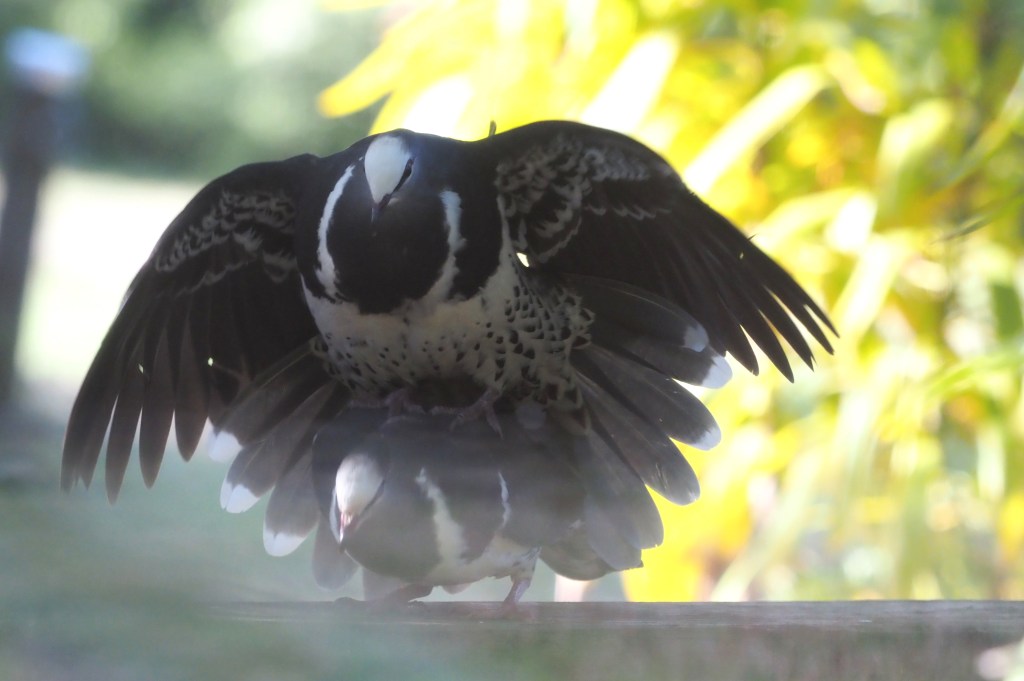
Member Michael Barnett caught this amazing moment of two Wonga Pigeons mating, through the window! On the video (on facebook) you can hear the TV doing the stock report, hahaha, but the Wongas were more entertaining!
Wonga Pigeons mating, Mallacoota by Michael Barnett
Bird of the Week: Superb Fairy-wren 8 January 2021
The much-loved and famous “Blue Wren” of south-eastern Australia. This is a bird that almost everyone knows or has some experience with. Overseas visitors are often fascinated by them – especially the bright blue males.
Superb Fairy-wren adult male, Mallacoota by Martin & Mariska AscherAdult male Superb Fairy-wren, about to develop breeding plumage, East Gippsland by John Hutchison
There are other blue birds in the world, but there’s something about fairy-wrens that is simply delightful. The jaunty cocked tail, the confident way they hop around – even in backyards and around picnic tables – the handsome colour palette of black and sky blue that seems to glow, make this bird an A-list star.
In East Gippsland they are so successful and numerous you can see them every day. But most of the Superb Fairy-wrens you see anywhere will be ‘brown’ birds: females, juveniles & non-breeding males. They are less obvious though, and easily overlooked.
Superb Fairy-wren female or juvenile Deddick by Jenny Lawrence, Gippsland High Country Tours
Adult breeding males have the well-known blue and black plumage. The dominant male of the group may keep this plumage all year round. It’s been my experience that you can always find a full blue Superb Fairy-wren in East Gippsland quite easily – maybe it’s because there are so many around. Other types of fairy-wrens seem to lose their blue colouring in winter more. Has anyone else noticed this?
Younger males change into blue plumage only in breeding season, which is why you see more ‘males’ in Spring & Summer. If you see a brown bird with a few blue feathers around the head, it is a young male changing into his breeding plumage.
Adult male transitioning into breeding plumage Superb Fairy-wren, East Gippsland by John HutchisonSuperb Fairy-wren – adult male developing blue breeding plumage, Mallacoota by Michael Barnett
Females are brown, with an orange-brown bill & lores*/eye-patch and a dull blue tail.
lores: the area between the bill and eye on a bird
Juvenile or female Superb Fairy-wren. Note the orange-brown bill & lores/eye-patch. Mallacoota by Caroline JonesSuperb Fairy-wren, possibly female based on blue tinge to tail, East Gippsland by Rob Clay
Juvenile birds look like females but have a brown tail.
Adult males outside of the breeding season always have a black bill and dark blue tail. They don’t have the orange-brown lores that females and juveniles have.
Non-breeding adult male Superb Fairy-wren, showing black bill and dark blue tail, East Gippsland by Rob Clay
There are six subspecies of Superb Fairy-wren that differ mostly in size. The 3 subspecies of Tas, Flinders & King Island have darker blue breeding males than the mainland subspecies.
There is possibly another species of fairywren that could come to Mallacoota: the Variegated Fairy-wren – see pics here: https://ebird.org/species/varfai5. They have been seen as close as Merimbula and Ben Boyd NP. So if you ever see a blue wren with no black line through his eye, and an orange “back” (actually the upper parts of his wings) take a pic and post on Mallacoota Birds please! Females have a dark mark in front of their eyes (lores) that is much darker than their orange bill.
Being bright and gorgeous gives males an advantage in their attractiveness to females, and thus breeding success, but it also comes at a cost. Bright blue males are more at risk from predators. An interesting study found that blue males are more likely to hide when danger is near, and take longer to re-emerge after danger has past.
Location: South-eastern Australia from central Queensland through coastal NSW, all of Vic & Tas to south-east SA. Our subspecies most of Vic except the far west, NSW & QLD. Other subspecies: cyaneus in Tas, leggei in SA, ashbyi in Kangaroo Island, samueli in Flinders Island & elizabethae on King Island.



 Mallacoota Birds