Have you ever wondered where all the dinosaurs went? Well I have good news: they are still among us, they just grew feathers.
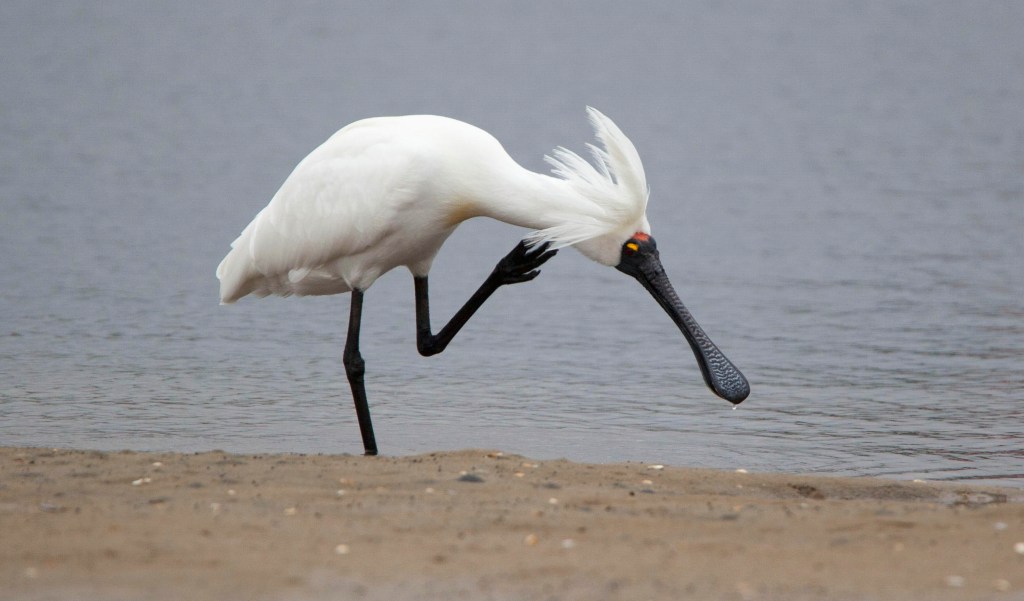
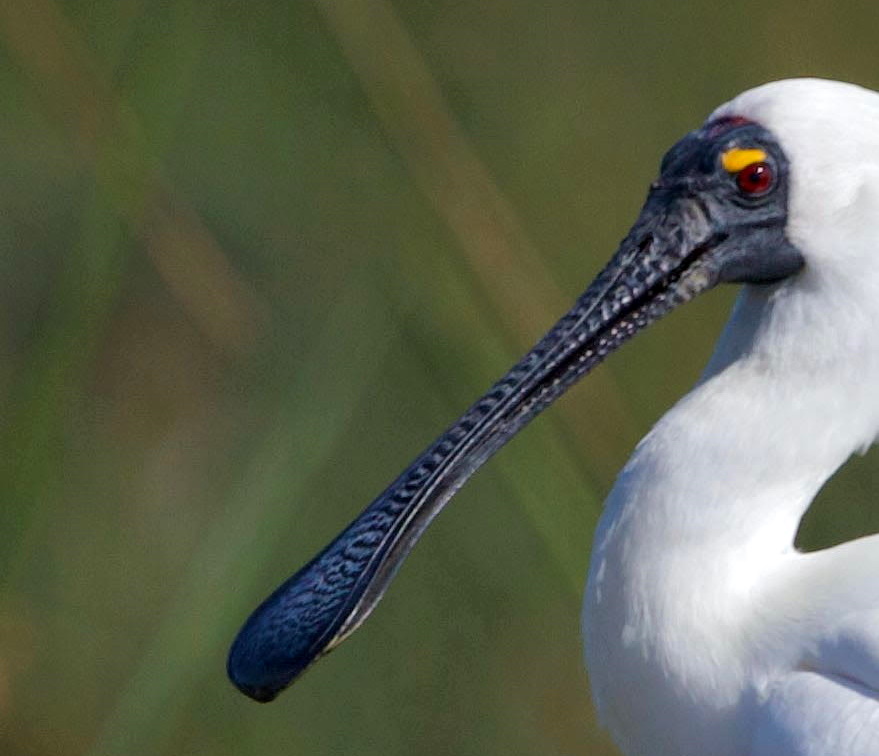
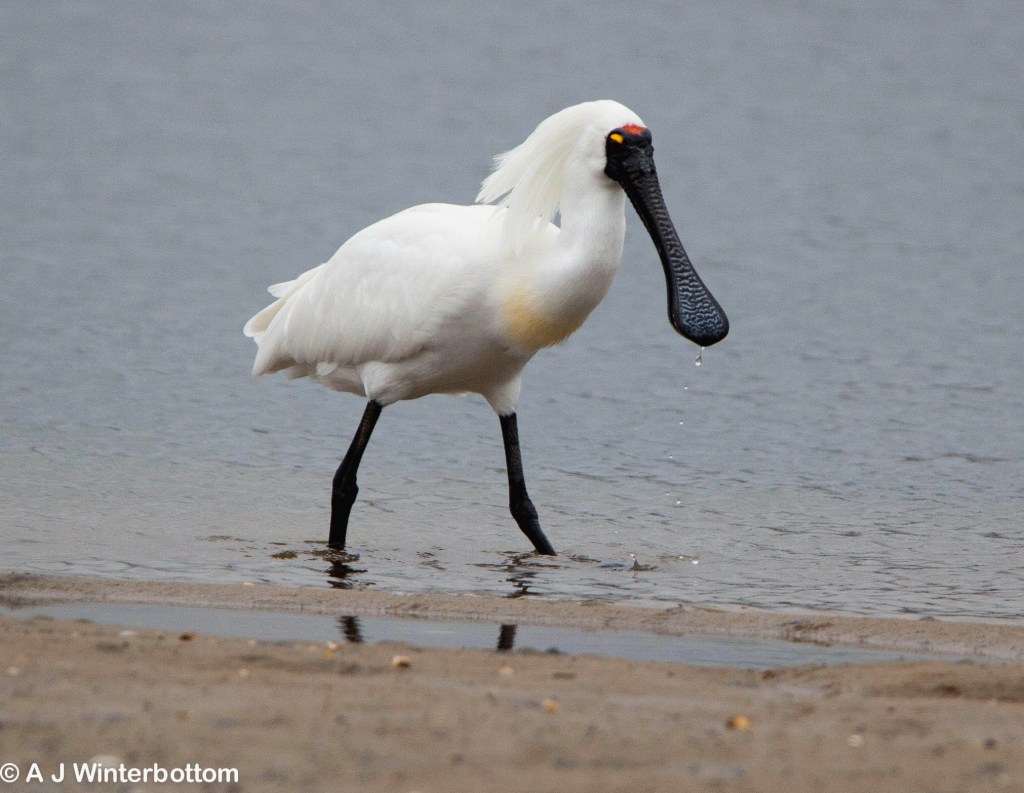
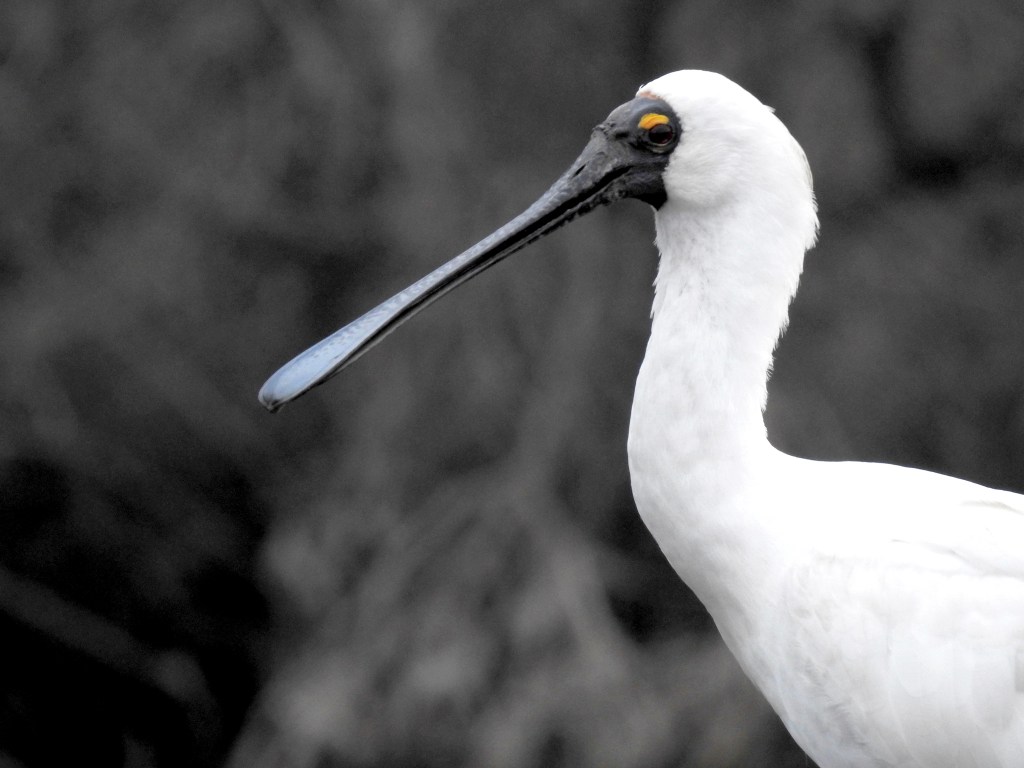
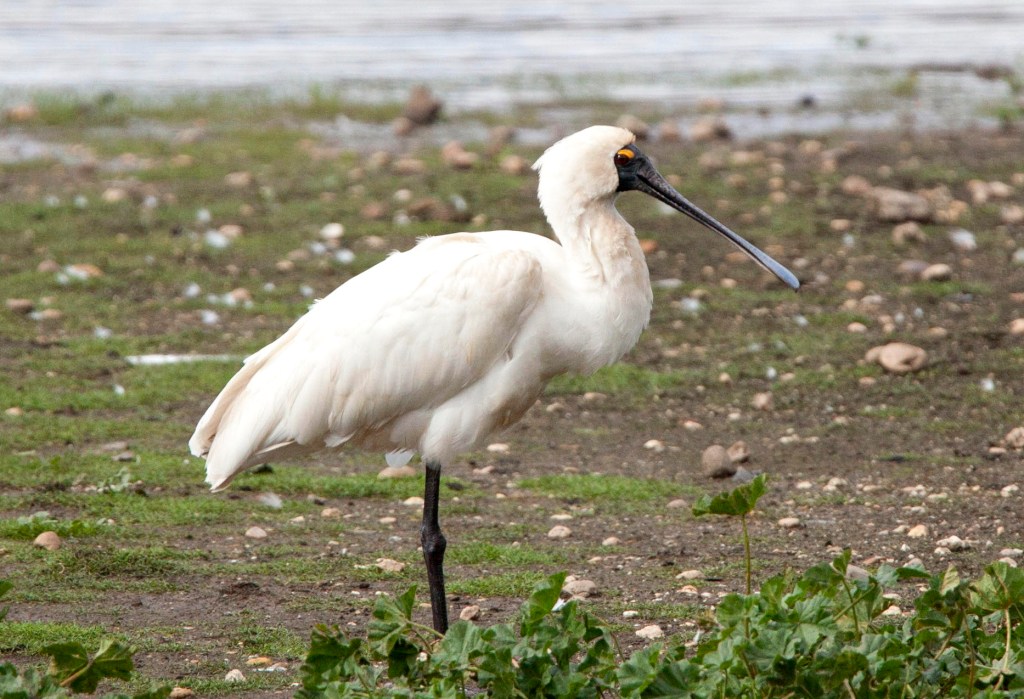
breeding adult Royal Spoonbill showing red crown and plumes, East Gippsland by Jack WinterbottomRoyal Spoonbill head and bill closeup, Macleods Morass, by John Hutchison
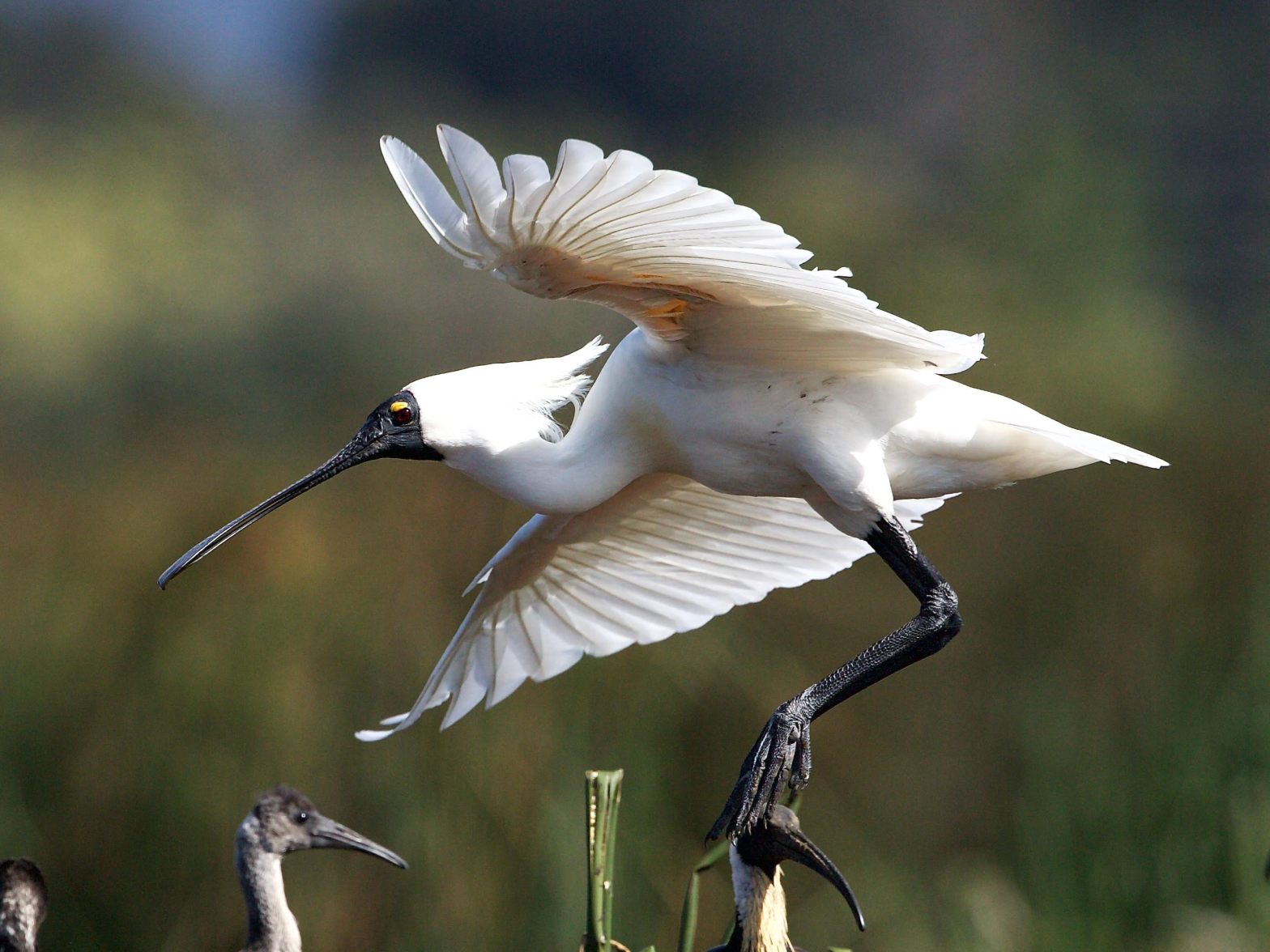
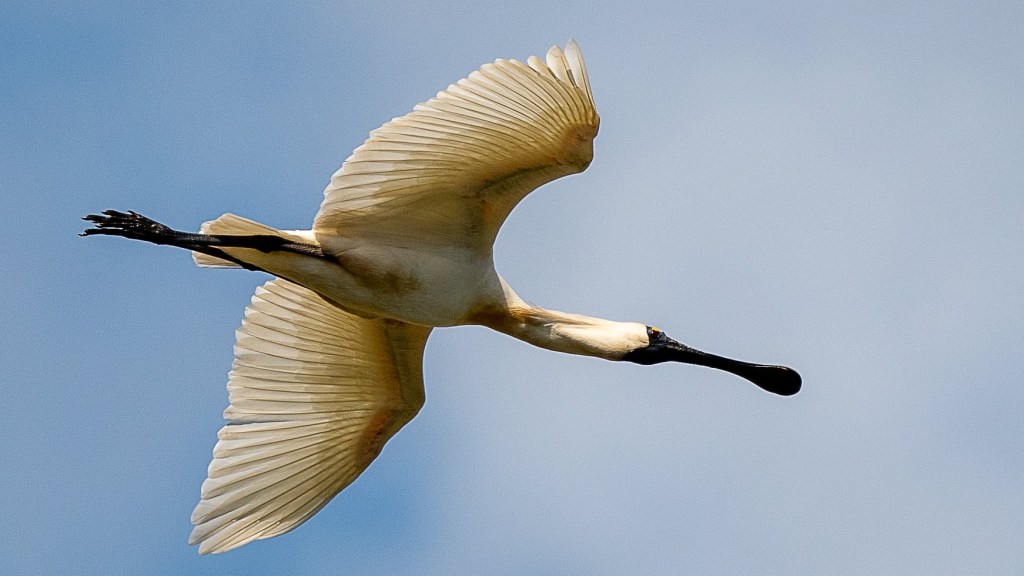
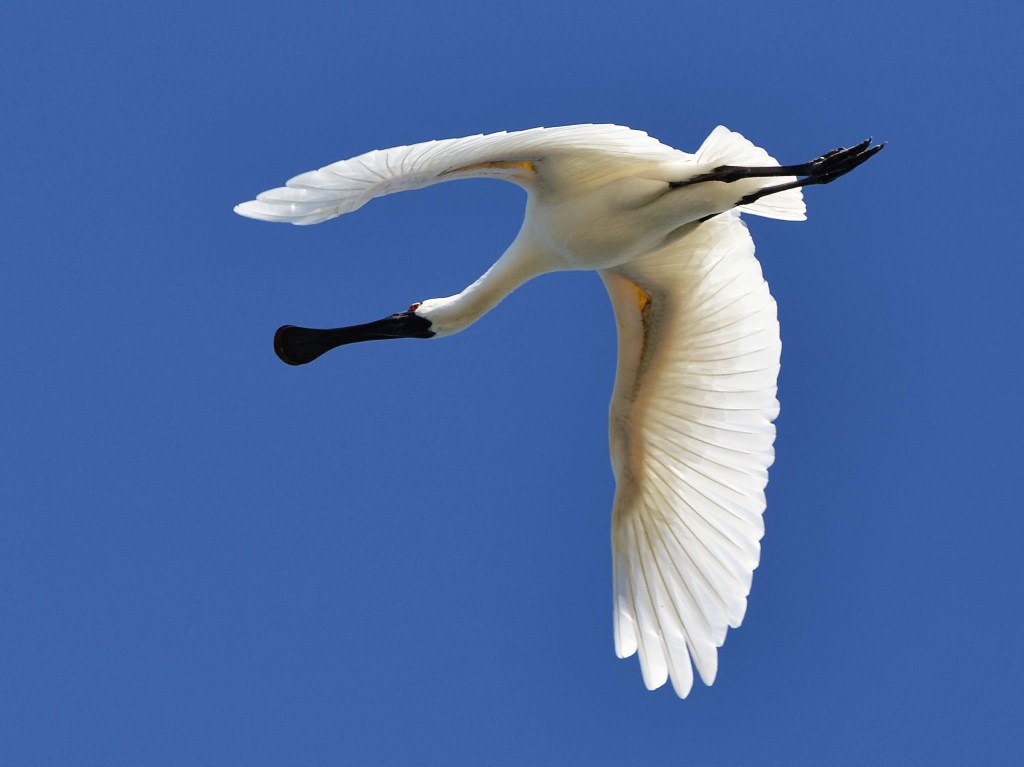
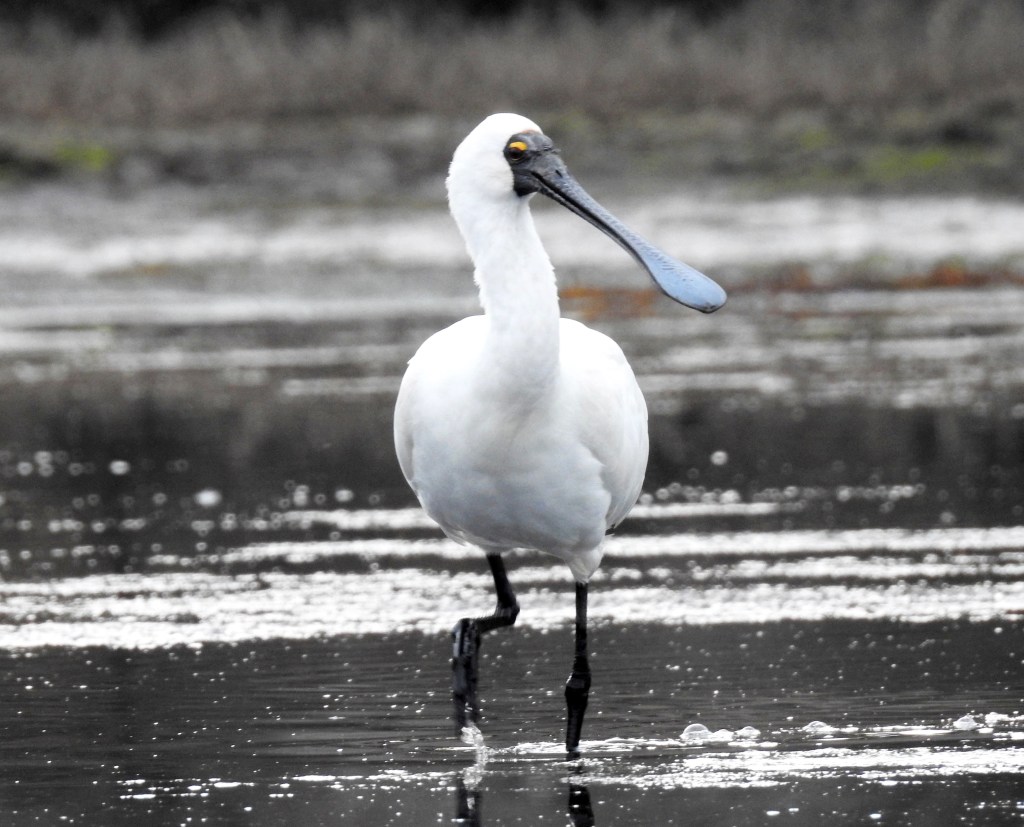
This marvel of nature, this magical being: the Royal Spoonbill – is so clearly a flying dinosaur. They have a ridiculous long bill made of black steel chequer-plate, crazy blood-red eyes, sunflower yellow eyeshadow and a crest like a Frilled Lizard.
Yet their immaculate white feather plumage is 100% modern bird.
Royal Spoonbill East Gippsland by Jack Winterbottom
When they fly their black-metal legs hang out the back, and that anachronistic bill sticks out the front, like the dinosaur inside is trying to show itself.
Royal Spoonbill flying East Gippsland, by Rob ClayRoyal Spoonbill flying, Mallacoota by John Hutchison
Adults have the yellow eyeshadow all year round. When they are breeding they develop long white plumes on the back of their heads, a red patch on their crown and a golden wash over their chests.
Juveniles have no yellow eyeshadow, shorter bills, and black tips to their primary (outer wing) feathers. Immature/sub-adult birds have all white plumage like adults, but lack the yellow eyeshadow.
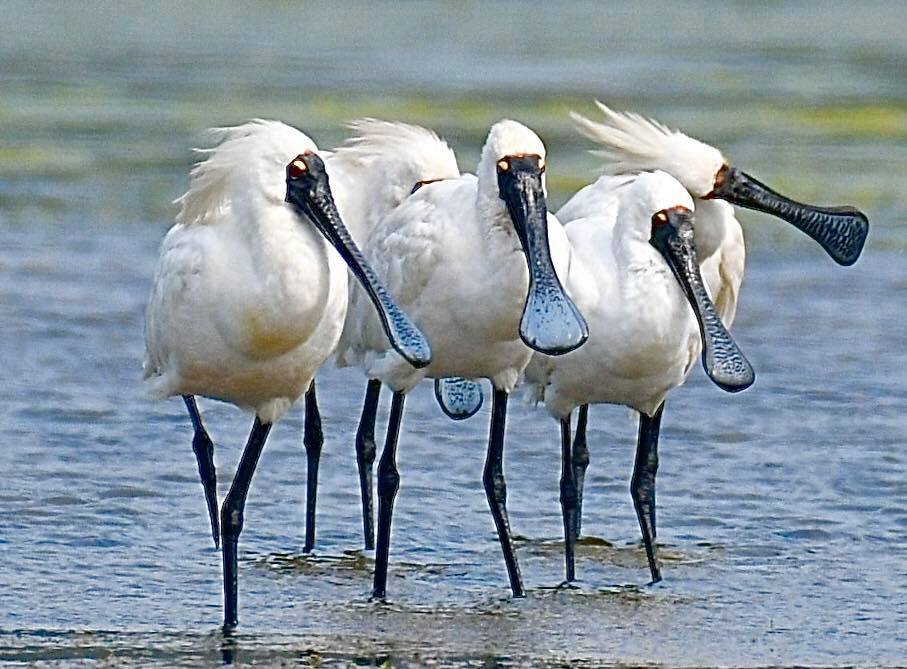
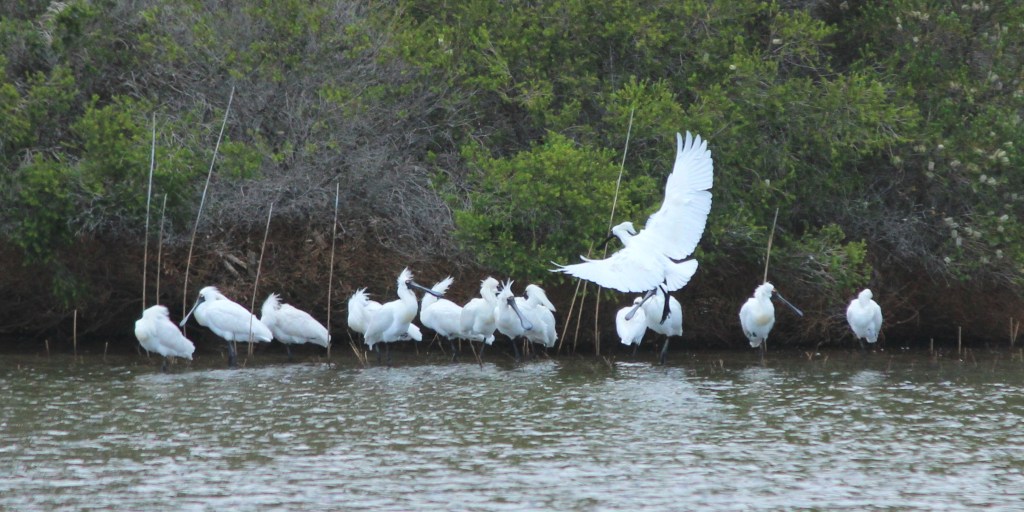
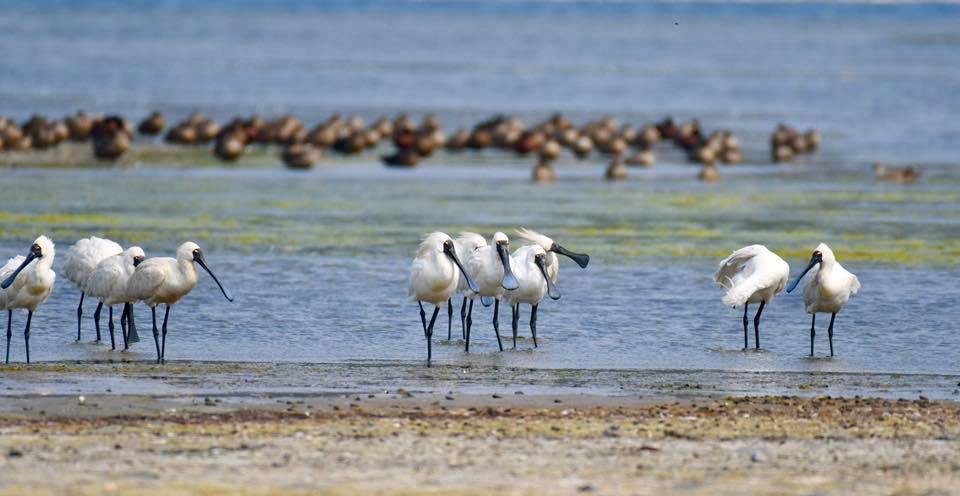
non-breeding adult Royal Spoonbill Mallacoota by Caroline JonesRoyal Spoonbills, East Gippsland, by Rob Clay
They seem to be present in Mallacoota all year round. If you don’t see them on the main bottom lake or at Coull’s Inlet, have a peek at the well-hidden lagoon at the south end of Broome Street. They seem to roost there a lot.
Bird of the Week: Black-faced Monarch 25 December 2020
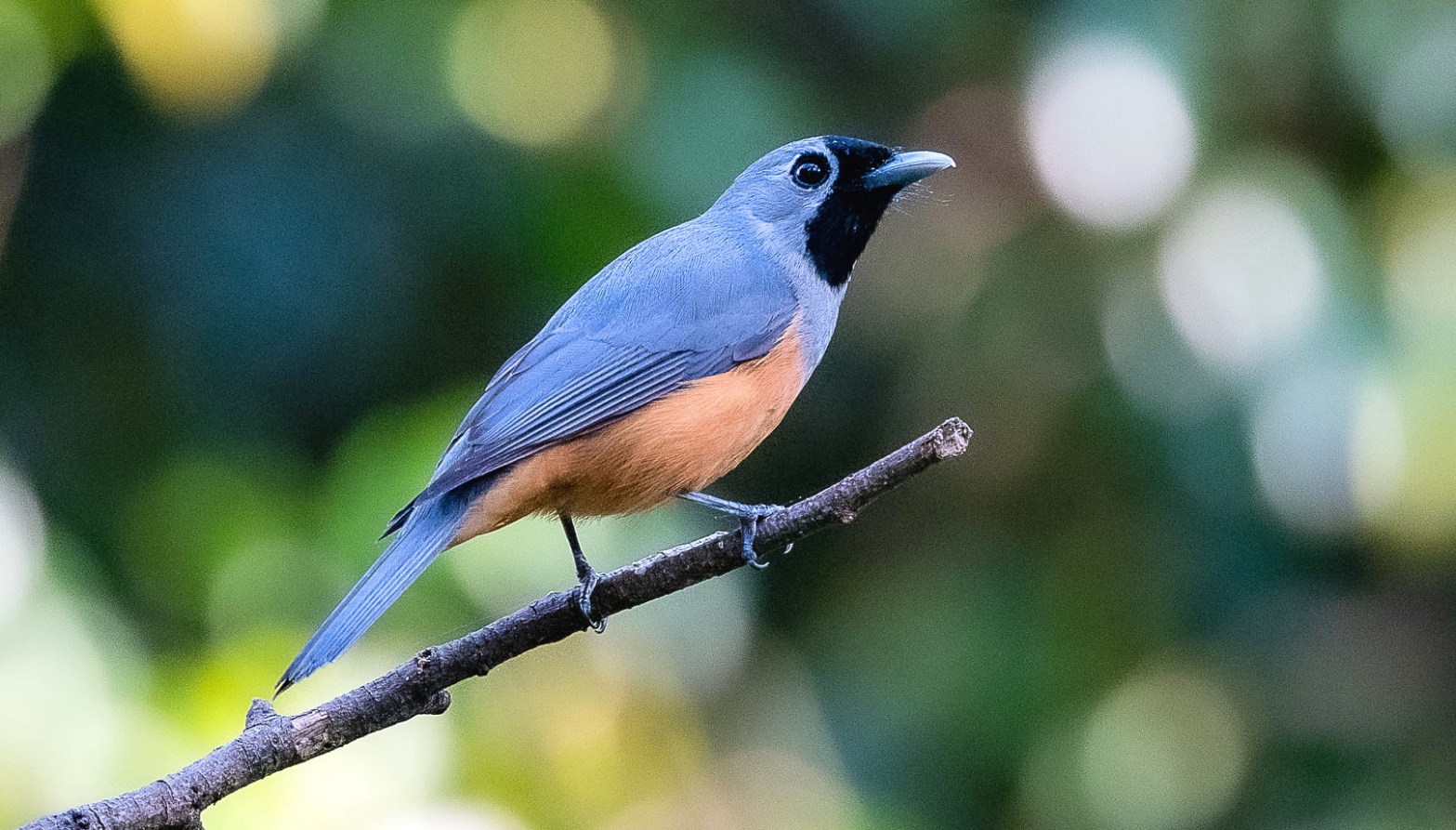
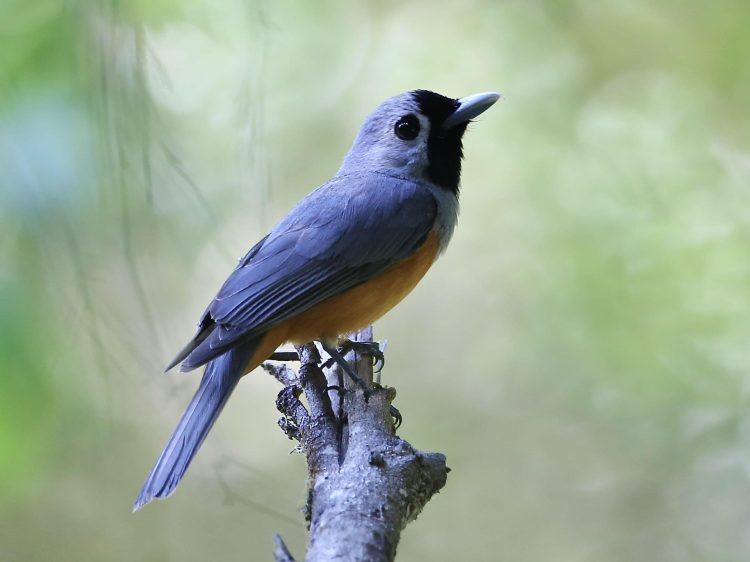
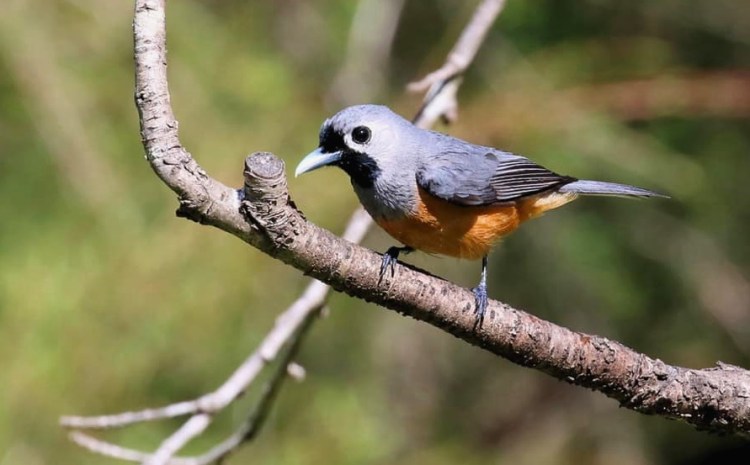
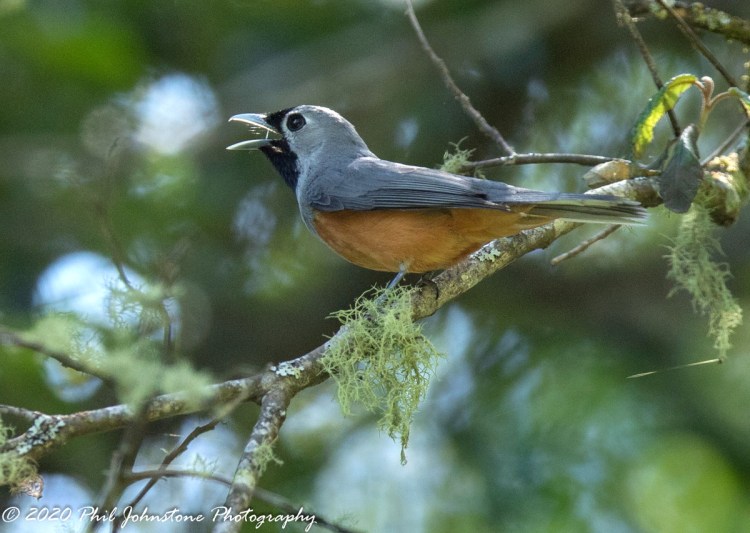
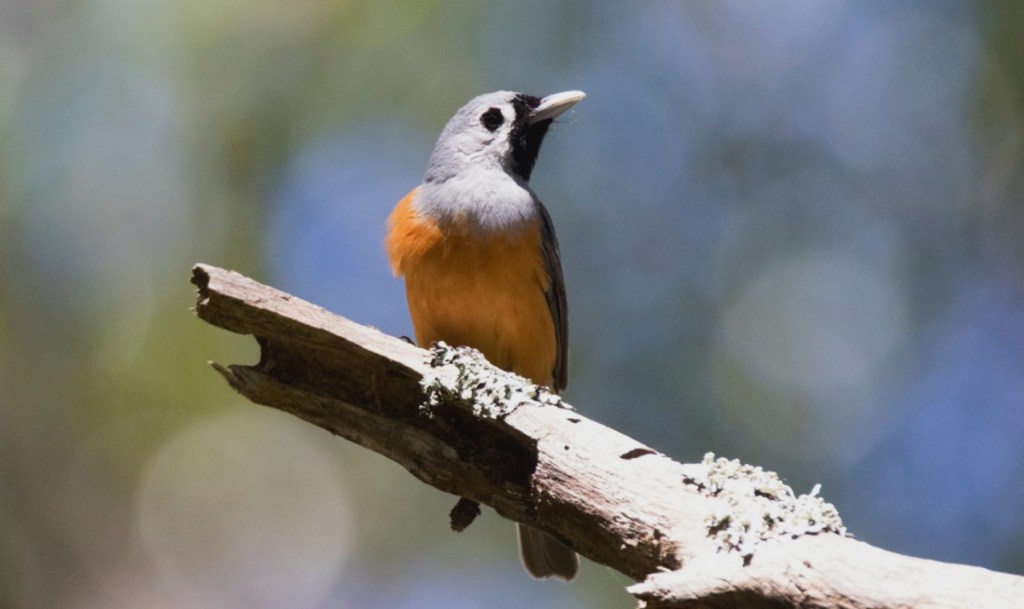
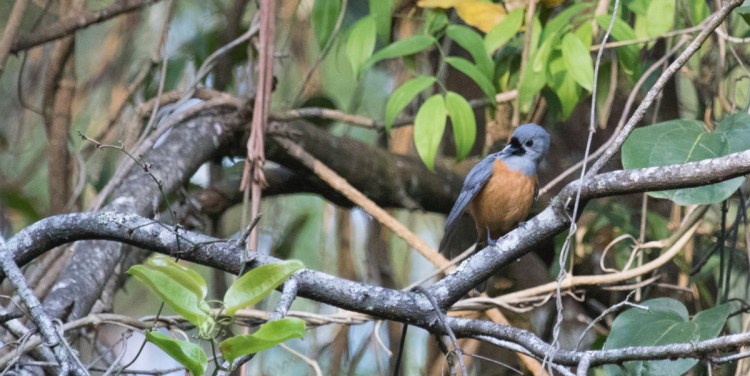
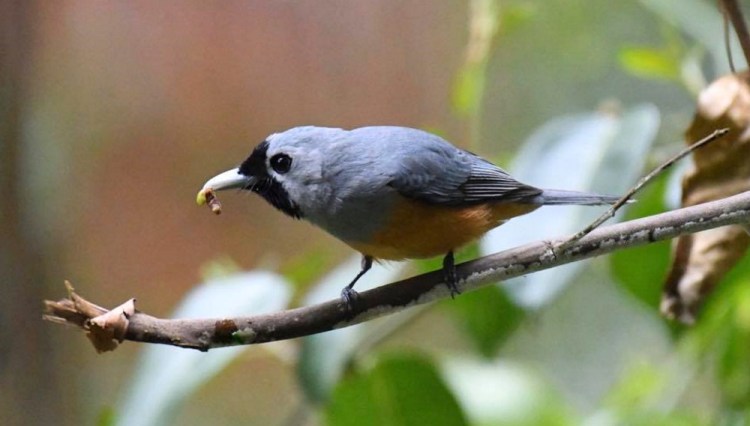
They fly down from the tropics every year to feed and breed in East Gippsland’s bountiful, insect-filled rainforests. They have something exotic and very cute about them – perhaps it’s that strange squeezy toy call, or maybe it’s their brilliant mango-coloured belly??? Or maybe it’s that perpetually-surprised look (enhanced by black feathers surrounding their black eye), like they are saying “Ow, ow, ee-ow … it’s cold down here!”
Black-faced Monarch, Fairy Dell, East Gippsland by John HutchisonBlack-faced Monarch, Lakes Entrance by Goldsmiths In The Forest
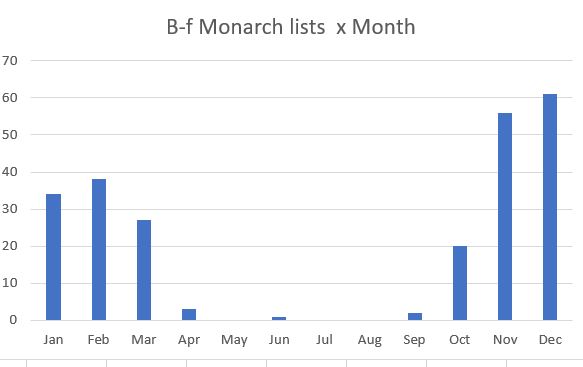
Martin Butterfield has put together some graphs to show sightings of Black-faced Monarchs in Mallacoota. They are most often sighted in November & December, but can be seen from September to April.
Sightings of Black-faced Monarch in Mallacoota VIC by month, from eBird
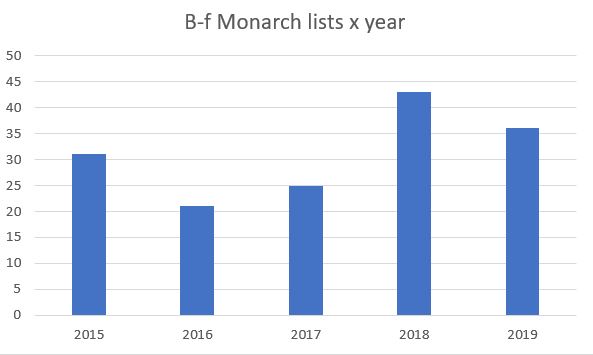
There seems to be some variability over the years too – they were sighted a lot more in 2015 & 2018 than in 2016 & 2017, and though sightings were low in early 2020 – presumably due to fires and lack of observers – he expects there to be a lot of sightings for 2021 as they are being reported everywhere at the moment.
Sightings of Black-faced Monarch in Mallacoota VIC by year, from eBirdBlack-faced Monarch Mallacoota by Phil & Kath Johnstone
They are a Monarch Flycatcher (Monarchidae) – a group of birds that includes our Magpie-lark, Australasian Myiagra flycatchers like the Leaden & Restless, paradise-flycatchers of Africa & Asia, crested-flycatchers of Africa, shrikebills from Melanesia & Polynesia and ‘elepaios of Hawaii.
Black-faced Monarch Cabbage Tree Palms, East Gippsland by John Alan
There are quite a lot of birds called Monarch, spread through Australia, New Guinea and Southeast Asia, but only 9 in the genus Monarcha. The rest are in closely-related genera Pomarea, Mayrornis, Neolalage, Metabolus, Symposiachrus, Carterornis, and Arses. Another group, Hypothymis – beautiful blue monarchs of Asia, are not as closely related but also called Monarch.
Black-faced Monarch amongst rainforest vines Smilax & Wombat Berry, East Gippsland by Martin Maderthaner
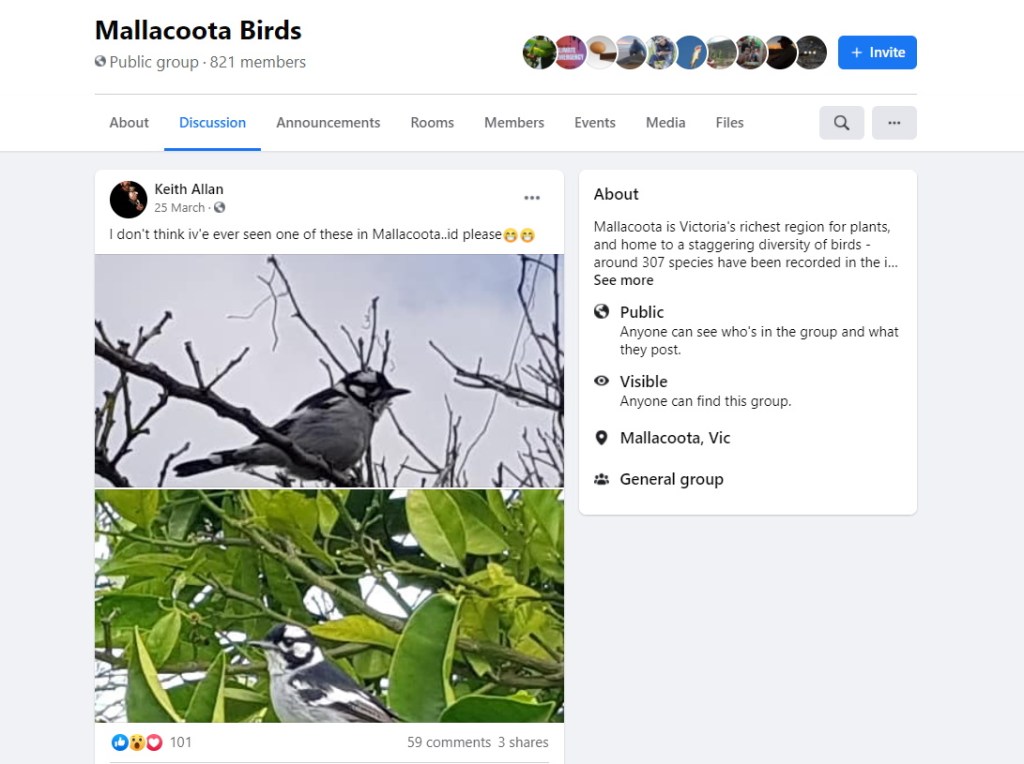
In fact another Monarch has famously visited Mallacoota: the White-eared Monarch. Keith Allan reported this NSW-QLD vagrant on 25 March 2020 to this group, with pictures! This sighting added a bird species to the list for Victoria, bringing the state up to 490 species. There has since been another added to the list, also from Mallacoota: Providence Petrel, by Rohan Clarke on 29 November 2020 which makes the eBird Vic list 491.
Keith Allan’s post to Mallacoota Birds announcing the White-eared Monarch
Tim Dolby & Dan Ashdown have pointed out that there is another record of a vagrant monarch in Mallacoota: a Spectacled Monarch, seen by Paul Peake in 2003. It was the second record of that species for the state – first seen at Point Addis in 1977.
Location: coastal eastern Australia and New Guinea. Generally only in eastern Victoria, but a few have turned up on the Great Ocean Road and in northern Victoria near Bendigo. A single bird was found dead in New Zealand – the only record in that country.
Black-faced Monarch Cabbage Tree Palms, East Gippsland by Rob Clay
Thanks to Phil & Kath Johnstone, Martin Butterfield, John Alan, John Hutchison, Rob Clay, Darilyn & Les Goldsmith, Gregory Storer & Michael Barnett, Martin Maderthaner, Tim Dolby & Dan Ashdown for your beautiful pics and info.
Bird of the Week: Australian King-Parrot 18 December 2020
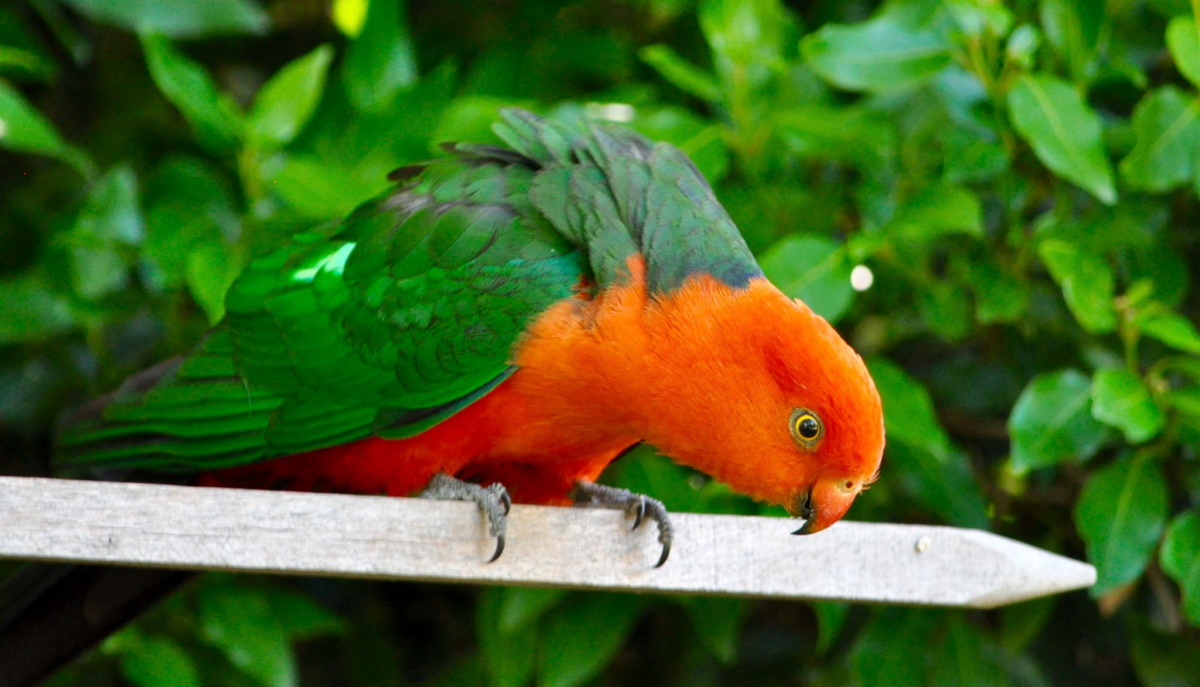
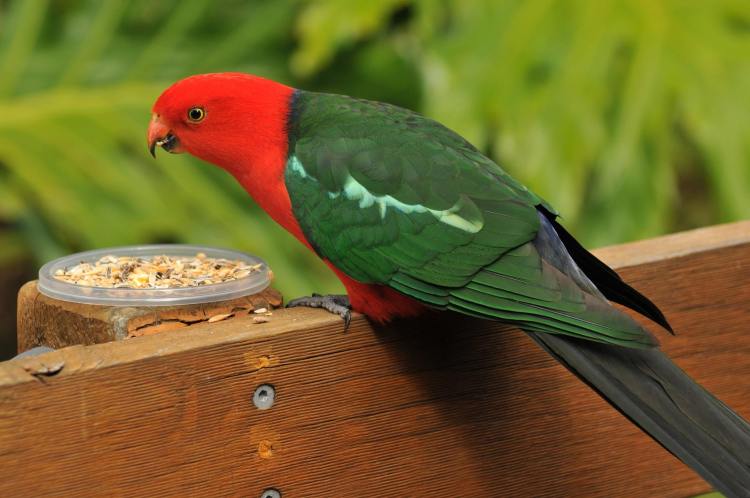
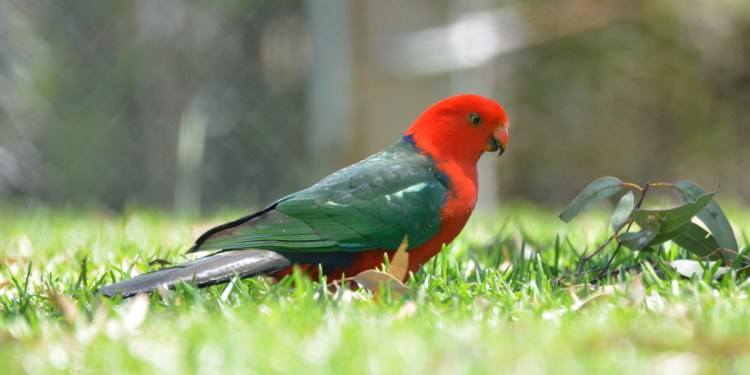
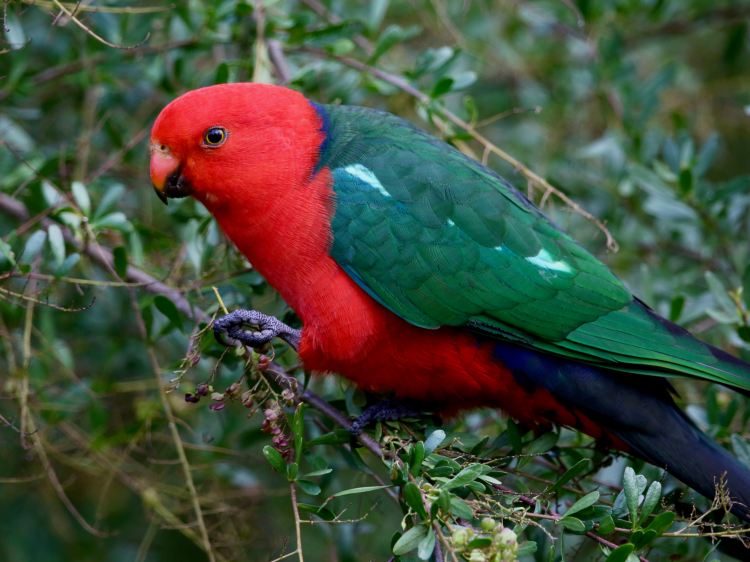
What is it about these birds that makes everyone love them? Is it their colour? That glowing velvet red, and emerald green!
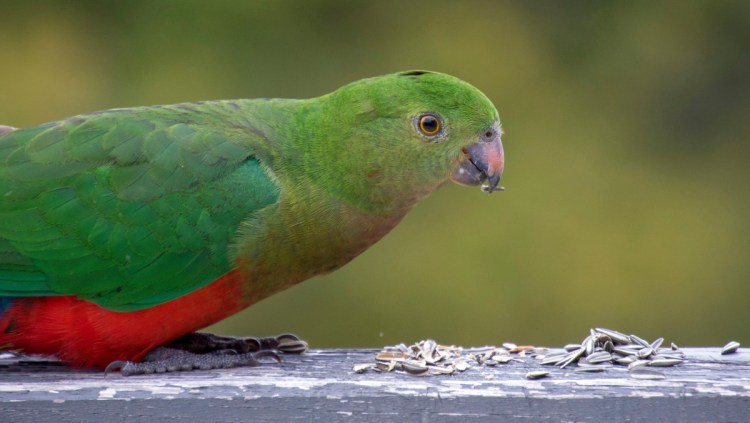
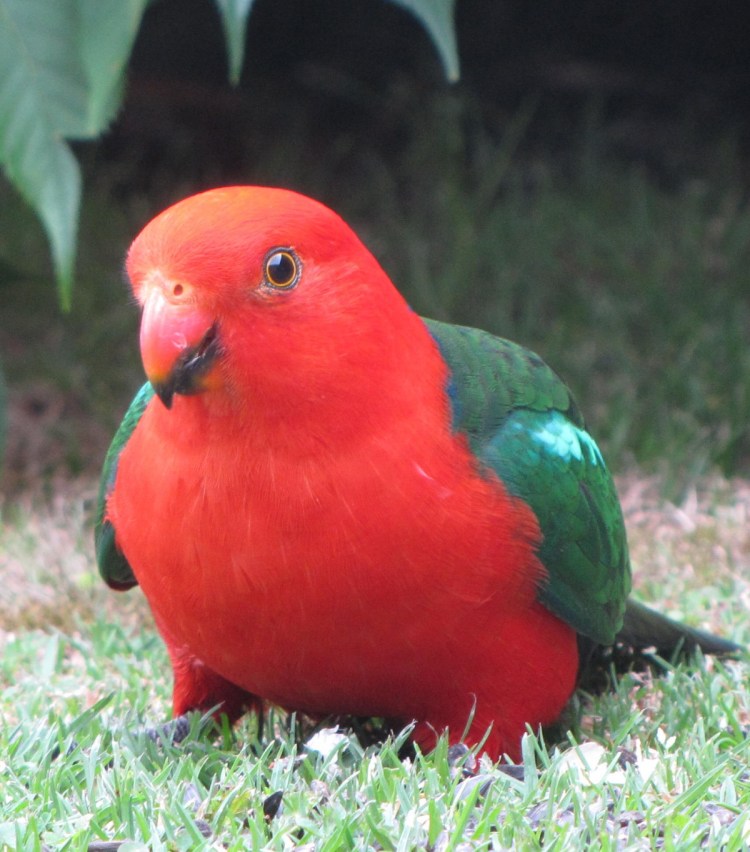
Adult male Australian King-Parrot at Mallacoota by Michael Barnett
Or is it their gentle behaviour? Compared to most parrots they seem elegant, classy, willing to wait their turn.
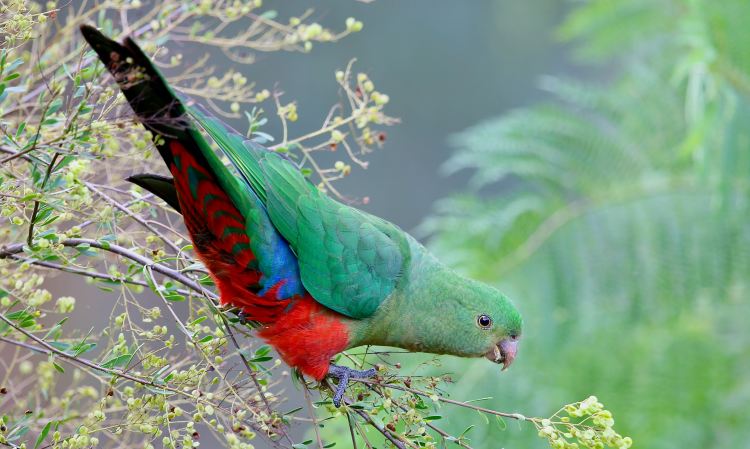
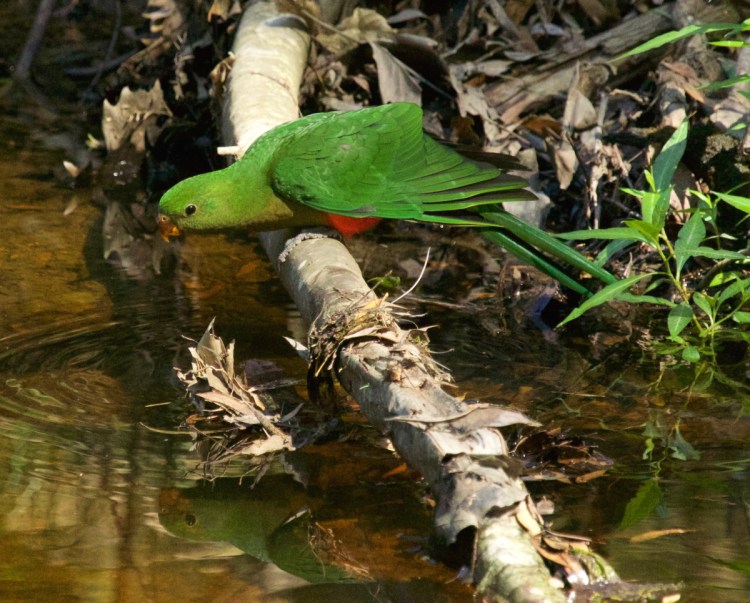
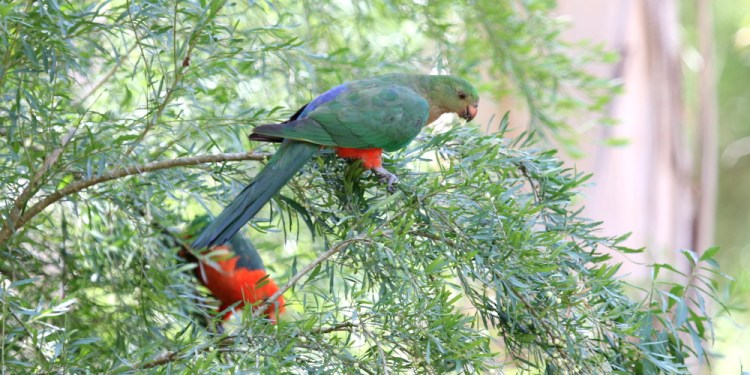
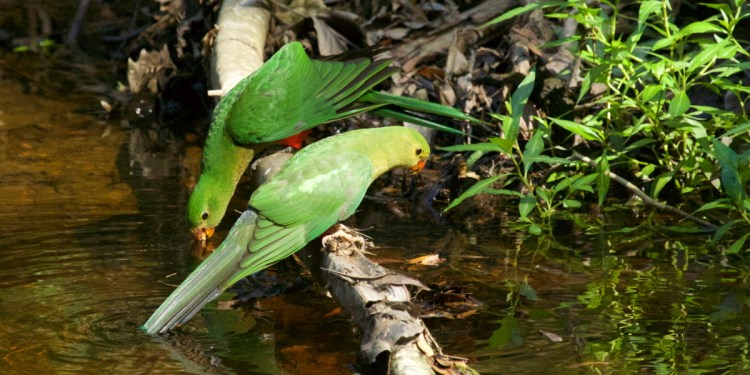
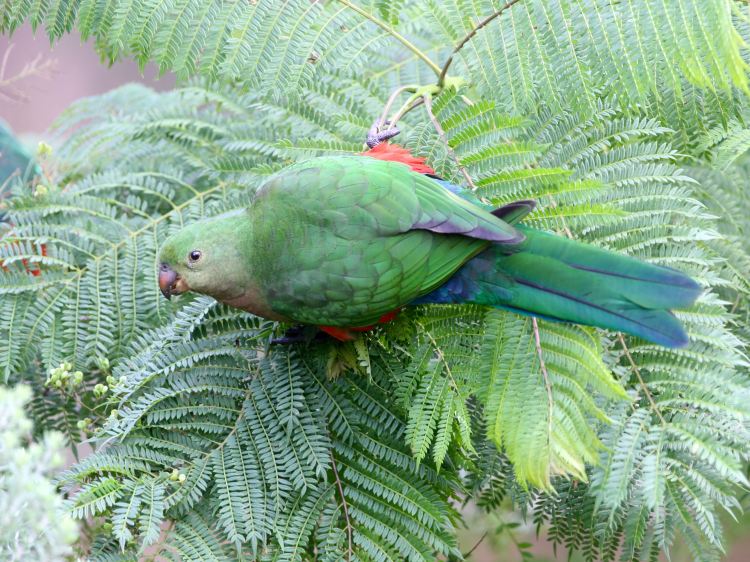
Adult female Australian King-Parrot East Gippsland by John Hutchison Juvenile Australian King-Parrot Buchan East Gippsland by Martin Maderthaner young female Australian King-Parrot Mallacoota by Caroline Jones
Martin Butterfield tells: “When we lived in Canberra we had a bird table outside Frances’ study window. King Parrots were frequent visitors and if she played a rhythmic tune on her tin whistle a King-Parrot would bob its head in time with the music.”
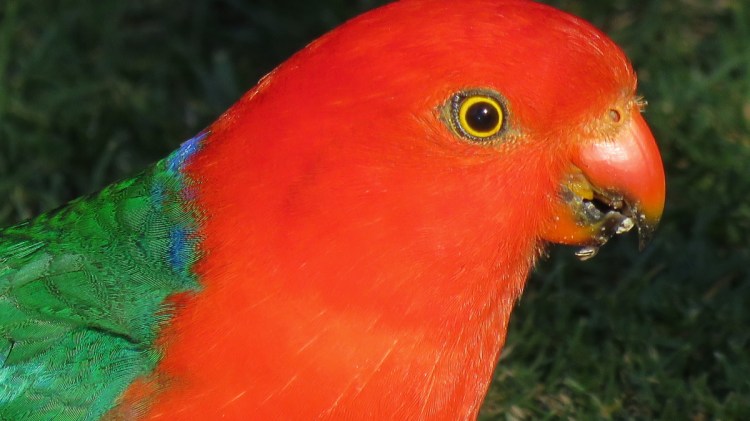
Adult male King-Parrot showing yellow iris, red bill Orbost, VIC by Janine DuffyAdult male Australian King-Parrot showing red bill, yellow iris and thin blue half-collar. East Gippsland by Brett Howell
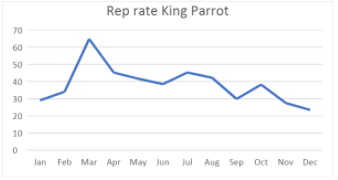
Reporting rate fairly even through year. Perhaps lower in spring-summer as they hide away for breeding and then the young birds come out in March – or possibly more groups of birders come and share lists in March?
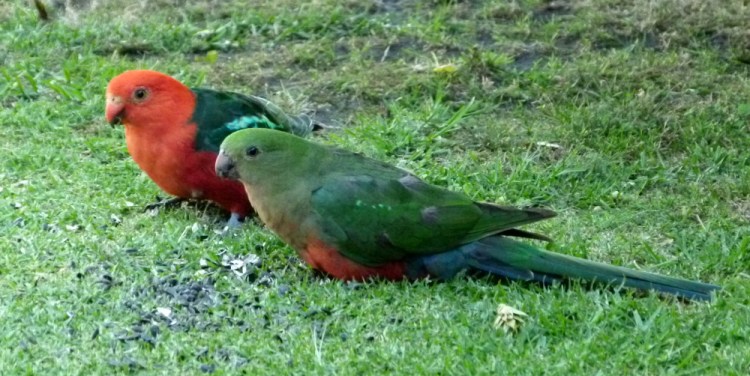
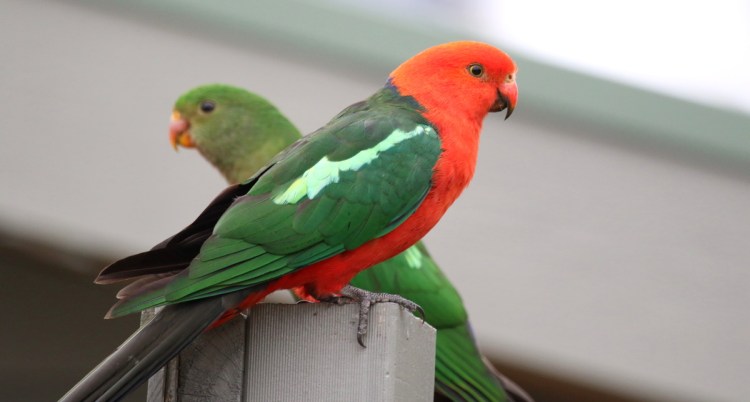
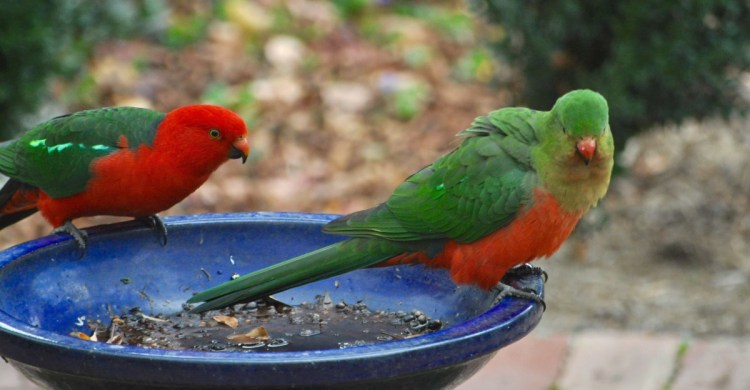
Young adult female Australian King-Parrot still showing pale orange bill, and blue rump that both sexes have. East Gippsland by Martin MaderthanerAdult female (front) & male King Parrots by Martin Maderthaner. Note the reduced shoulder stripe on the female, and dark bill.
Identifying the adult male is easy – he’s the showy fellow with all red head and breast. But picking adult females from juveniles is much more tricky.
Points to look for are: Bill colour: dark in adult female, pale apricot-orange in juveniles Eye (iris) colour: pale yellow in adult female, dark in juvenile Face colour: deep rich green in adult female, green tinged olive in juvenile
Juvenile Australian King-Parrots Buchan East Gippsland by Martin Maderthaner, Echidna Walkabout
Then there’s the great dilemma of the ‘shoulder stripe’: that glowing turquoise band across the folded wing. Males are supposed to have the strongest, most obvious shoulder stripe, females have a smaller version, and juveniles barely have it at all. But I’ve seen full adult males with a reduced stripe, adult females with a huge one and everything in between. Possibly it becomes stronger with age? Or could the feathers simply cover it at times?
Adult male Australian King-Parrot with barely visible shoulder stripe, Raymond Island by Mark AldermanAdult male King-Parrot with prominent shoulder stripe, red bill and pale iris. Young female behind. East Gippsland, by Martin Maderthaner
Bird of the Week: Nankeen Night-Heron 11 December 2020
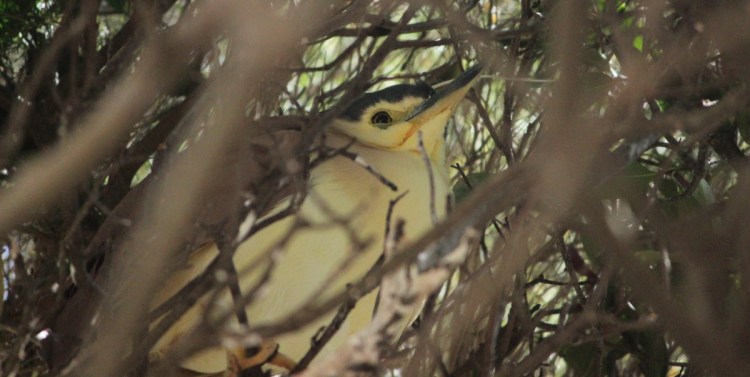
You can live near a Nankeen Night-Heron for years and never notice it.
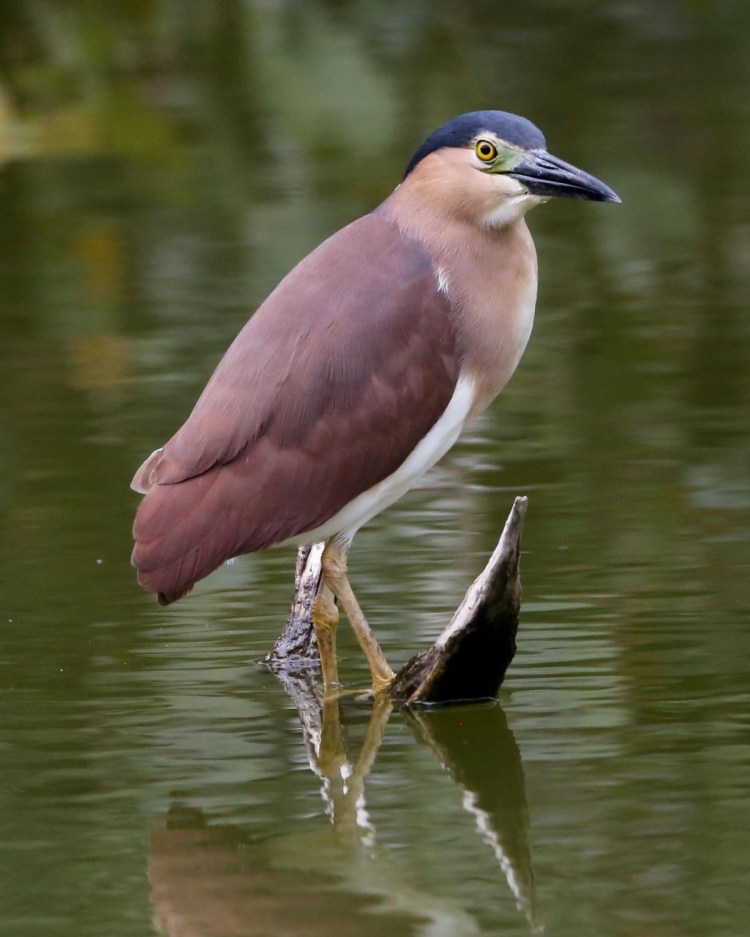
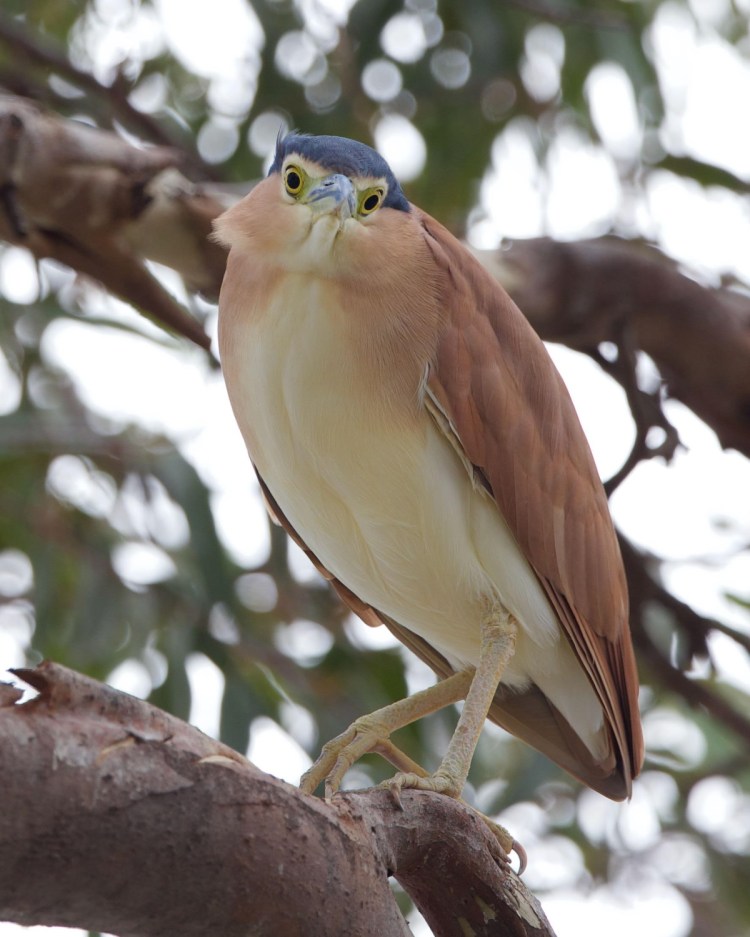
Adult Nankeen Night-Heron East Gippsland by John Hutchison
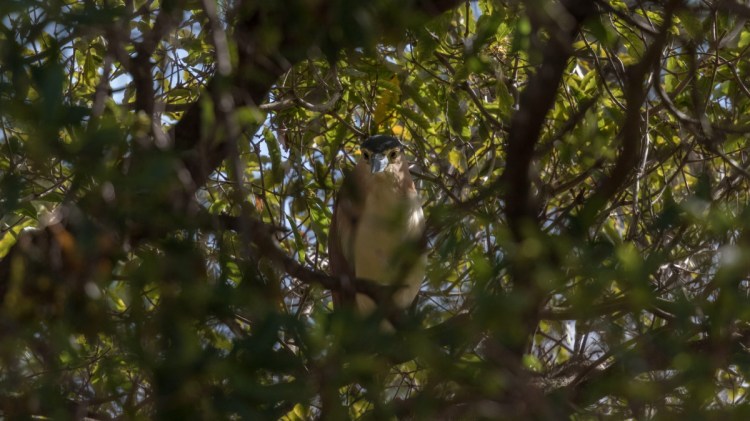
During the day they hide in thick vegetation, staying very still. At night they get active. Like most herons they are hunters of frogs, fish, insects and crustaceans.
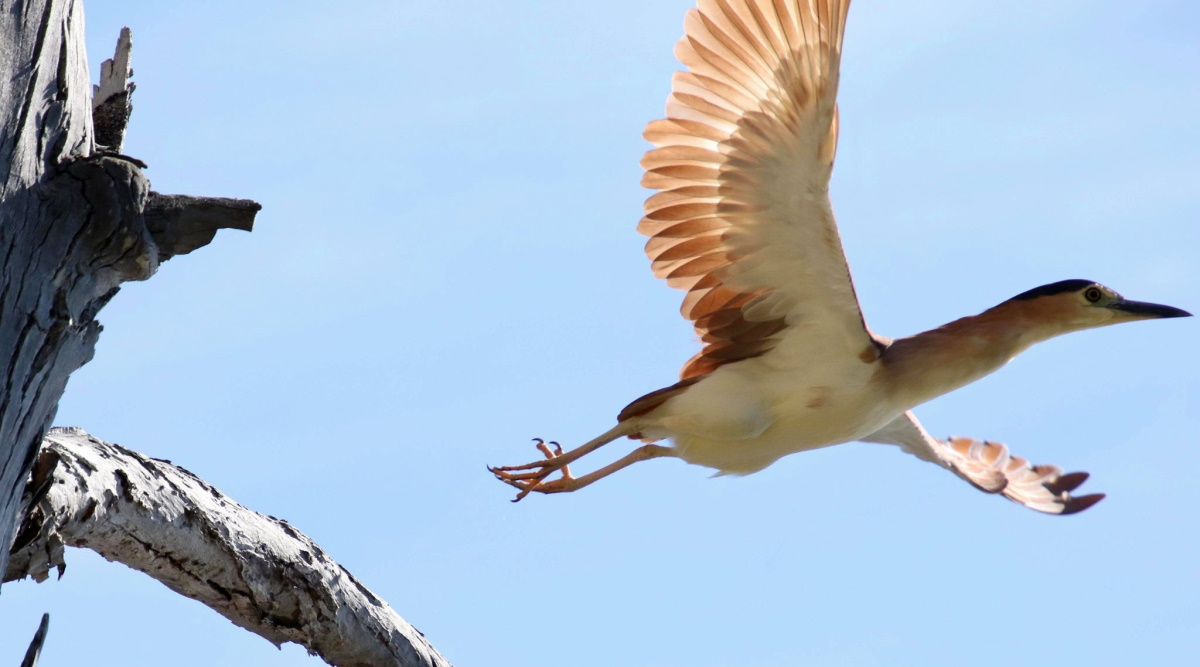
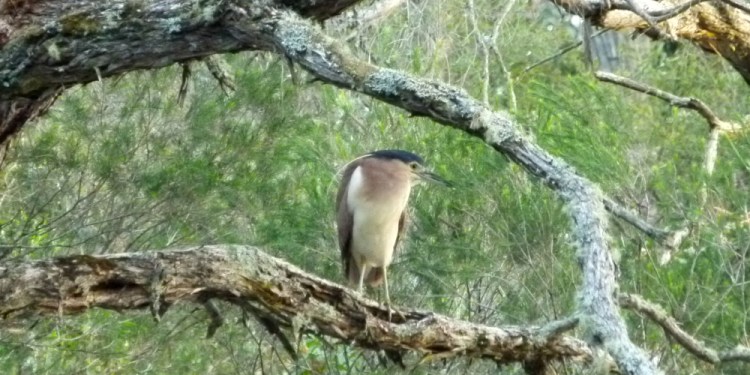
Sometimes early in the morning or on dusk you can see one fly out to or from their daytime roost. Their preferred roosts are often near water, but not always – I have seen them in huge pine trees several hundreds metres away from water.
The Bucklands Jetty Nankeen Night-Heron Mallacoota by Jack Winterbottom
There was a regular Night-Heron that roosted at the Mallacoota Bakery. There is another couple that roost in Pittosporums at Bucklands Jetty – start of Narrows Walking Track.
Martin Butterfield tells:
I first became aware of this species at Mallacoota when someone reported one in the Foreshore Caravan Park. Some how I found that this bird used to be seen around dawn perched on the marker ropes of the boat moorings. About 7am it would then fly into a clump of large trees between the moorings and the road. It was relatively easy to spot due to the white wash on the roost tree. About mid-morning it would fly off towards the road.
At the Bakery, I was able to find it quite easily, although it did switch between roosts a bit. This bird maintained position after the fire with some preference for a tree above a seat on the pavement which became plastered with second hand fish. I had trouble locating it later in 2020 and wondered if pruning the trees had driven it away. However I have spoken with the Bakery owners in December who said it had acquired a friend in about September and both birds had vanished and not been seen for three months.
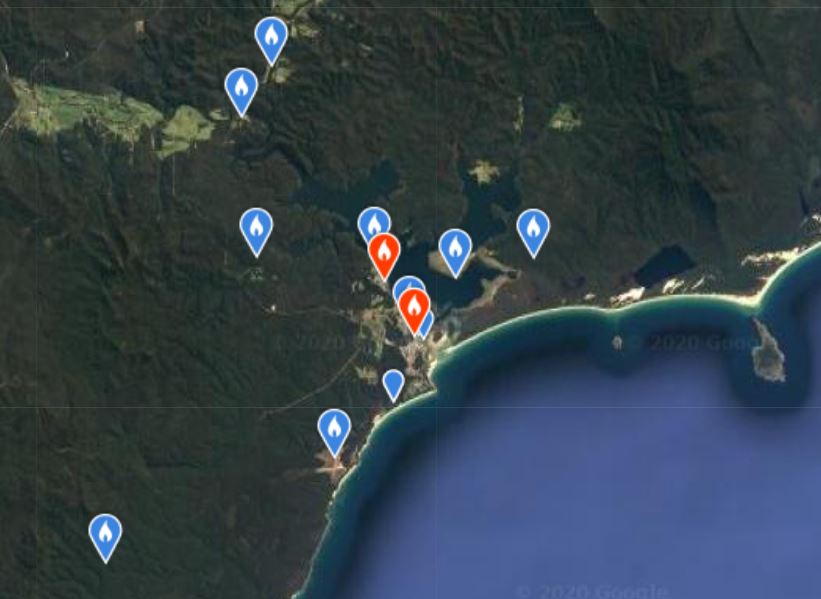
Map of Nankeen Night-Heron sightings around Mallacoota, from eBird
Janine also told me of a location at the turning area at the mouth of the Narrows (Bucklands Jetty). On occasion I found this bird and the Bakery bird on the same day day so there were definitely two herons in the area. Once I had worked out where the bird roosted it became easy to find it , although it seemed very skittish to begin with. I found that if I parked away from the roost trees and walked over it wouldn’t flush but just peer down at me. In August and October 2020 I found 2 birds in the site. (I suspect this means there were 4 birds in the area.) They both then vanished which I suspected meant they were nesting somewhere nearby and I looked carefully in the dense vegetation for evidence of a nest – without success. I then lost track of them for about 2 months until Rohan Clarke found a bird in its usual roost, where we observed it on the first group walk.
The Mallacoota Bakery Nankeen Night-Heron by Janine Duffy
Breeding adults develop three ‘nuptial plumes’ (special showy breeding feathers) on the backs of their heads for the short time they are breeding.
Nankeen Night-Heron showing nuptial plume, East Gippsland by Martin Maderthaner
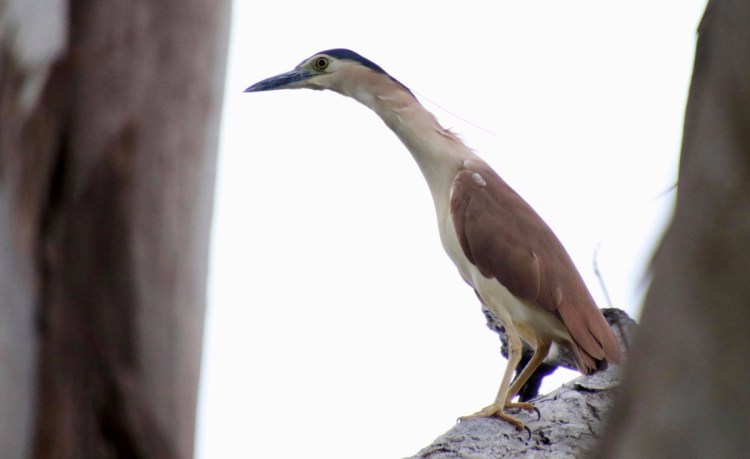
They look a bit different to most herons – partly because they don’t seem to have a long neck. But they can stretch their necks out quite a lot. Most night-herons around the world have this short-necked, big-headed appearance.
Nankeen Night-Heron with neck stretched out, Mallacoota by Caroline Jones
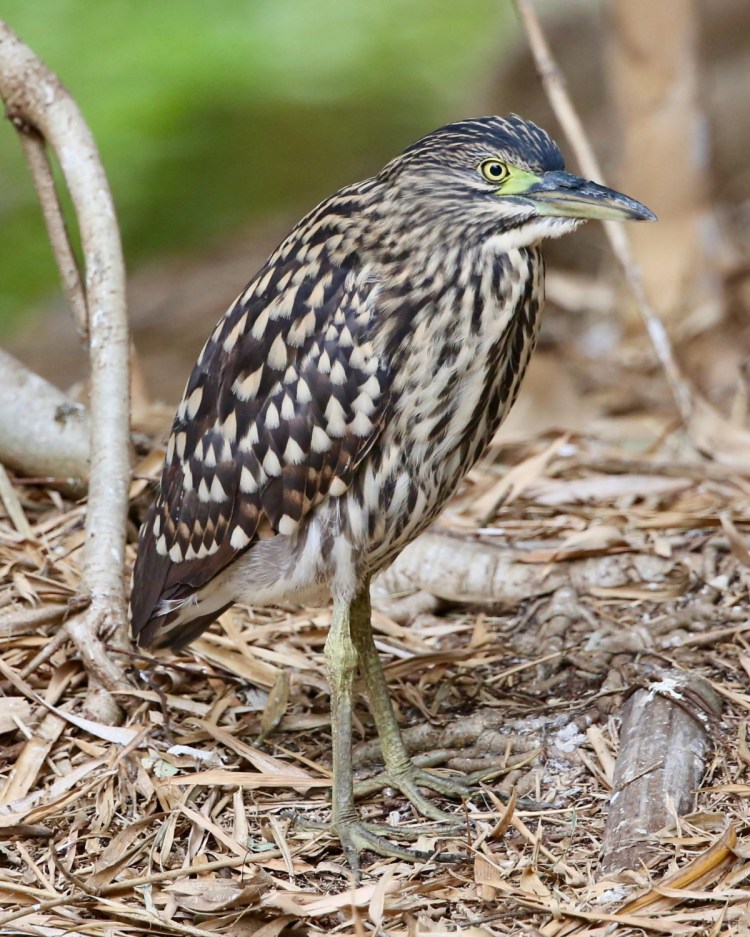
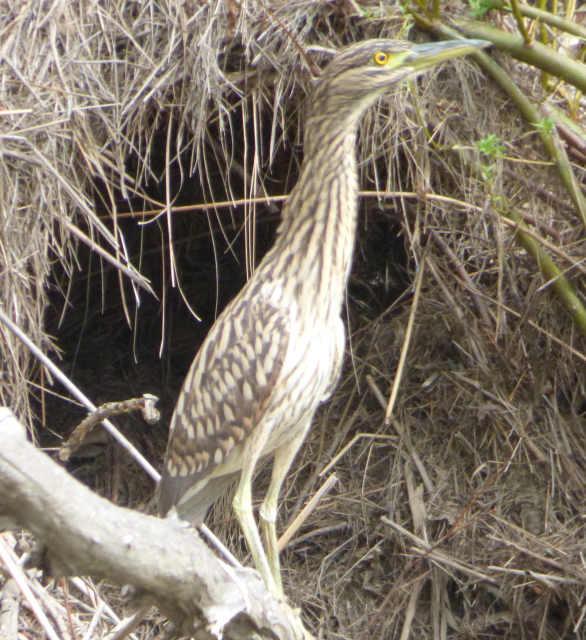
As juveniles they are streaky brown and buff, with a prominent neon green face, eye and lower bill. They look like quite a different bird, and could be confused with (much smaller) Striated Heron, the (much larger) Australasian Bittern or (darker) Black Bittern (though that bird is not likely in Victoria).
Juvenile Nankeen Night-Heron East Gippsland by John HutchisonJuvenile Nankeen Night-Heron by Martin Butterfield
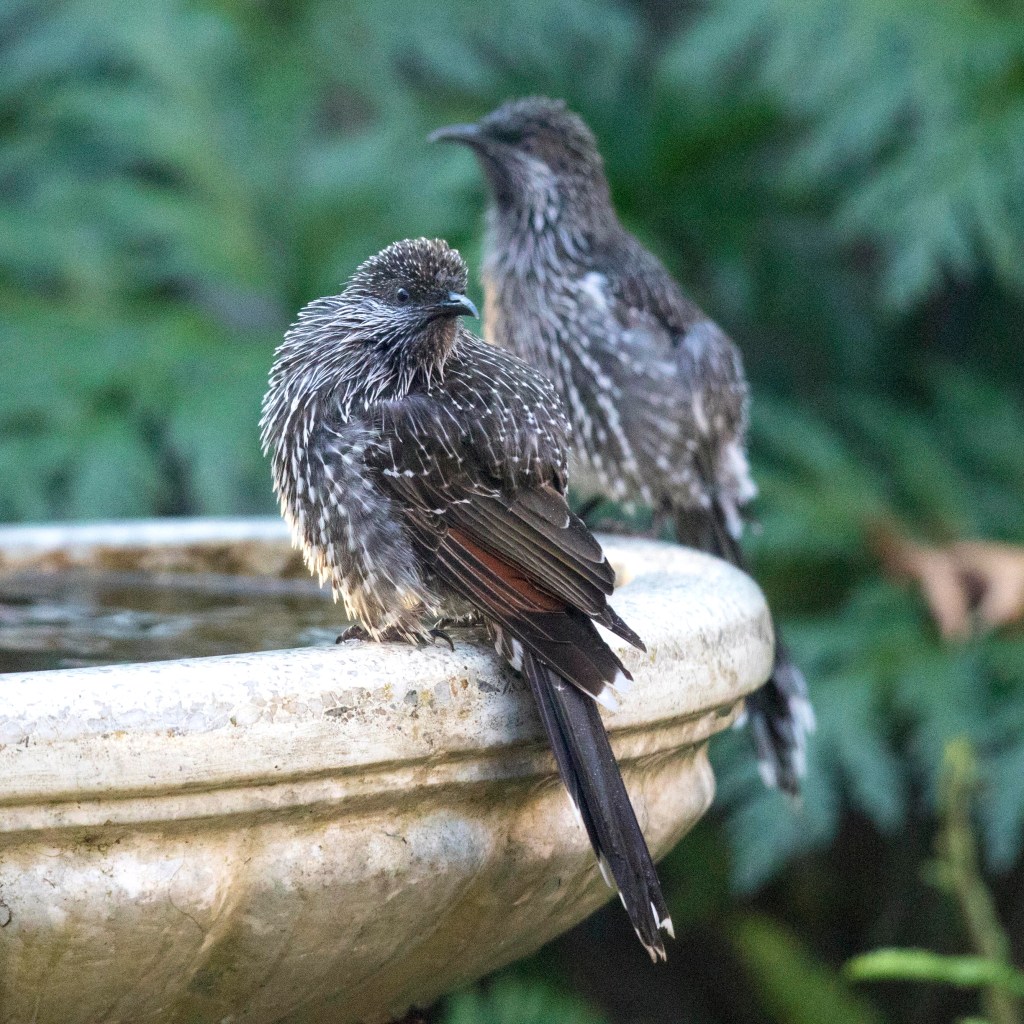
Bird of the Week: Little Wattlebird 4 December 2020
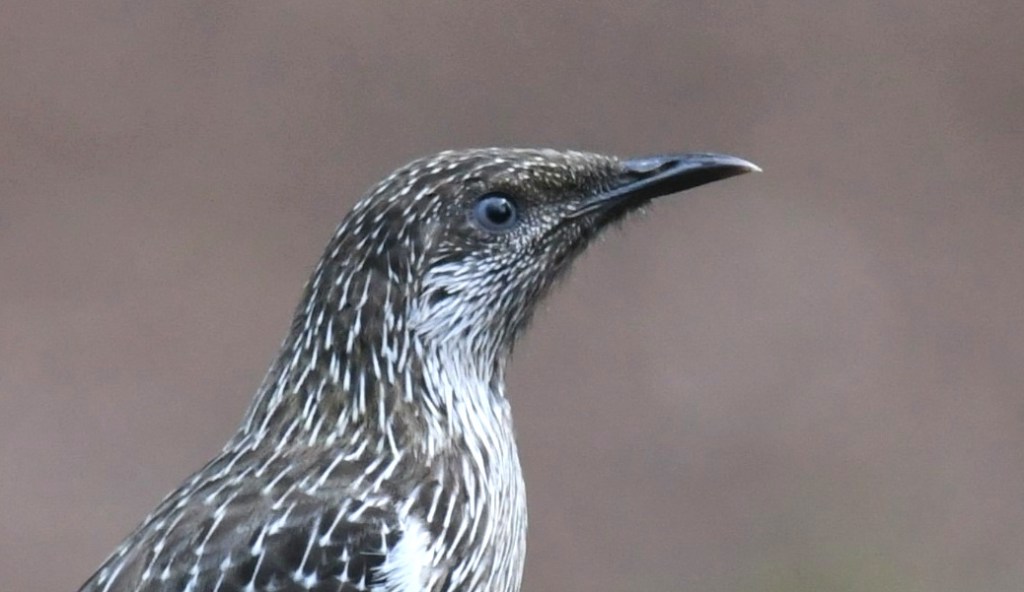
There’s something joyous about these birds. If you were to watch them calling with the sound off, you’d be forgiven for thinking they were operatic masters, with beautiful voices. They have such vigour and pride!
Little Wattlebirds East Gippsland by Jack Winterbottom
But to hear them is something else altogether. Their ‘song’ is a strangled, hiccuping croak-hoot, usually pitched low. They can do a high-pitched nasal version too. There is often a bill rattle at the start, and the call has a rhythmic, repetitive quality that Red Wattlebirds don’t have as much. Listen: https://ebird.org/species/bruwat1/ And compare to Red Wattlebird: https://ebird.org/species/redwat1/
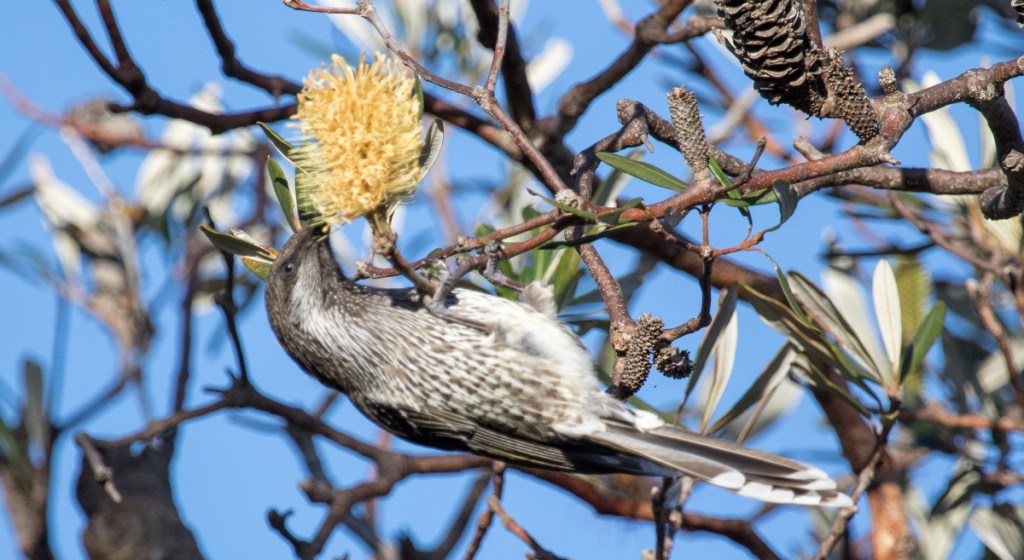
Little Wattlebird feeding on Coast Banksia, East Gippsland by Martin Maderthaner
It can be hard to tell the two wattlebirds apart by call. Both do the bill rattle, both do the “Jock!” Both do a version of the “Be-kerk!” Generally I feel that Little Wattlebirds are more tuneful, more inclined to make a memorable tune and repeat it. Red Wattlebirds seem to throw in any note at any time in no particular order.
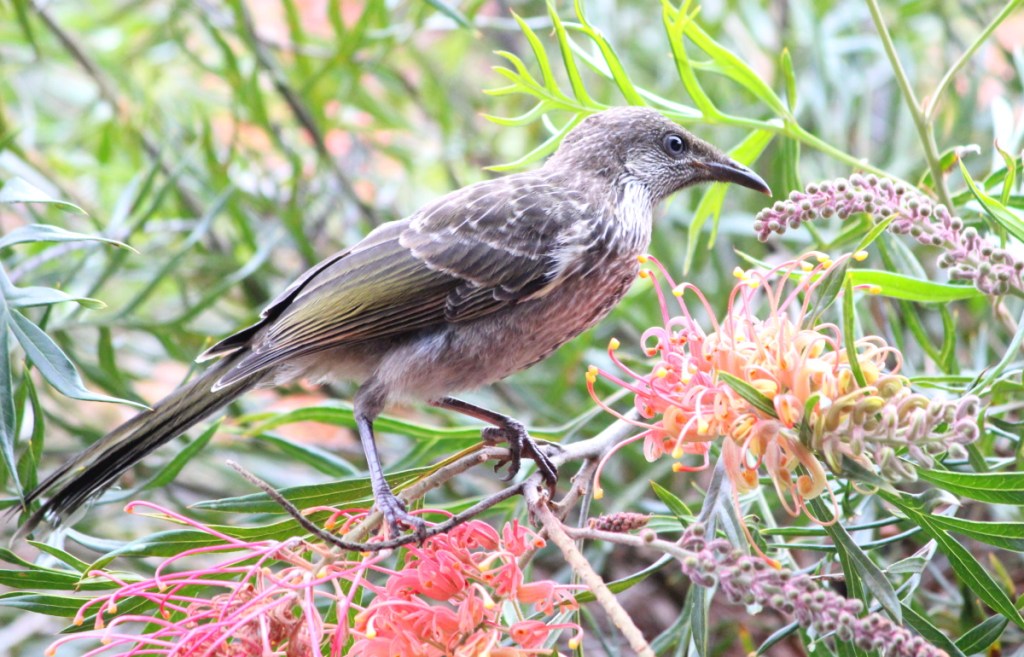
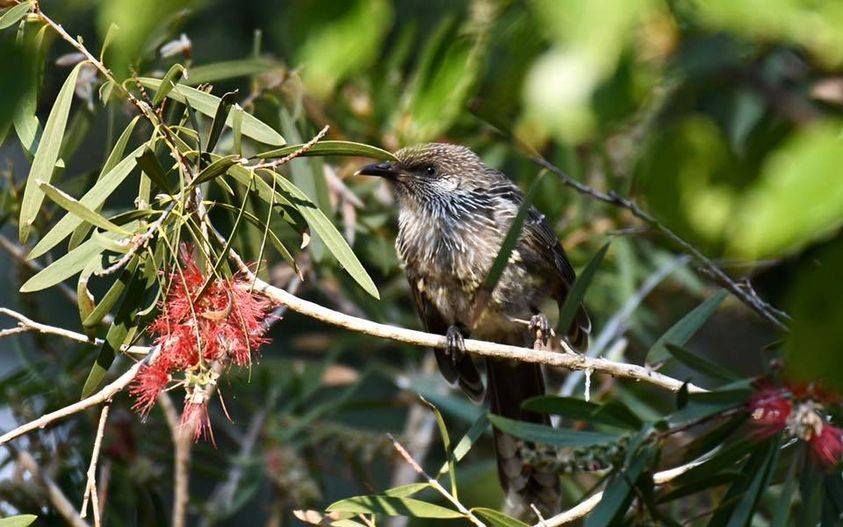
Little Wattlebirds are the fairly large brown-grey honeyeaters found most commonly along the coast. Both they and Red Wattlebirds are common in gardens around Mallacoota.
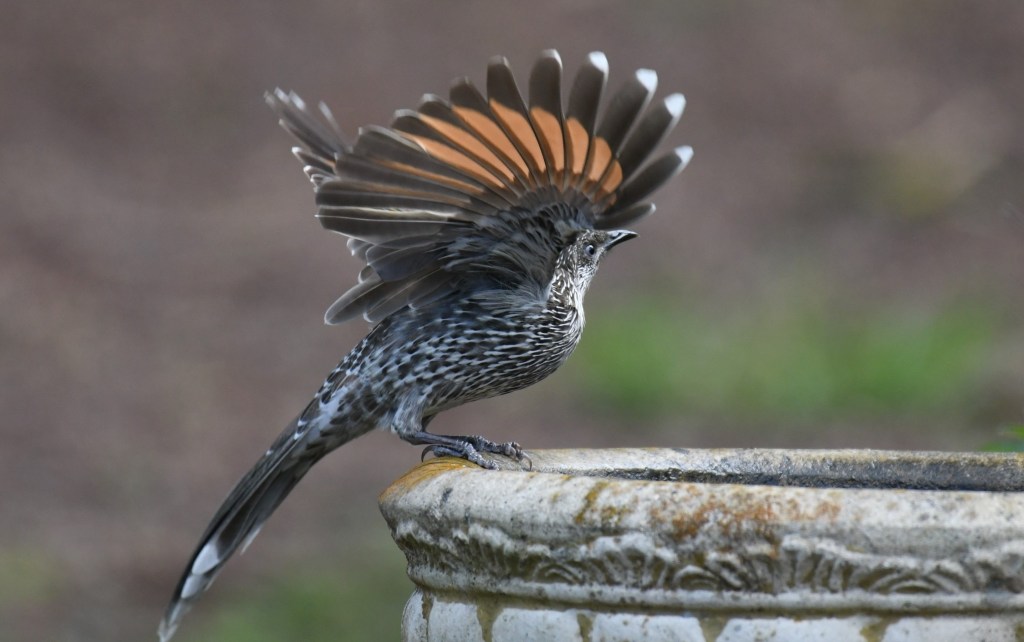
Little Wattlebird showing rufous wing patch, East Gippsland by Rob Clay
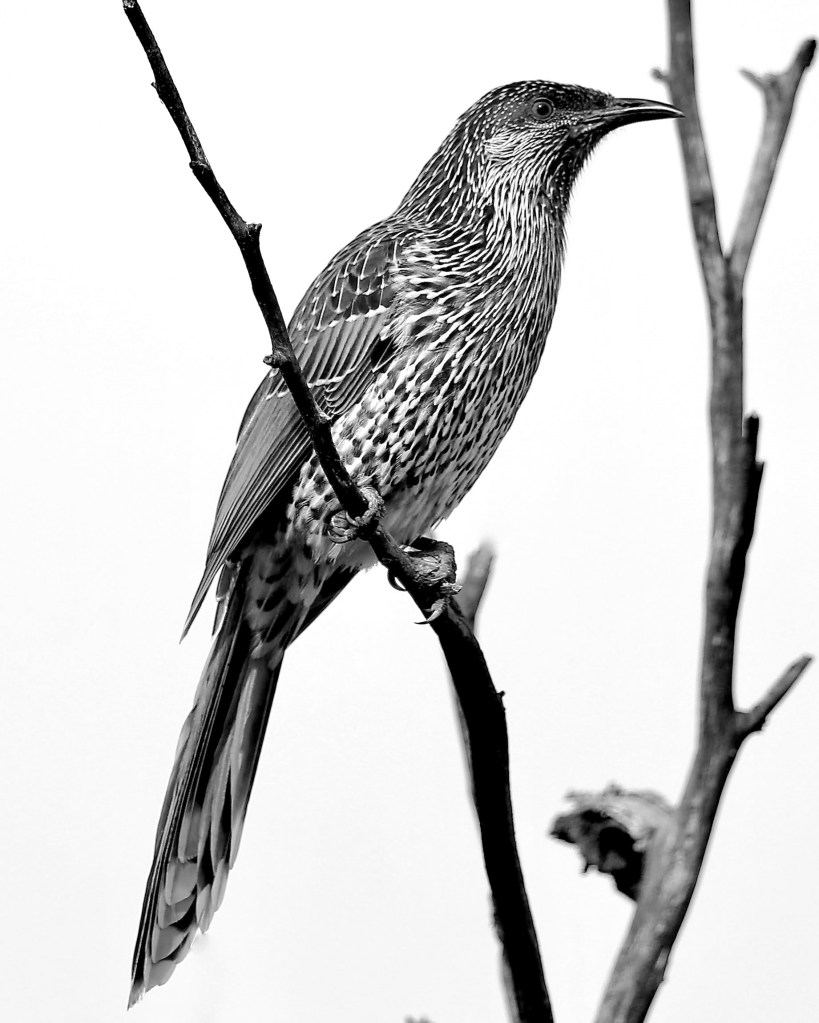
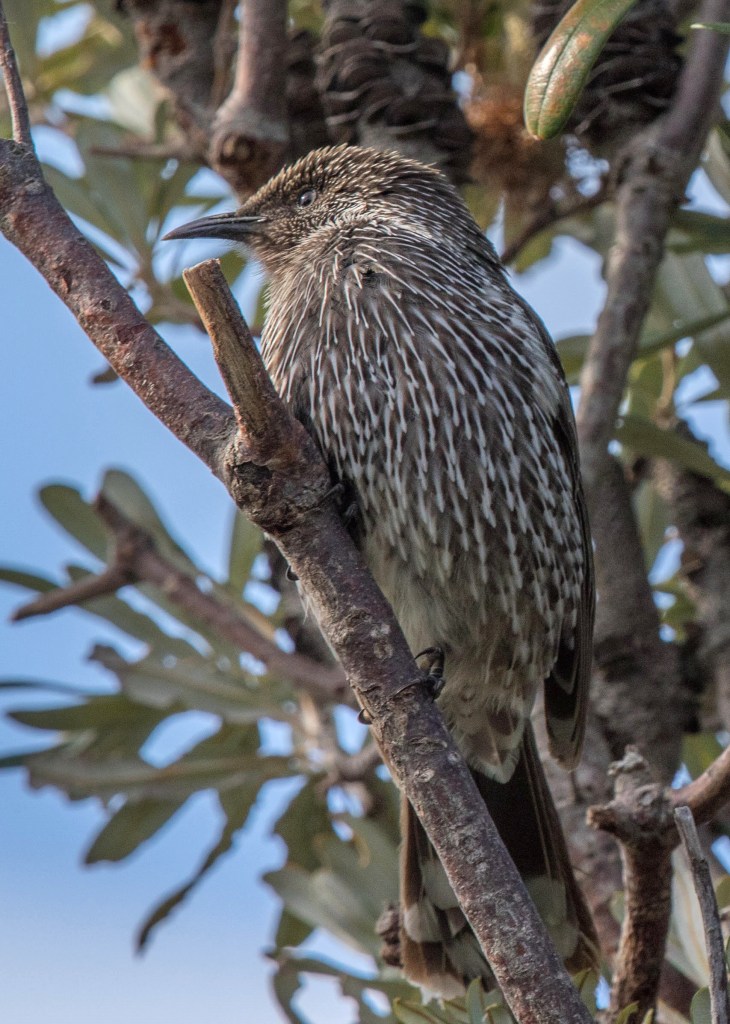
You can tell the Little Wattlebird by their red-orange wing patch in flight – Red Wattlebirds don’t have that. Close up, Little Wattlebirds have a shooting-star pattern on their feathers: a bright white vane, with a little star at the tip of the feather. It’s very beautiful.
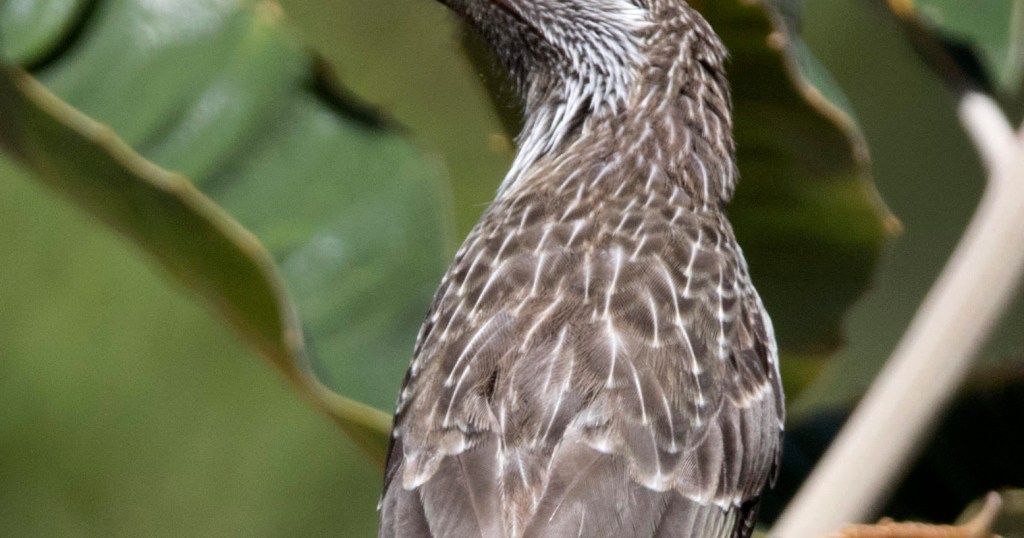
Little Wattlebird feather detail, showing “shooting stars” East Gippsland by Jack Winterbottom
Red Wattlebirds also have a white central vane on their feathers, but it is not as showy and doesn’t have the star at the tip.
Little Wattlebirds have grey legs & blue-grey eyes, whereas Red Wattlebirds have pinkish legs & red eyes.
Little Wattlebird showing blue eyes, East Gippsland by Rob ClayBlack and white pic just for fun, shows off the very strong streaking of the Little Wattlebird, by John Hutchison
Many people call them just Wattle Bird, I’ve heard others call them Jock and they used to be called Brush Wattlebird in some books (but I don’t think that ever took off). What do you call them at home?
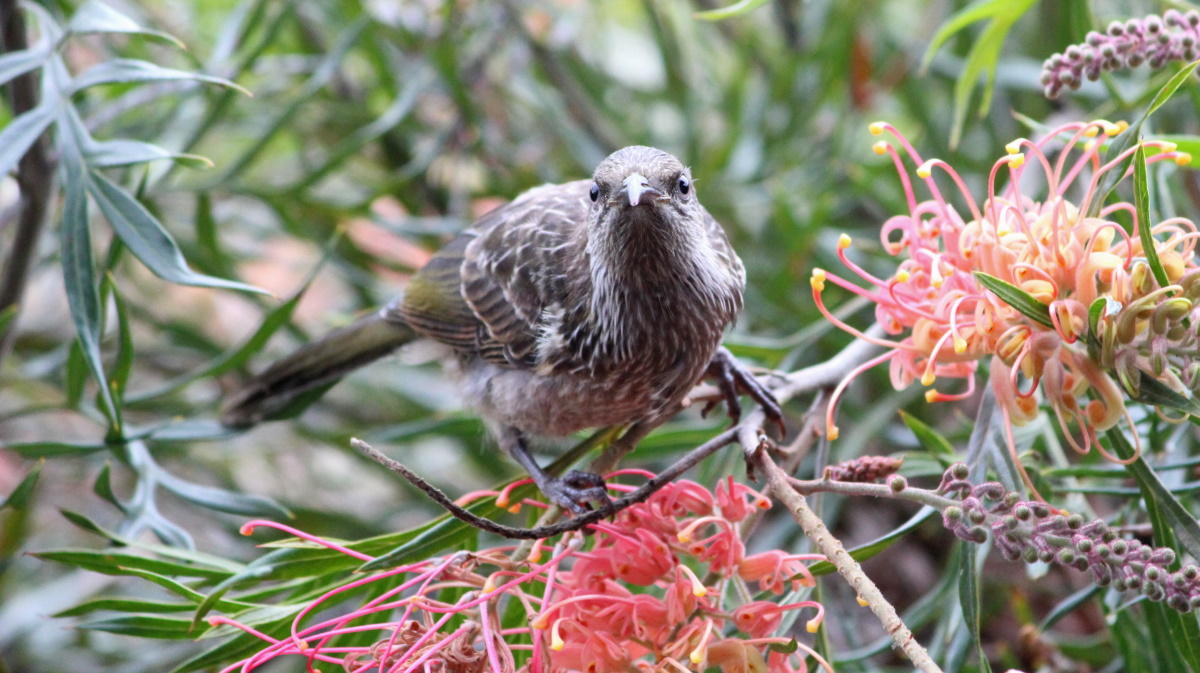
Young Little Wattlebirds look like adults, but less striking and browner.
A young Little Wattlebird at Gipsy Point by Janine DuffyYoung Little Wattlebird East Gippsland by Rob Clay
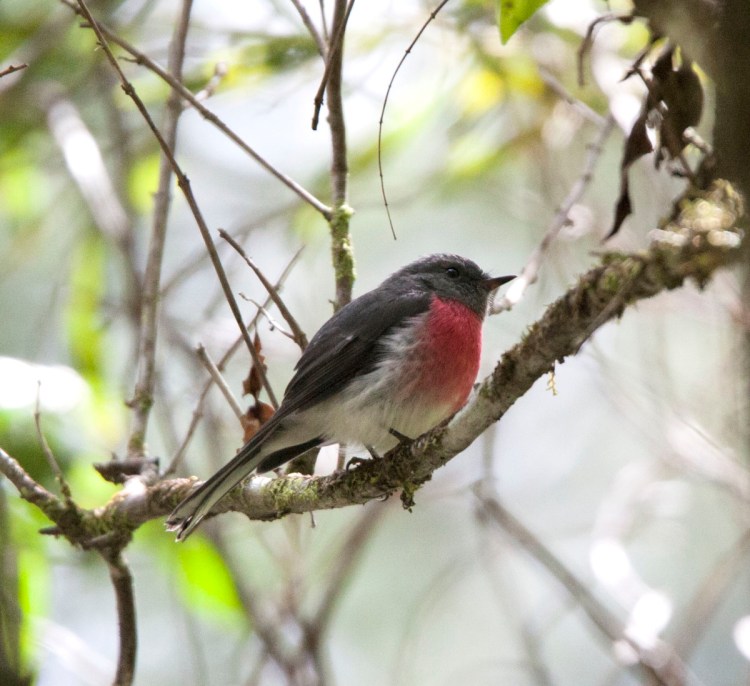
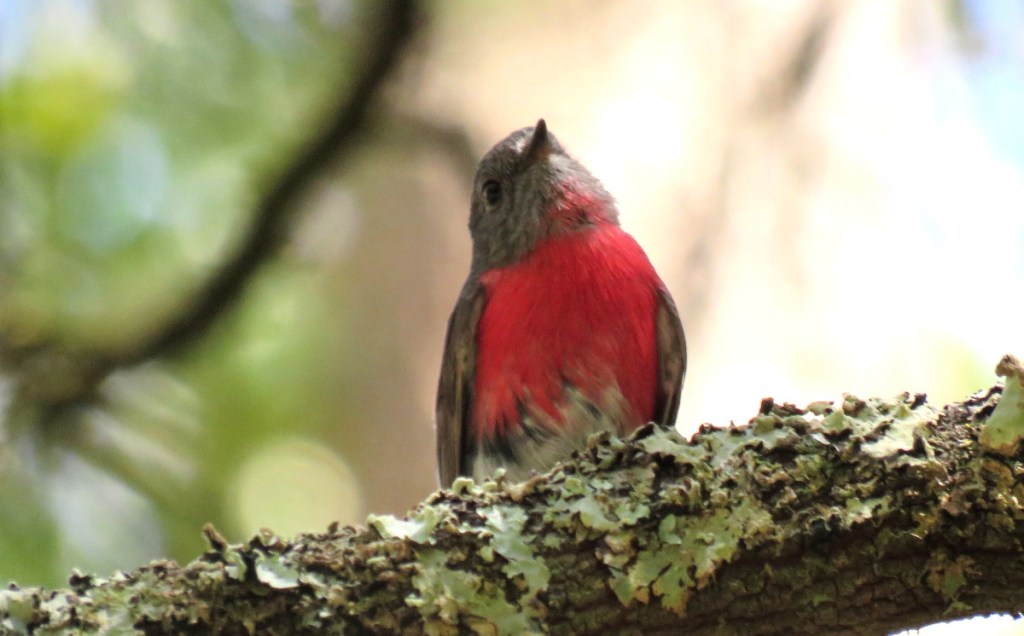
The sweet whistle of the Rose Robin sounds to me like:
I’m going to East Gippsland!
I know they can be seen in other parts of Vic, NSW and even QLD but that ditty is stuck in my head.
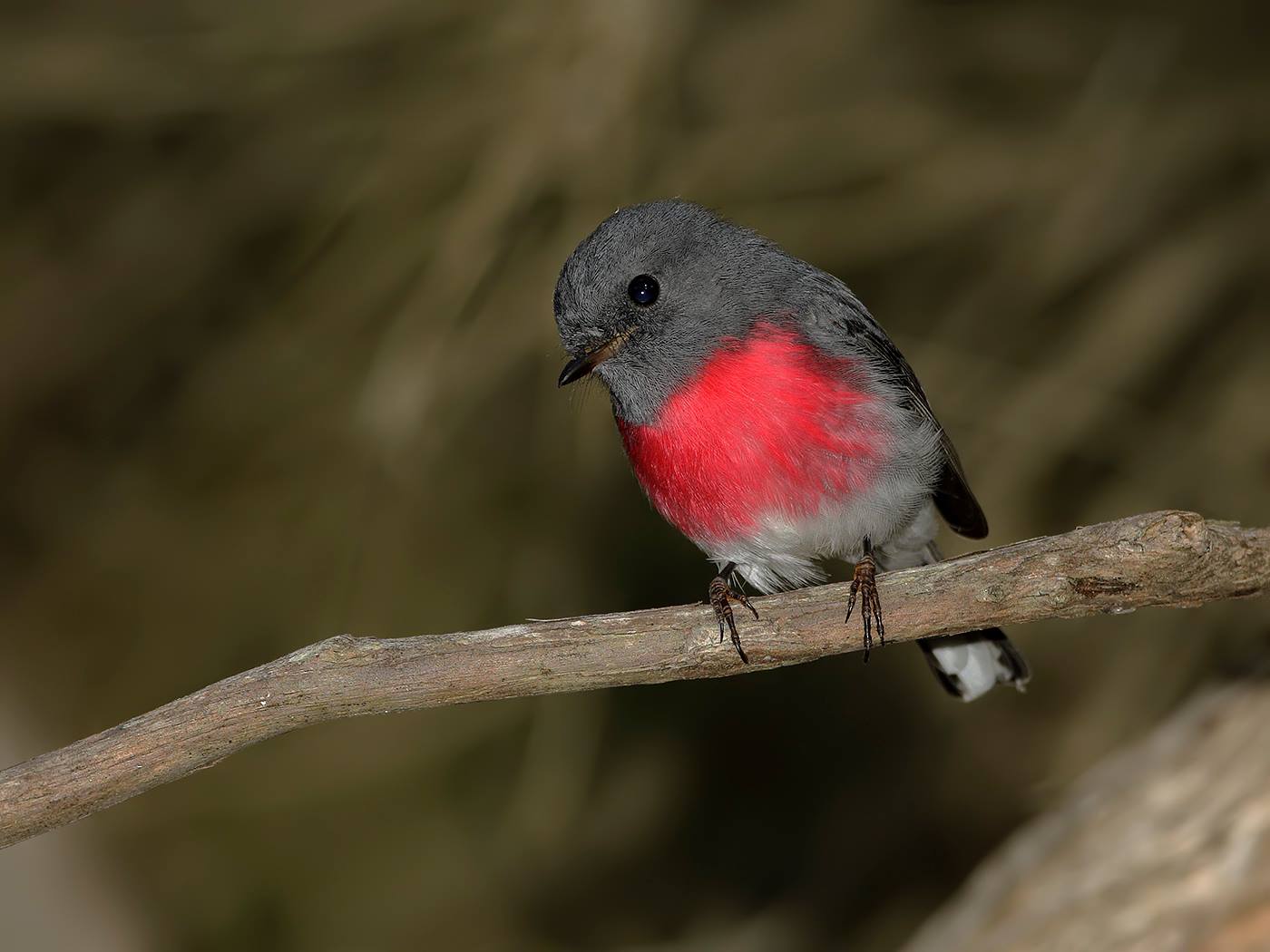
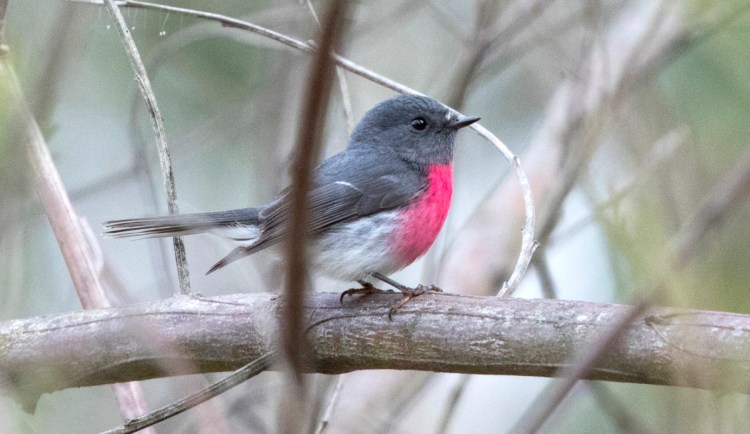
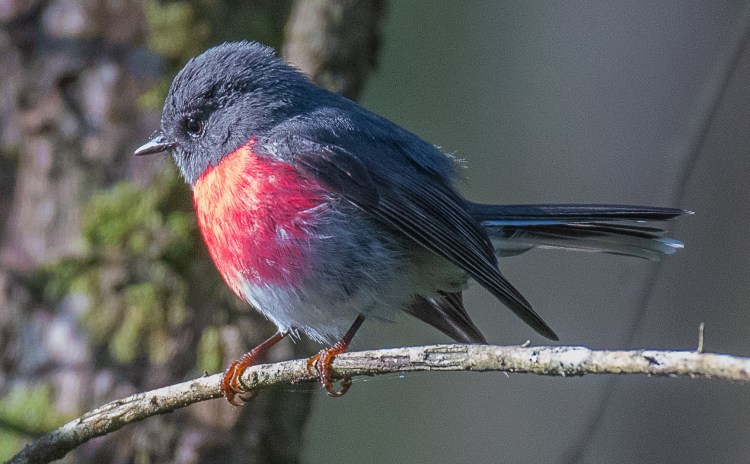
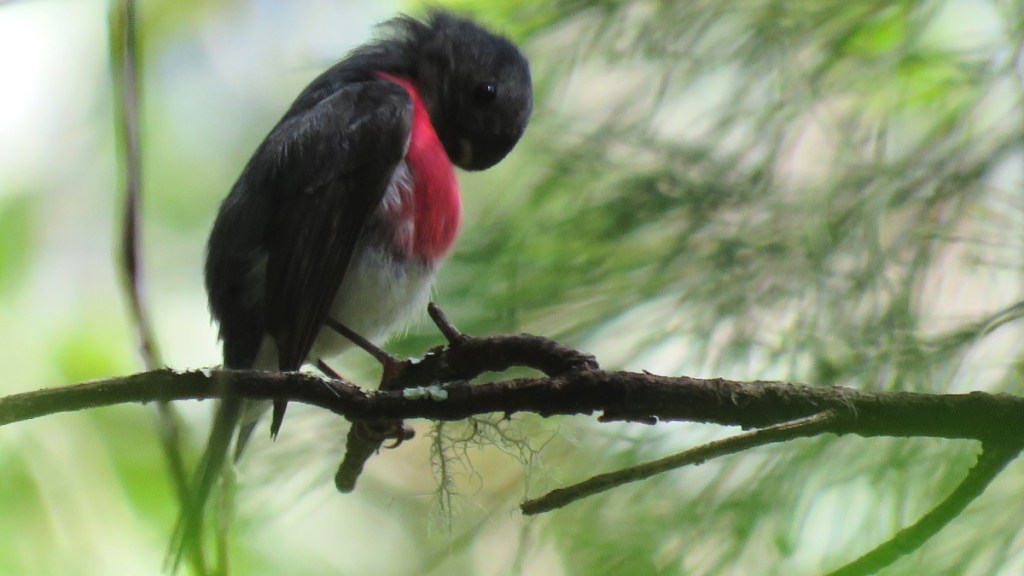
male Rose Robin, East Gippsland by Jack Winterbottommale Rose Robin, East Gippsland by Rob Clay
In East Gippsland, telling ‘red’ robins apart can be tough – we get nearly all of them! Rosies like the wet forests, rainforests, melaleuca scrub and tall eucalypt forests. Flames like the open country, particularly high in the mountains in summer, Scarlets like the drier eucalypt forests. Pinks are rarer, and like really wet, mountain forests but can come down to the coast occasionally (though records of them in EG are few). Even Red-capped, an inland bird, come into East Gippsland occasionally.
You can easily tell a male Rose from Scarlet, Flame & Red-capped by the wing bar – Rose don’t have it (unless he’s a young male), all the others do. Females are much harder.
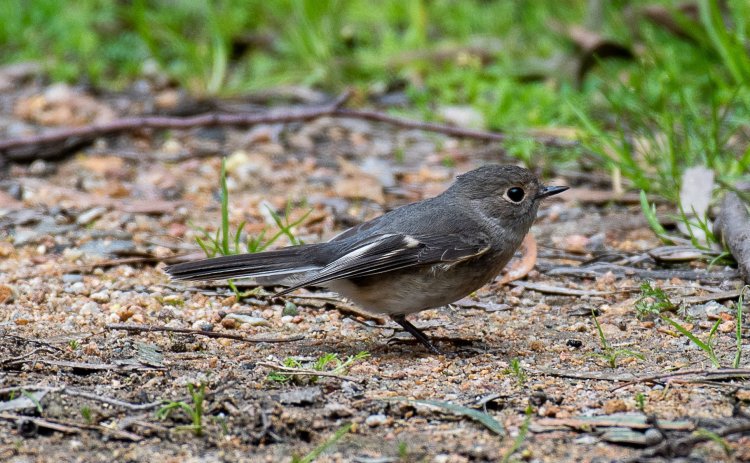
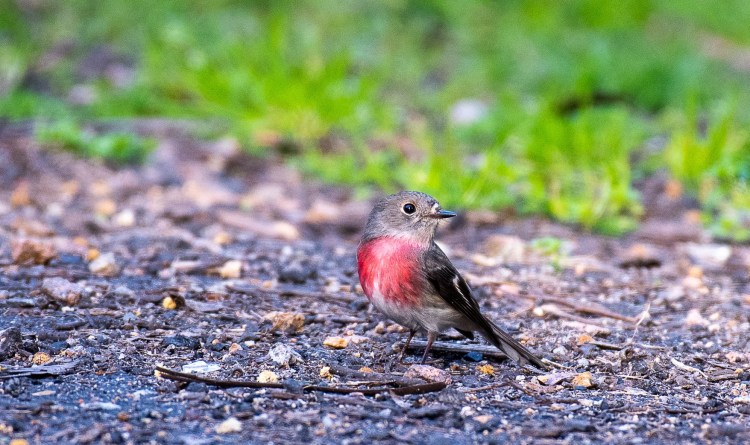
Female Rose Robin, East Gippsland by Scott Roberts female Rose Robin showing white outer tail feathers, East Gippsland by Rob ClayMale Rose Robin, showing lack of wing bar, Mallacoota by Michael Barnett
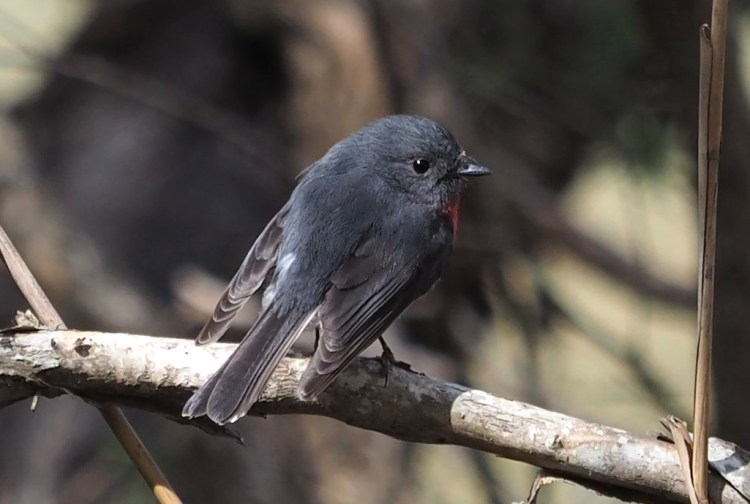
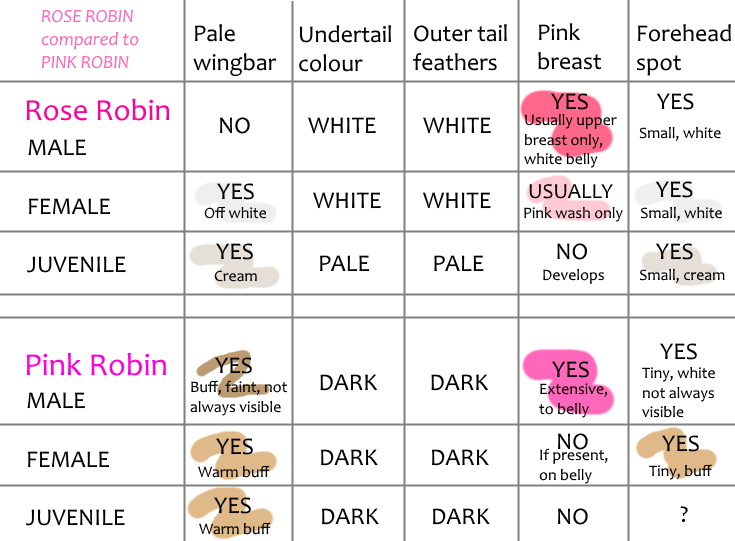
Telling the male Rose and Pinks apart is not always easy. The Rose Robin is more common, has a slate grey head and back but that can look really dark in the rainforest! His breast is pink, and he has a variable extent of white belly, and pale undertail. His tail is a fraction longer than a Pink Robin, and it has white outer feathers.
male Rose Robin showing pink feathers on throat, East Gippsland by Brett Howellmale Rose Robin looking very dark, East Gippsland by Brett Howell
Here’s a diagram to summarise.
Chart comparing Rose and Pink Robins, by Janine Duffyfemale Rose Robin with extensive pink breast, East Gippsland by Rob Clay
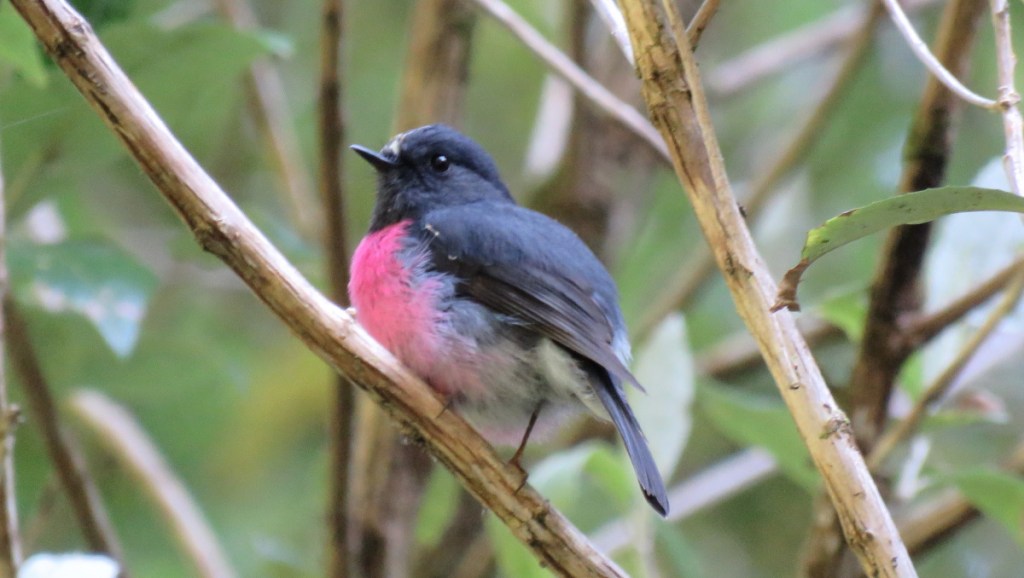
The male Pink Robin has a very dark grey to black head and back, but in strong light that can look grey. The pink on his breast goes down to his belly, but the extent is variable and can depend on the angle. He sometimes has a faint buff wing bar, that can be hidden if his feathers are fluffed up. He has a fairly short tail, that looks mostly dark underneath.
Look how difficult it can be! From this angle he appears to have a white belly. Male Pink Robin, Otways VIC by Brett Howell Echidna Walkabout
In summary – look at the tail!
male Rose Robin showing pale undertail, East Gippsland by Jack Winterbottom
Bird of the Week: Eastern Whipbird 20 November 2020
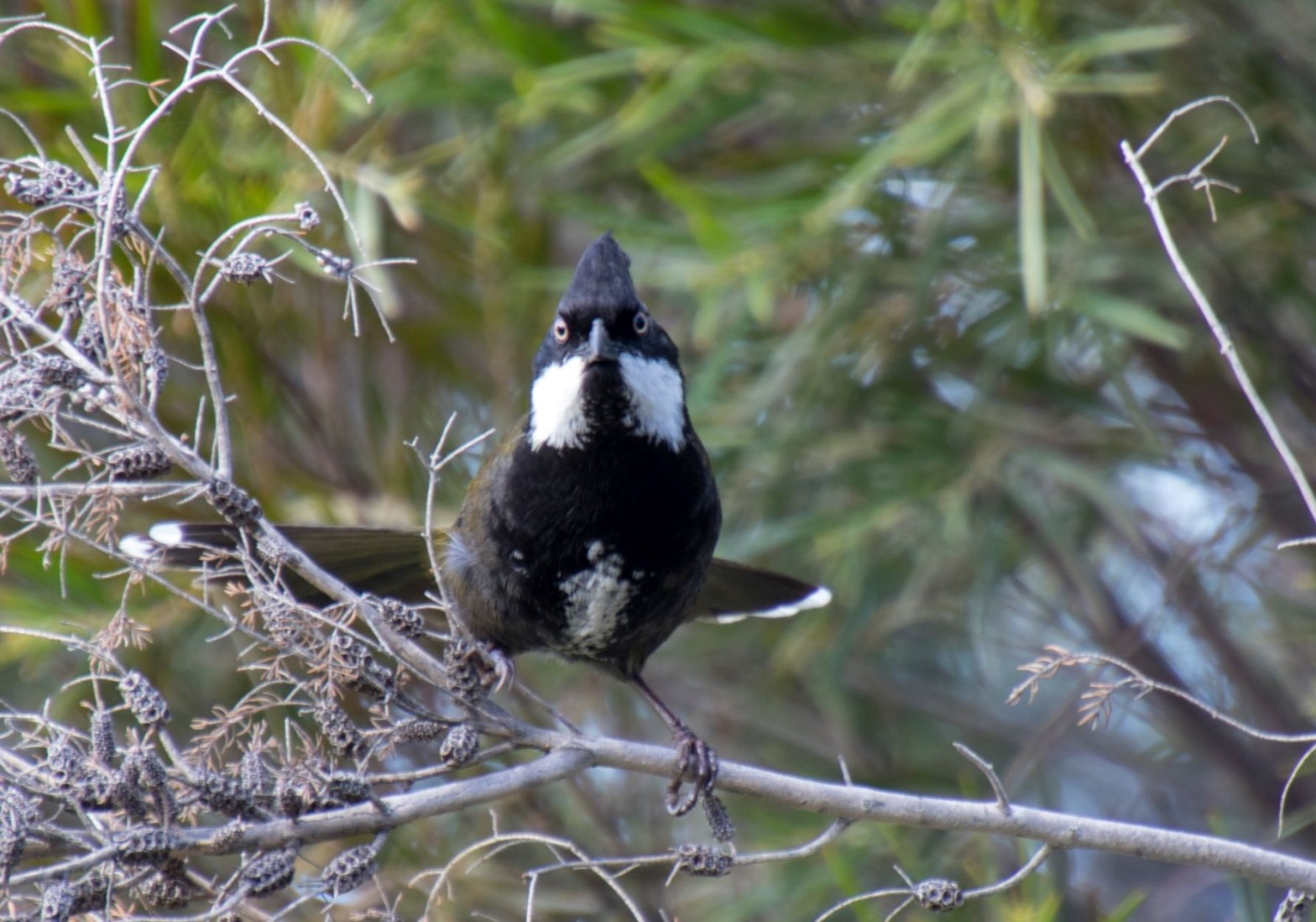
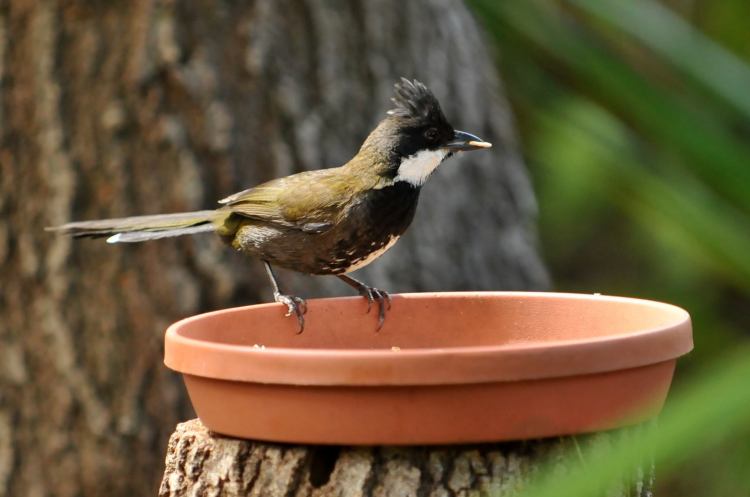
This bird is so well known – their loud whip-crack call is a feature of the forests of East Gippsland. They are sometimes hard to see, though – they love to forage amongst dense shrubbery near the ground, fossicking around in the leaf litter. Any other bird doing this you just wouldn’t know was present, but the call is so loud and compelling that you find yourself searching for the bird with near-desperation.
It is widely believed that the male does the whip-crack and the female answers with a two note choo-choo! But there is no way to tell the male and female apart as adult plumage, so how do we know which bird is doing what?
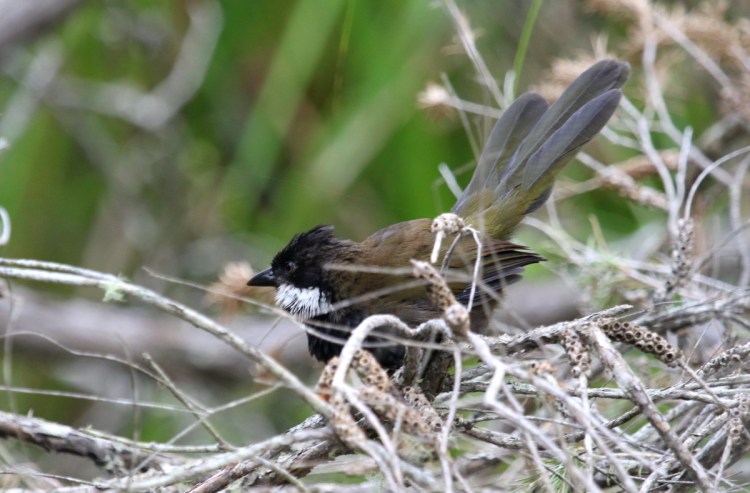
Adult Eastern Whipbird singing East Gippsland by Martin Maderthaner
On his excellent site Graeme Chapman tells how he watched a young whipbird mature, and heard the young bird do both male and female calls and a variety of other calls. He also describes their nesting behaviour, which is fascinating. The female sits on the 2 eggs and the male brings her food. https://www.graemechapman.com.au/library/viewphotos.php?c=555
Eastern Whipbird adult showing white belly, Mallacoota by Michael Barnett
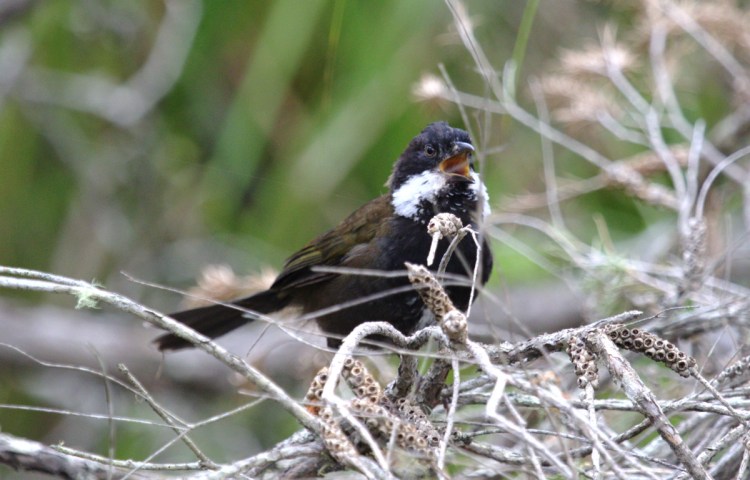
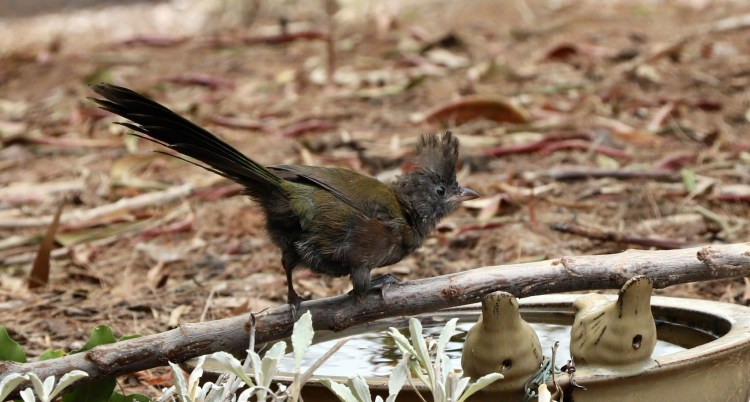
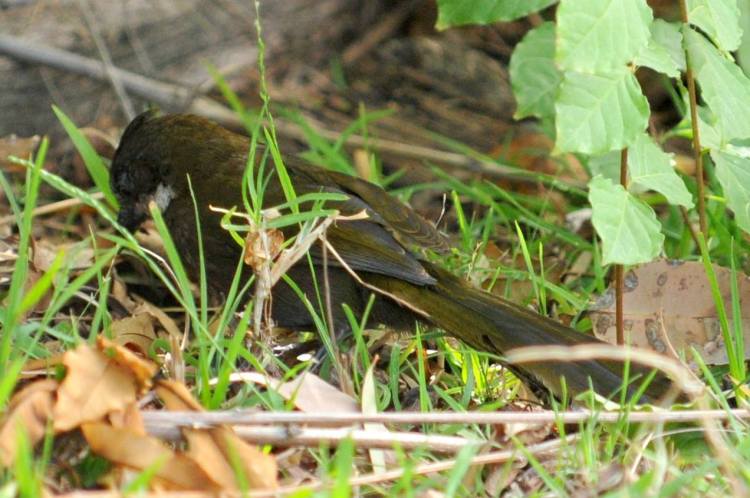
Juveniles are olive-grey-brown all over, with no white on their cheek. They have a little crest, and their bills are pale at the base. But you can see on this pic by Caroline Jones that they can raise their crest to look quite prominent.
juvenile Eastern Whipbird with crest up and pale base to bill, Mallacoota by Caroline Jones
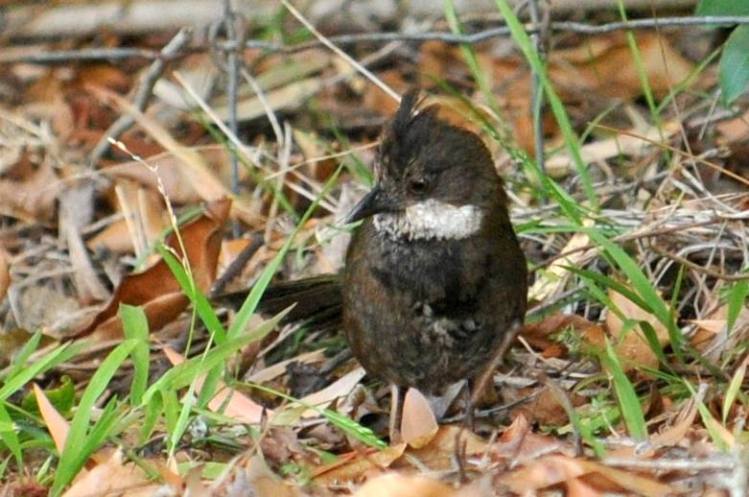
Immatures start to develop the pale cheek and black head, and their bills go dark. They can appear like a washed-out adult – the white throat is not bright, the dark head is not black, but they are almost there.
Eastern Whipbird immature, dirty white throat, sooty dark head, Mallacoota by Michael Barnett
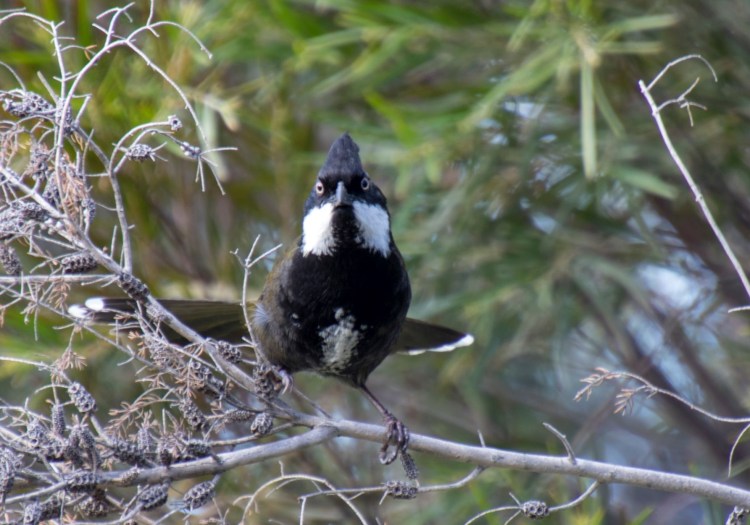
Adult males and females are similar, with a black head and breast, bright, strongly-contrasting white cheek, usually some white on their belly (apparently that is quite variable). They have brown eyes that become golden over time.
Their tails are usually held straight, but if they are fanned out you can sometimes see white tips to the tail feathers. But that can wear off or become dirty, so it’s not always seen.
Eastern Whipbird adult showing white tips to tail, Mallacoota by Caroline JonesEastern Whipbird adult white tips on tail completely worn off, East Gippsland Martin Maderthaner
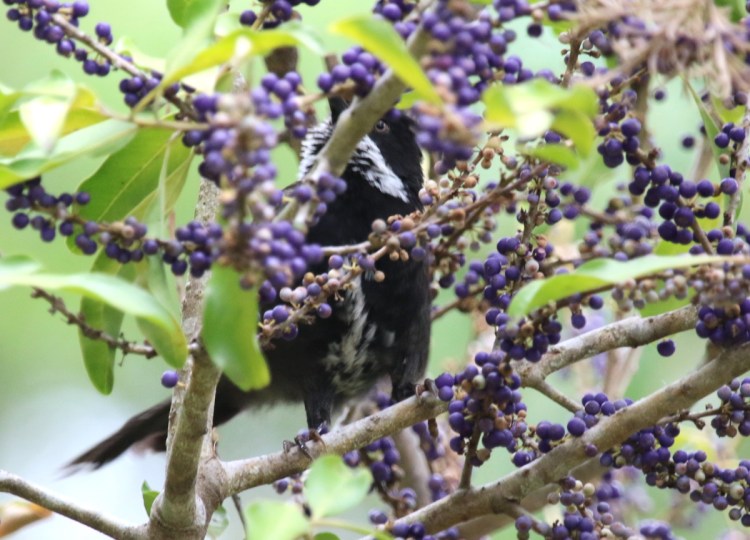
Adult Eastern Whipbird in fruiting Muttonwood, East Gippsland by Martin Maderthaner Echidna WalkaboutImmature Eastern Whipbird Mallacoota by Michael Barnett
Thankyou to Karen Brockley, Caroline Jones, Martin Maderthaner & Michael Barnett for your photos and videos for this post.
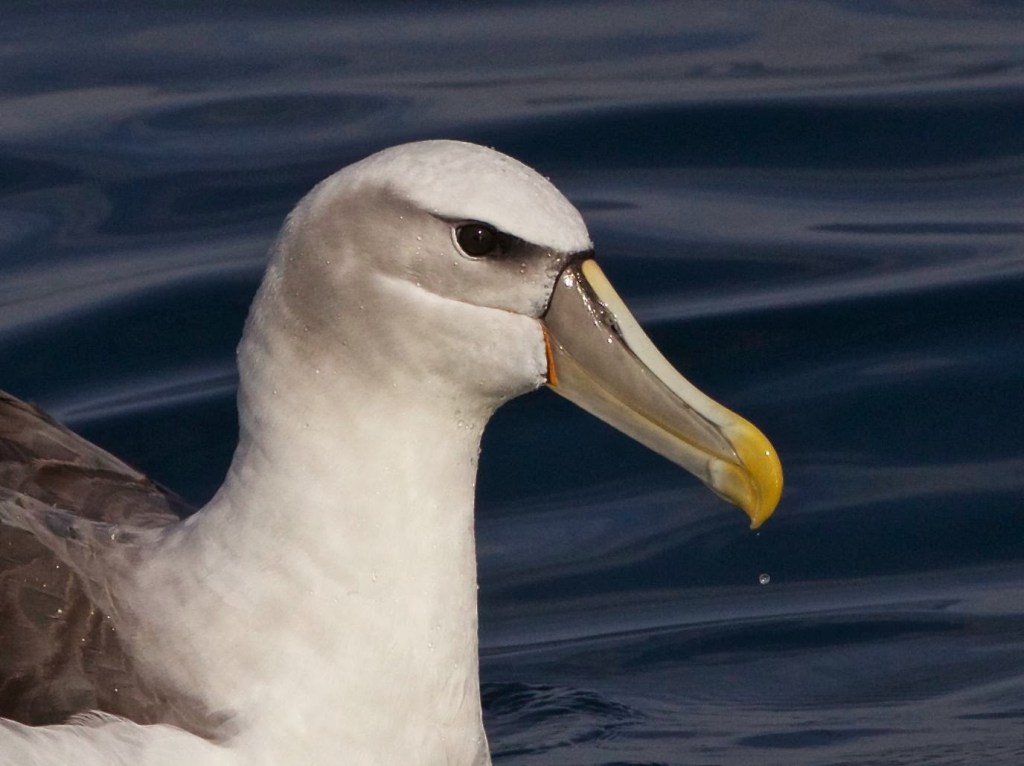
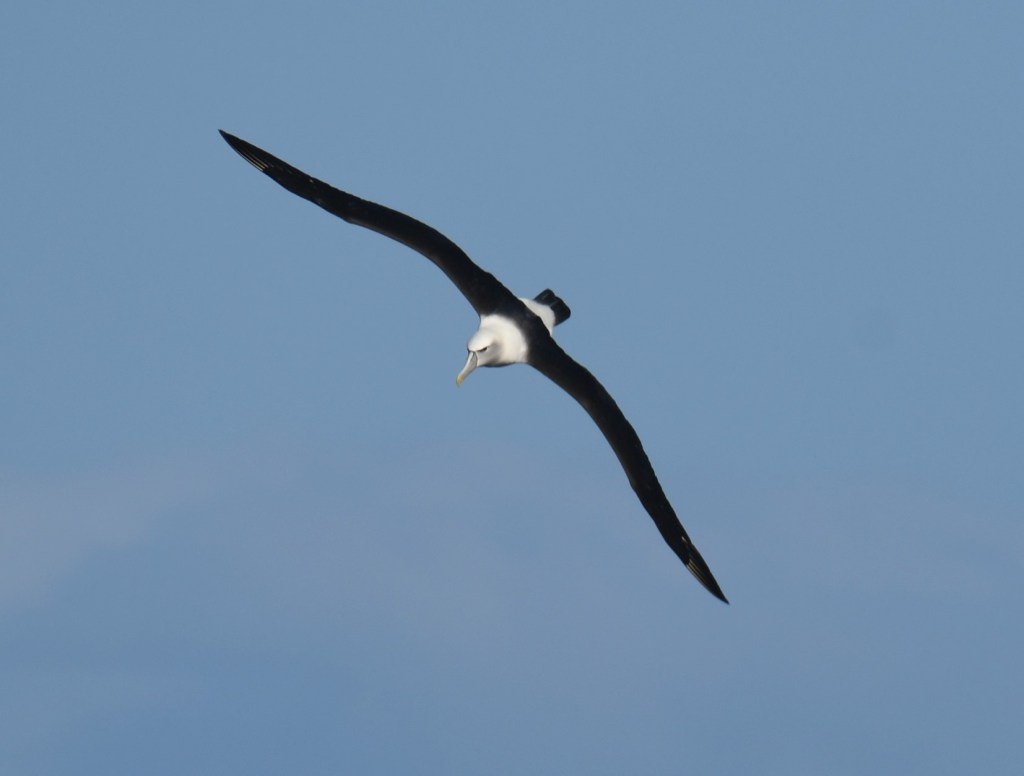
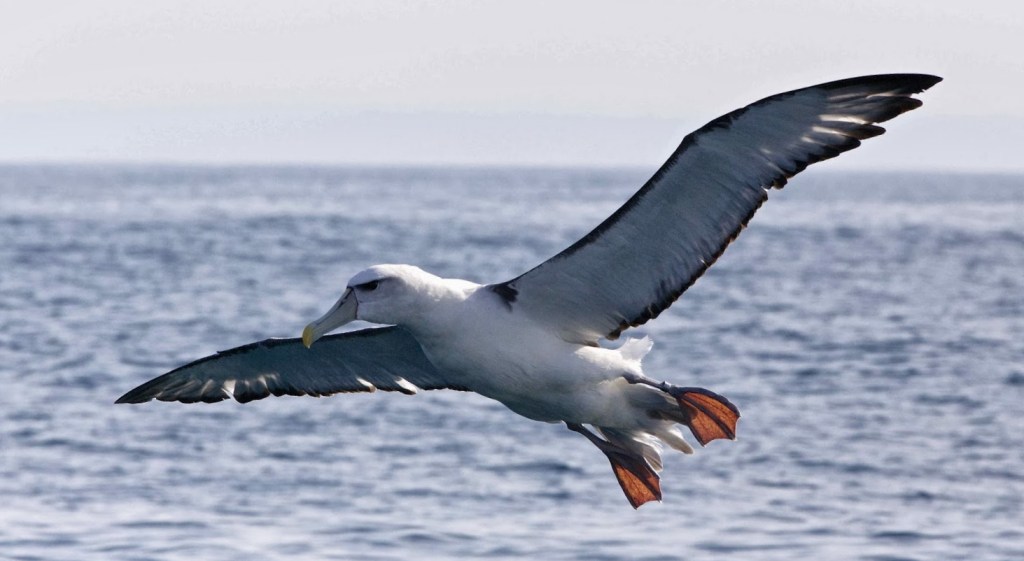
There is no albatross more truly Aussie than this. Shy Albatrosses (ssp cauta) only breed on three Tasmanian islands: Albatross Island in the northwest near Stanley, Pedra Branca and Mewstone Is south of Tas.
Shy Albatross Lakes Entrance by John Hutchison
For us lucky people in Australia’s southeast, they are the most frequently-seen albatross. But elsewhere in Australia and around the world the sight of this beauty is a rare and thrilling event.
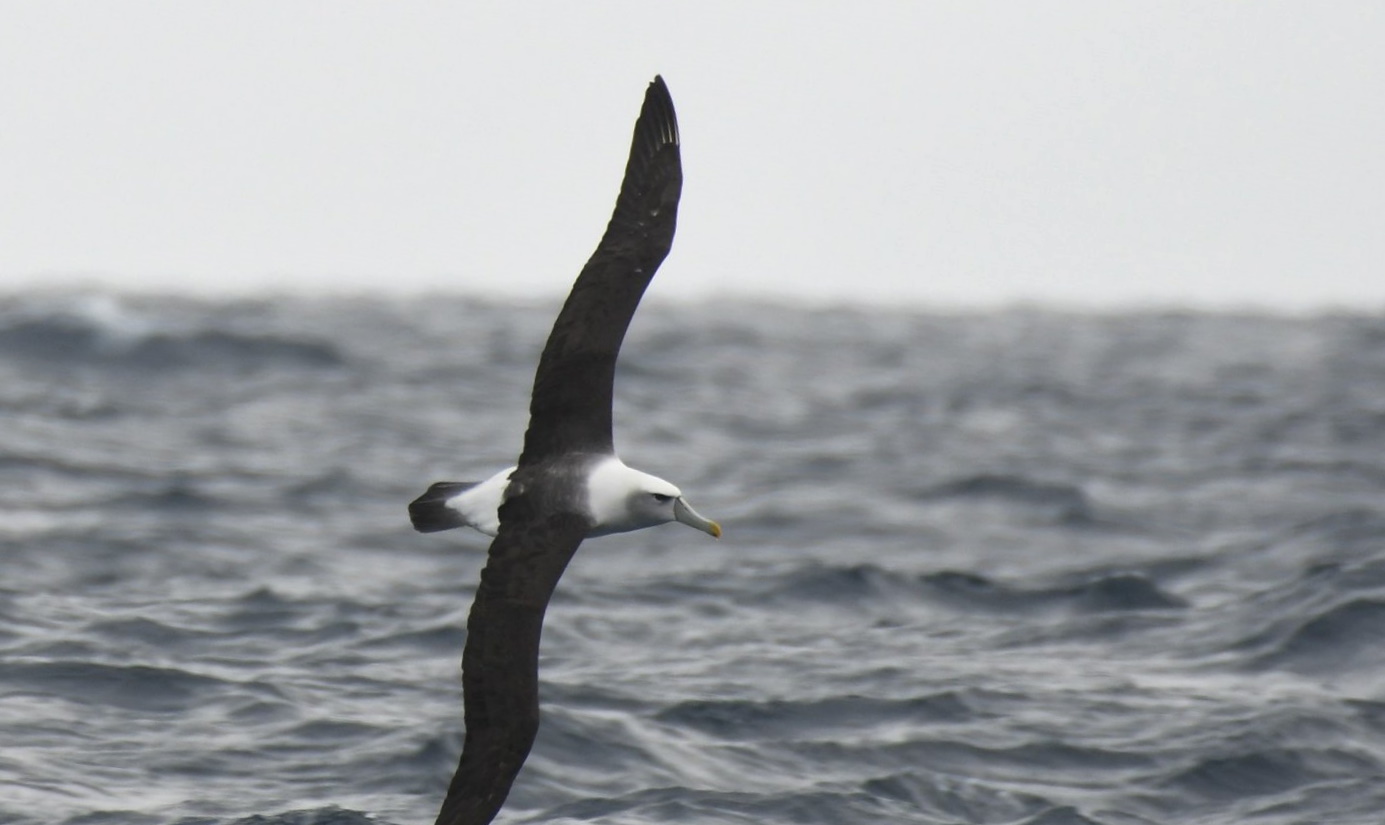
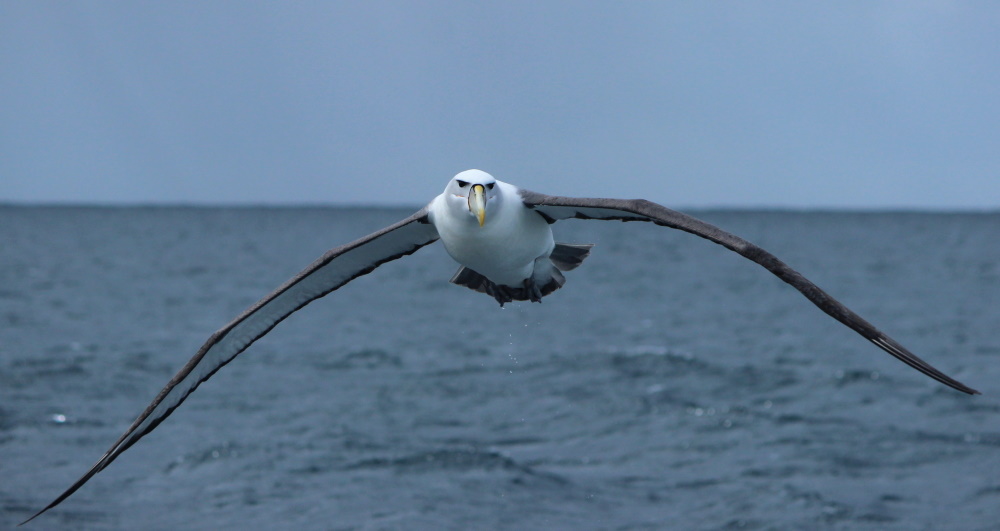
Shy Albatross showing its impressive wingspan, Eaglehawk pelagic, TAS by Janine Duffy
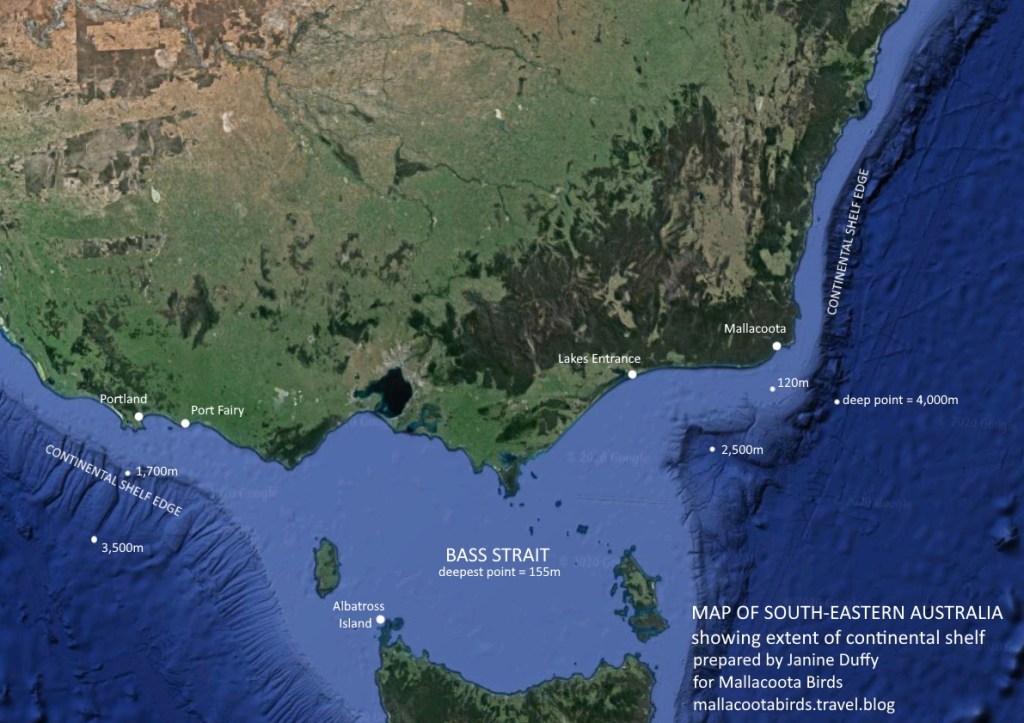
Albatrosses are truly oceanic birds. Most prefer the deep ocean water, and many are best found where the edge of the continental shelf drops off into deeper water. At this point their preferred food – squid, fish and carrion – is swept up to the surface.
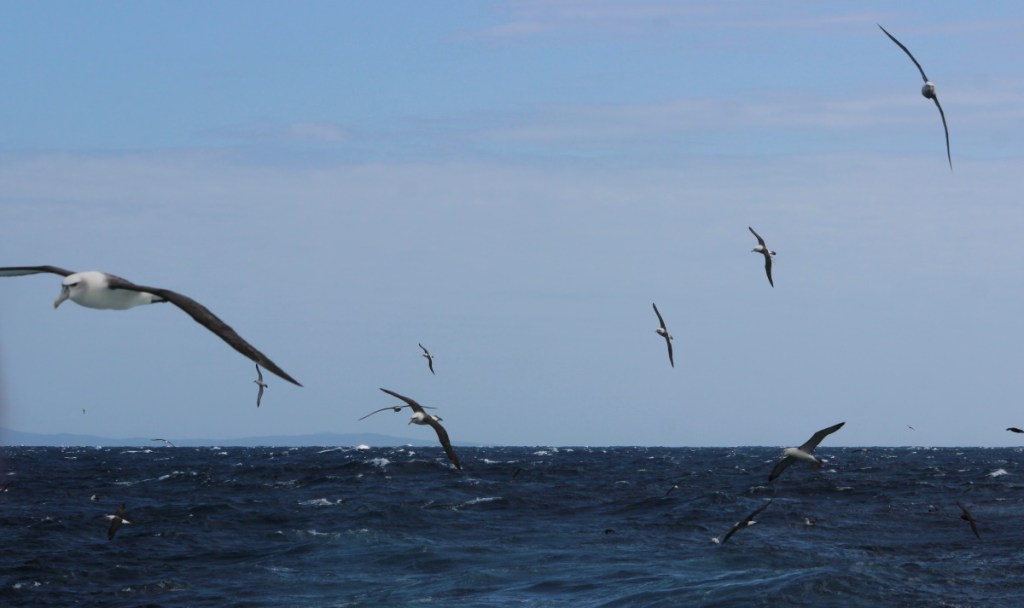
map showing edge of continental shelf around southeastern AustraliaA lot of Shy Albatrosses off East Gippsland by Janine Duffy
It is fairly difficult to see albatross from land – though it is possible in strong winds, and with good binoculars or a spotting scope. Shy Albatross are a bit more likely to be close to land than other albatrosses, and because they are quite big they can be seen from a distance. It is always worthwhile pointing your binoculars way out to sea on a rough day. You may see them, with their wings fixed out straight, dynamic soaring up and down in great arcs.
Shy Albatross dynamic soaring with straight wings, Eden by Rob Clay
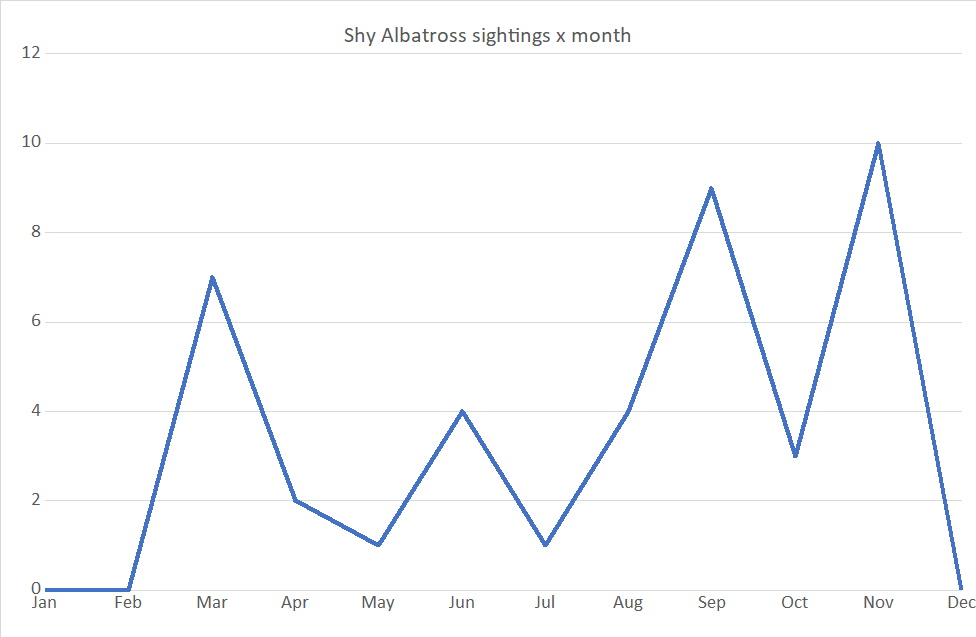
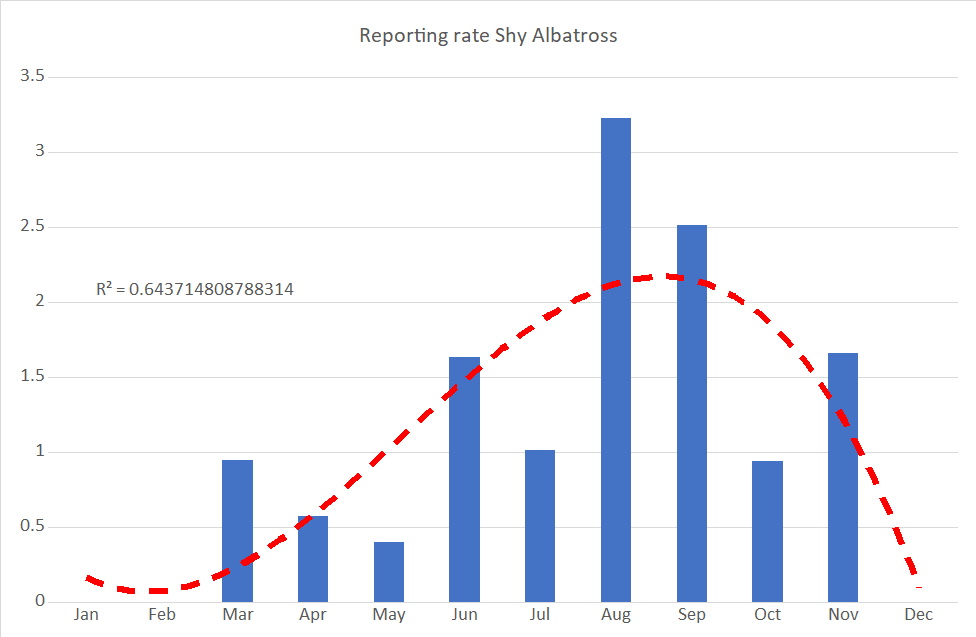
Most sightings of Shy Albatross around Mallacoota occur in September and November, with another little peak in March. They breed in September, chicks hatch by December and fledge in March-April, and all that time the adults forage close by. For an albatross in northern Tasmania, Mallacoota is close!
Martin Butterfield has produced some handy charts of Shy Albatross sightings & reporting rates – see below.
Sightings of Shy Albatross by month at Mallacoota VIC by Martin ButterfieldReporting rate of Shy Albatross at Mallacoota VIC by Martin Butterfield
Most of the Victorian coastline is a long way from the edge of the continental shelf – Bass Strait is fairly shallow water all the way to Tassie. But at Mallacoota in the east, and Portland/Port Fairy in the west the continental shelf comes close to the land. In fact near Mallacoota there is a very deep spot – over 4,000m.
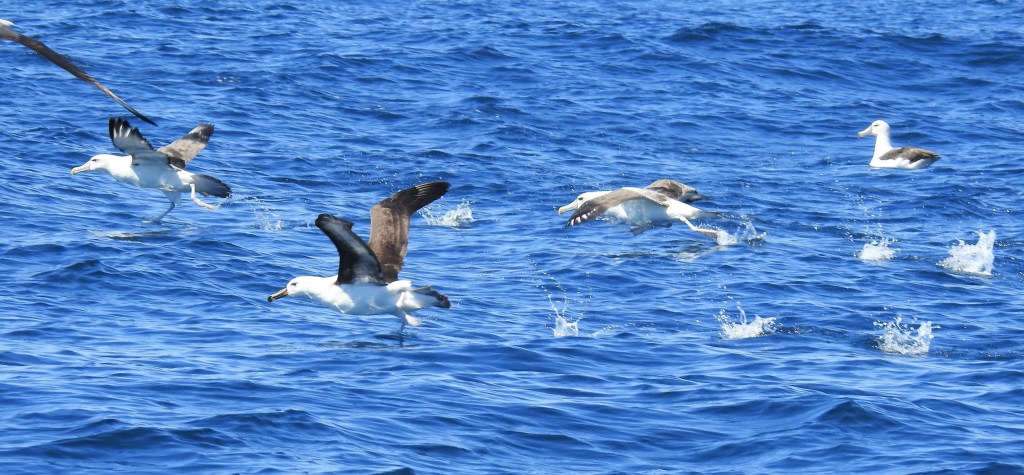
John Hutchison says that albatross can be seen quite close to land at Lakes Entrance, possibly as a result of the fishing fleet based there. On one trip he saw 12 albatross gathered behind a fishing boat – mostly Shy Albatross, just outside the entrance. He says that Indian Yellow-nosed and Buller’s Albatross can also be seen, mostly in summer and autumn.
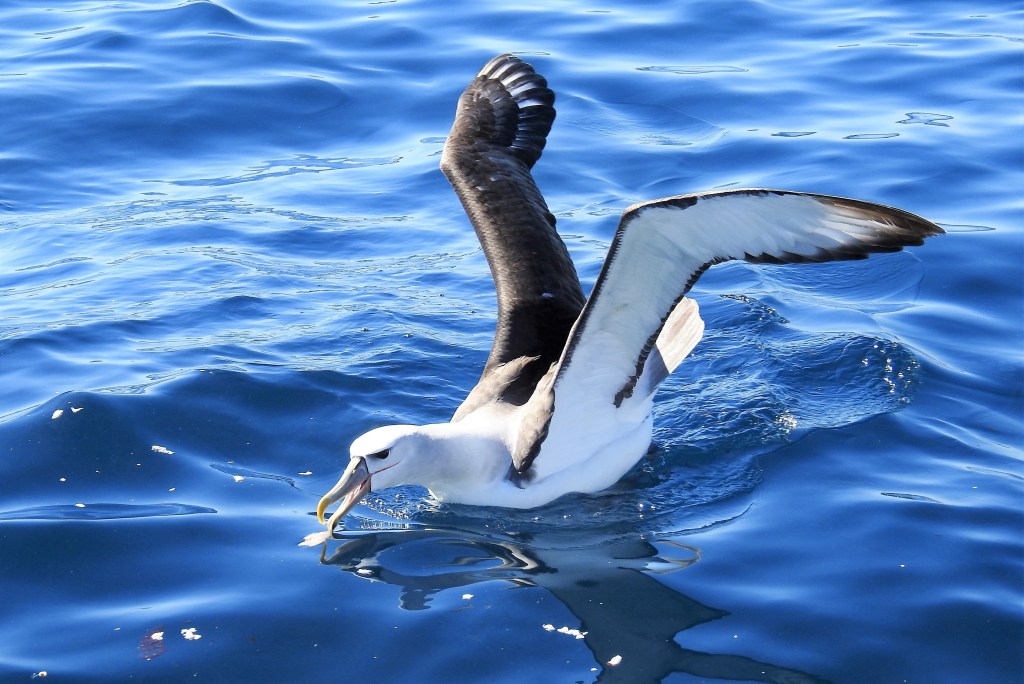
Shy Albatross eat small fish, cephalopods (squid, octopus), tunicates (sea squirts) and scraps. They feed by surface-lunging. Rob Clay tells of their mastery of fish filleting:
My Shy Albatross story is we had a dead Spiky Gurnard floating behind the boat. As the name suggests, they are very spiky fish with very tough skin. A Shy Albatross saw the fish and landed grasped the fish with it’s beak and gave a powerful backwards flap with it’s wings. With that sudden jerking motion, the sharp beak opened up the skin on at tough and spiky fish with amazing ease. It was unbelievable skill and power. I have a hard time getting into a Spiky Gurnard with 2 hands and filleting knife! To watch Shy Albatross master in action was an amazing treat.
Shy Albatross can live 60 years, they mate for life and raise only one chick per year. The entire world population of Shy Albatross is only 15,000 pairs. So if you see one, feel privileged.
Shy Albatross Port Macdonnell, SA by Sue Lee
On some pelagic trips off Tassie & East Gippsland I’ve seen hundreds in just one day. I feel extremely honoured.
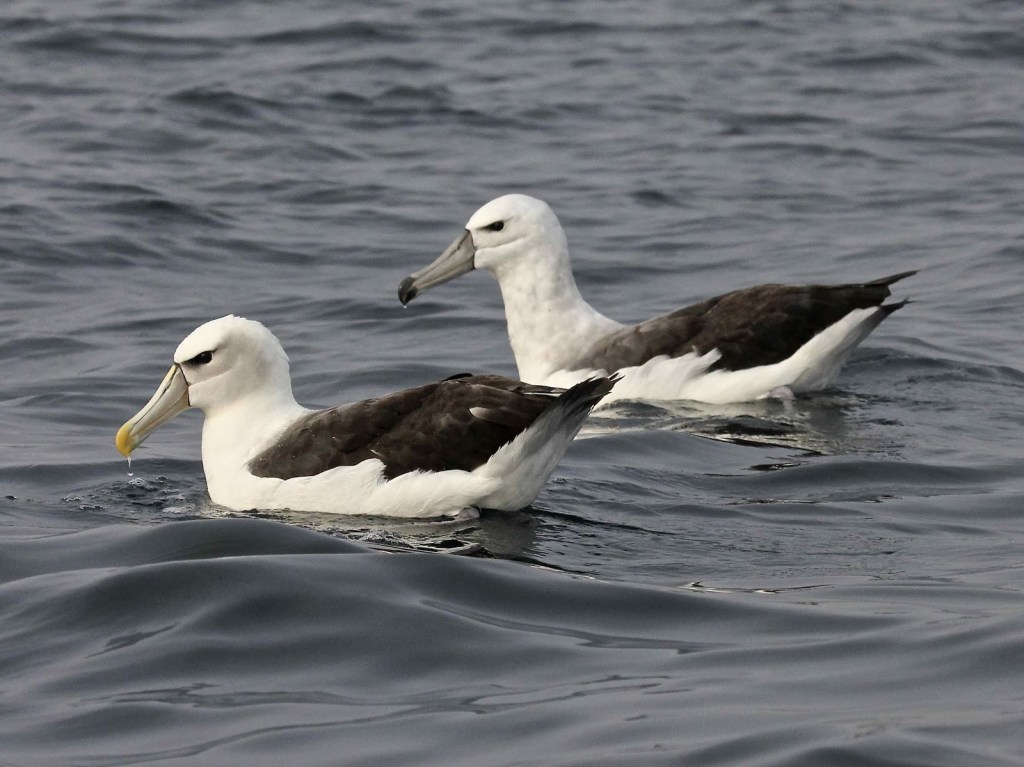
Shy Albatross adult Lakes Entrance by John Hutchinson
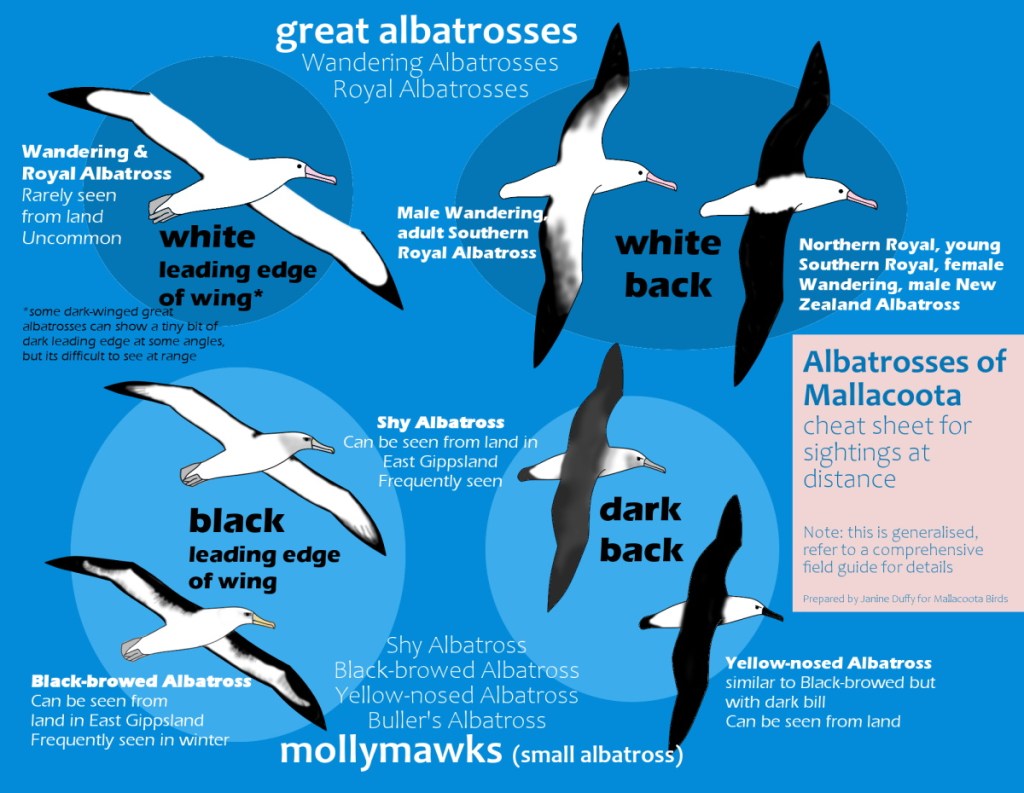
To tell them apart from other albatross, look for the dark grey (not black) upperwings, white flecks in the primaries, thin black edges to the underwings and grey bill with yellow tip. I’ve made a cheat sheet for albatrosses – useful for those you see at distance.
Albatrosses of Mallacoota diagram for distant sightings Shy Albatross adult (front) juvenile (back) Lakes Entrance by John Hutchinson
In NZ they call their subspecies (steadi) White-capped Albatross and its very difficult to tell them apart from our Shy Albatross. Some bird lists use this name for our Shy Albatross too.
Location: Breeds Tasmanian islands: Albatross, Pedra Branca & Mewstone. Ranges around Tasmania and throughout Bass Strait while breeding, then disperses (probably) throughout the Southern Ocean. Banded Aussie birds have been found in South Africa, Namibia & New Zealand.
Conservation status/learn more: Recently uplisted to Endangered, due to climate change affecting breeding success and bycatch by longline fishing operations.
Bird of the Week: Yellow-tailed Black-Cockatoo 6 November 2020
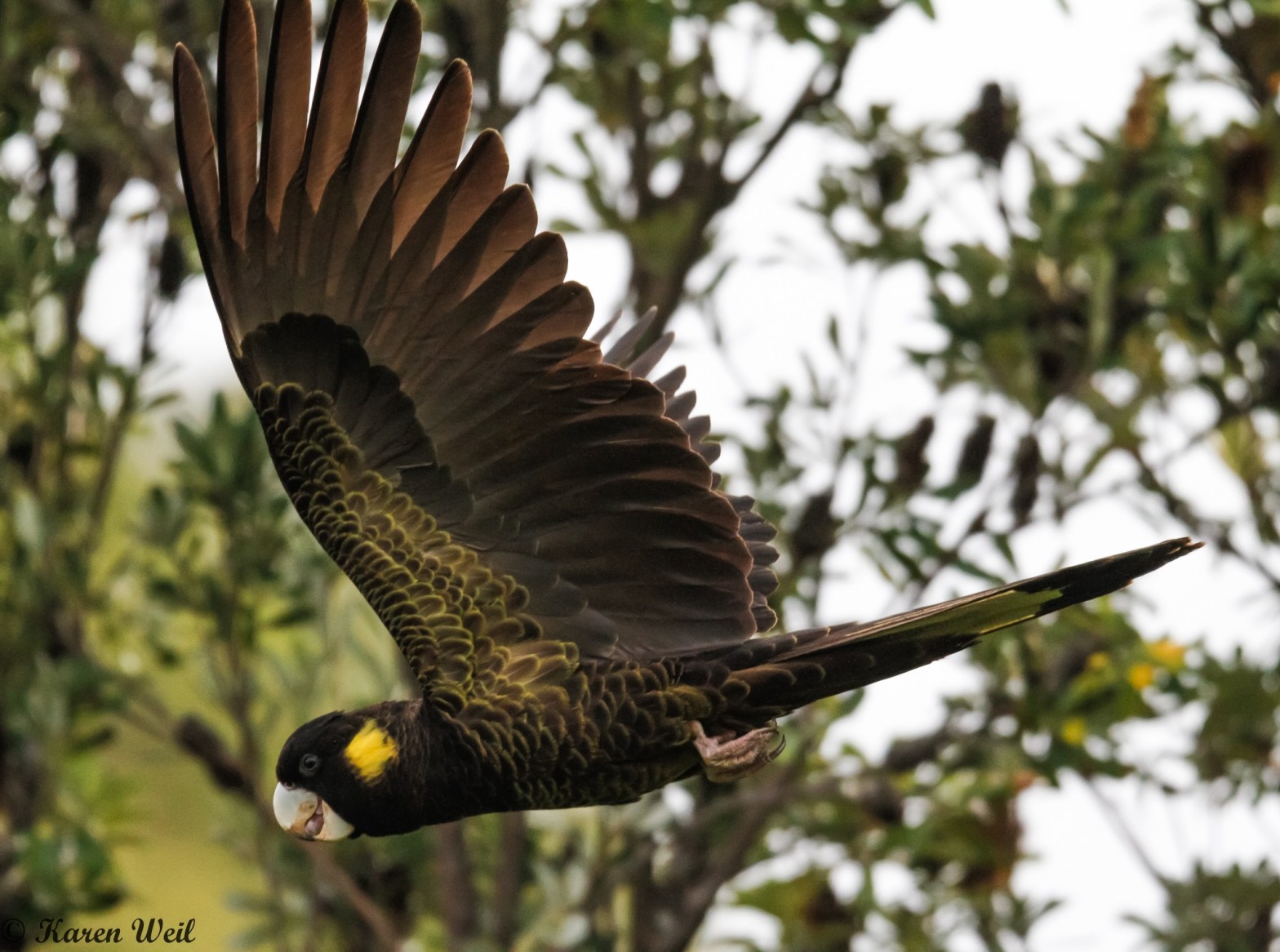
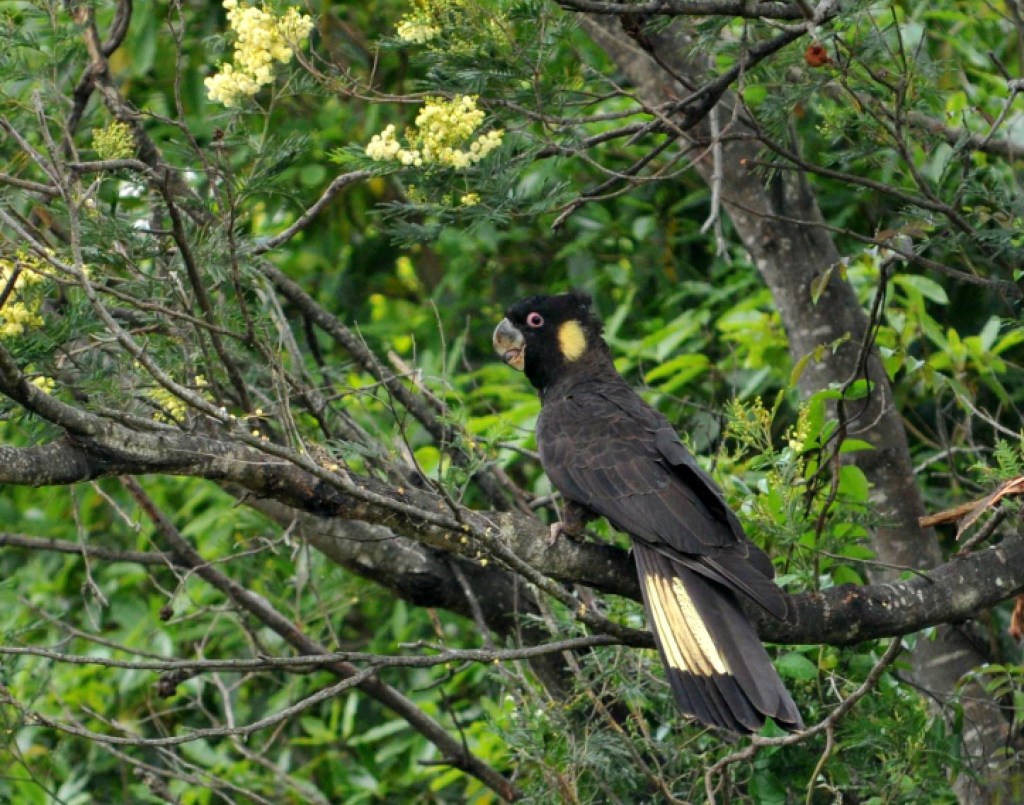
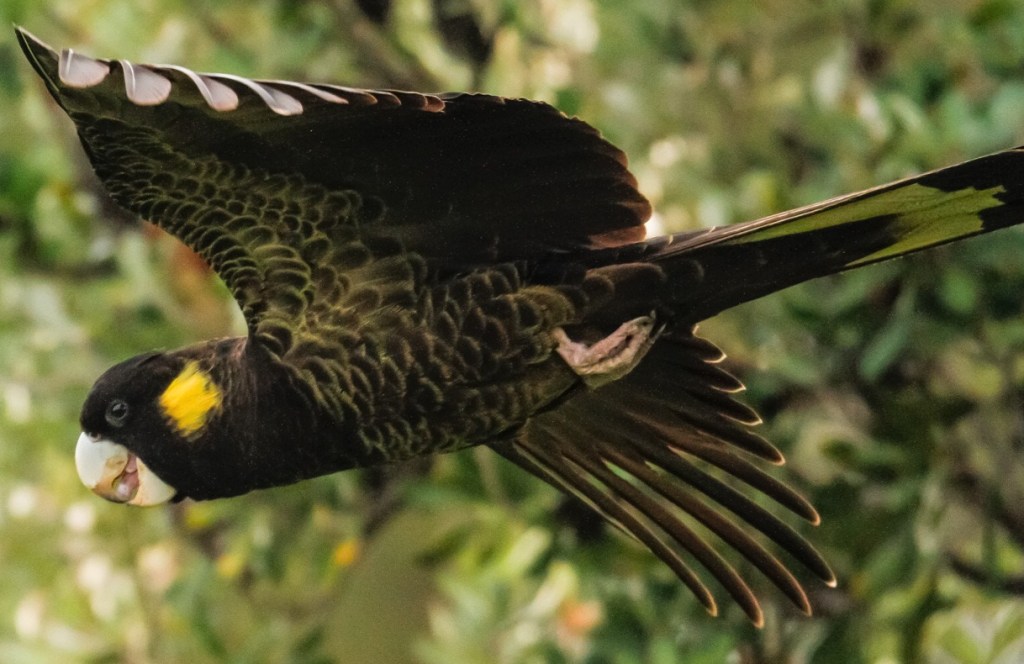
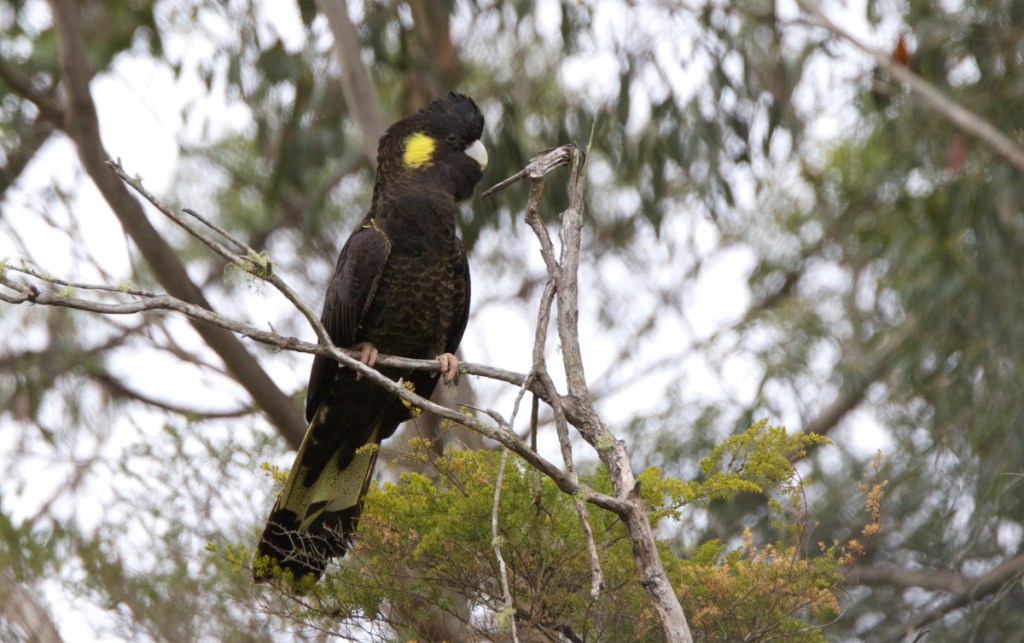
These large, spectacular cockatoos have something of the X factor about them. I find them captivating. Their plumage is like the magnificent giant Blackwoods (Acacia melanoxylon) of East Gippsland’s wet gullies: darkness and shadows with startling splashes of lemon and gold. This picture of Michael Barnett’s (though this is a Black Wattle A. mearnsii) sums them up for me:
Yellow-tailed Black-Cockatoo in wattle Mallacoota by Michael Barnett
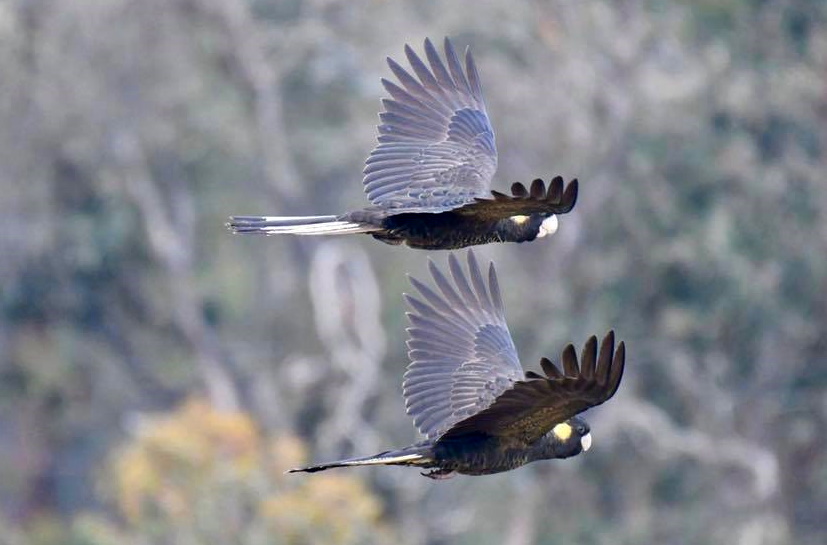
I find their call thrilling. Overseas visitors have likened it to a pterodactyl – which is not so far off the mark. When you hear those spine-tingling squeals travelling through the ancient tree fern (Dicksonia) and Mountain Plum-pine (Podocarpus lawrencei) forests of Errinundra Plateau, knowing that dinosaurs also travelled past those trees, its not hard to think of a pterodactyl with yellow-edged black feathers.
Yellow-tailed Black-Cockatoo flying Canni Creek by Rob Clay
There is an old story that their calls mean rain is coming, or an increase in the birds mean rain is coming. There is another version that says that if you see Yellow-tailed Black-Cockatoos flying from the mountains to the coast, rain is coming.
If you travel a lot in East Gippsland forests you hear Yellow-tailed Black-Cockatoos call almost every day, so it can’t possibly mean that rain is coming every single day.
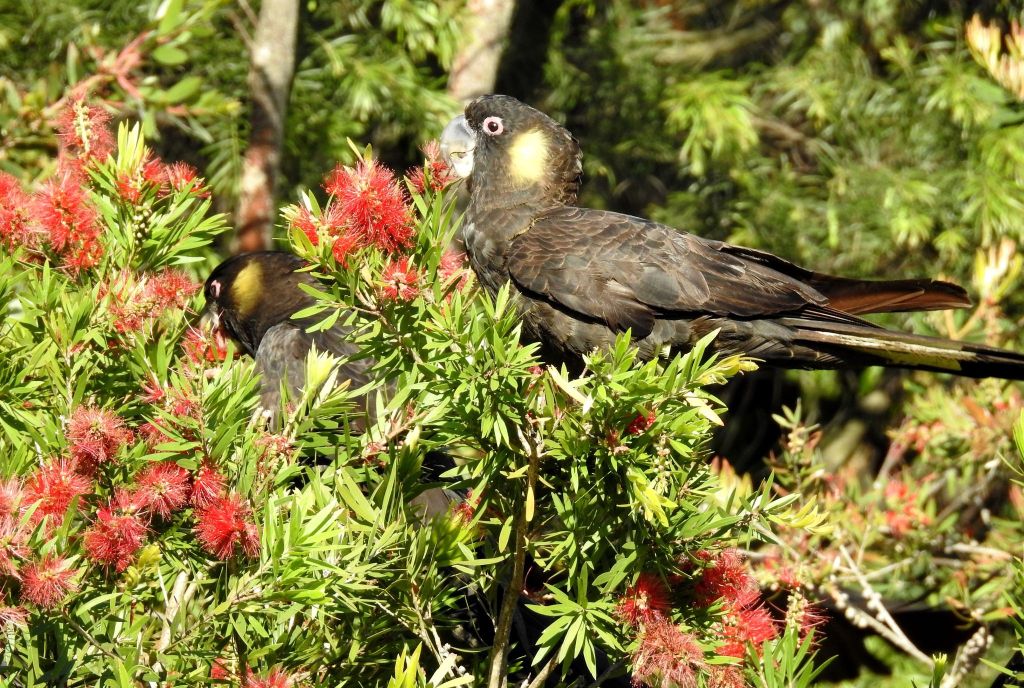
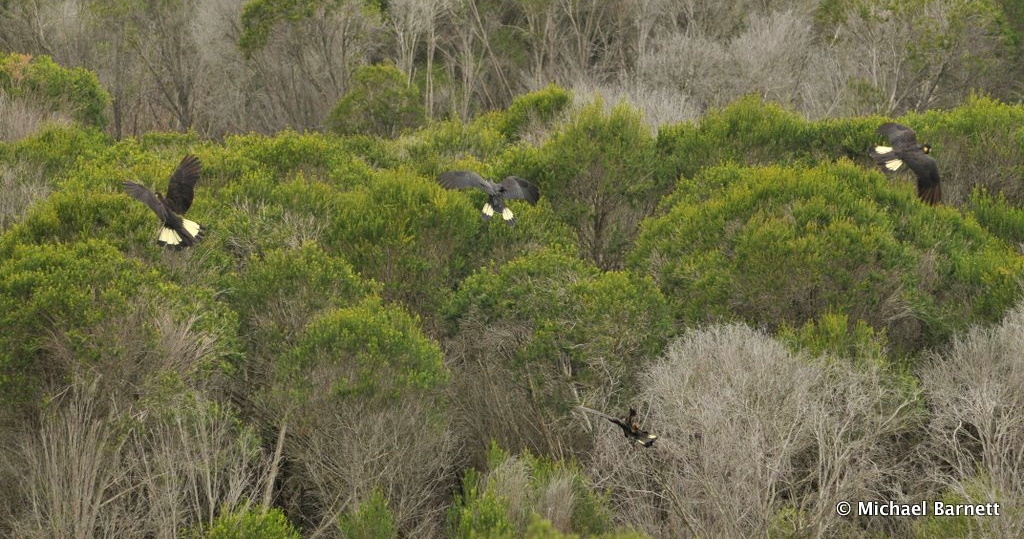
Yellow-tailed Black-Cockatoos feeding in bottlebrush, Mallacoota by Caroline JonesYellow-tailed Black-Cockatoos flying Mallacoota by Michael Barnett
I wonder if Yellow-tailed Black-Cockatoos were a calendar animal (bio-indicator) to local Aboriginal People. In The Grampians (Gariwerd) winter is Cockatoo Season, and Yellow-tailed Black-Cockatoos are on the move and seeking new feeding grounds. This type of knowledge passed on, changed and simplified, could have created the story as we know it. http://www.bom.gov.au/iwk/calendars/gariwerd.shtml
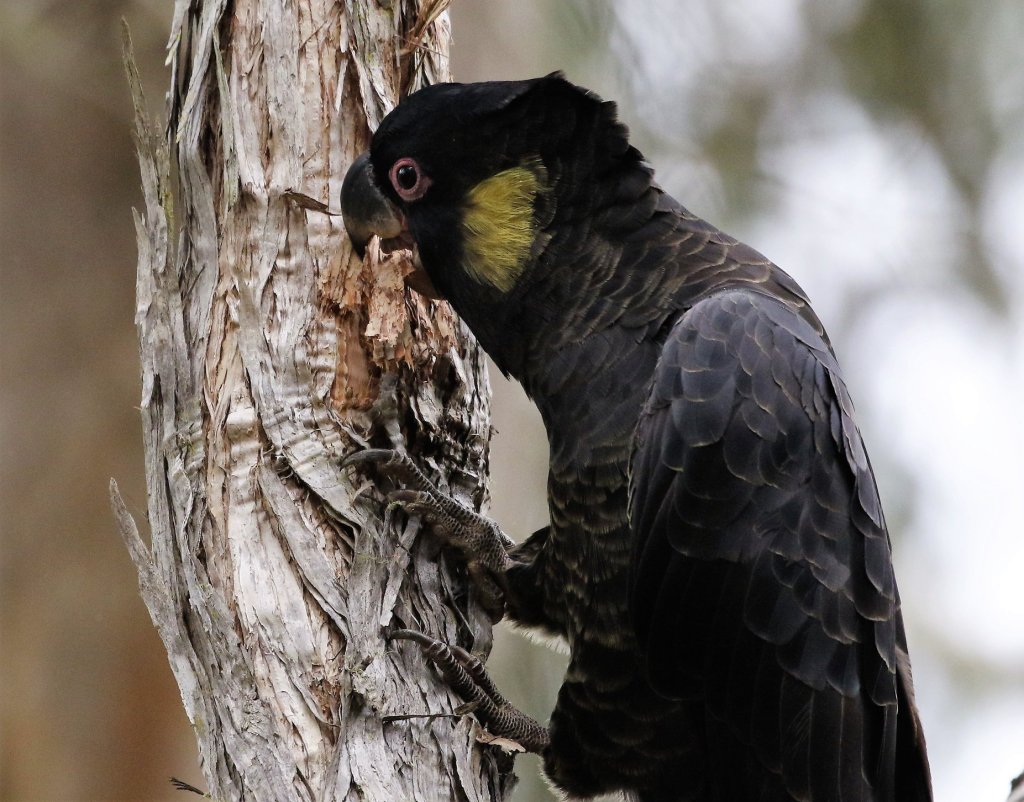
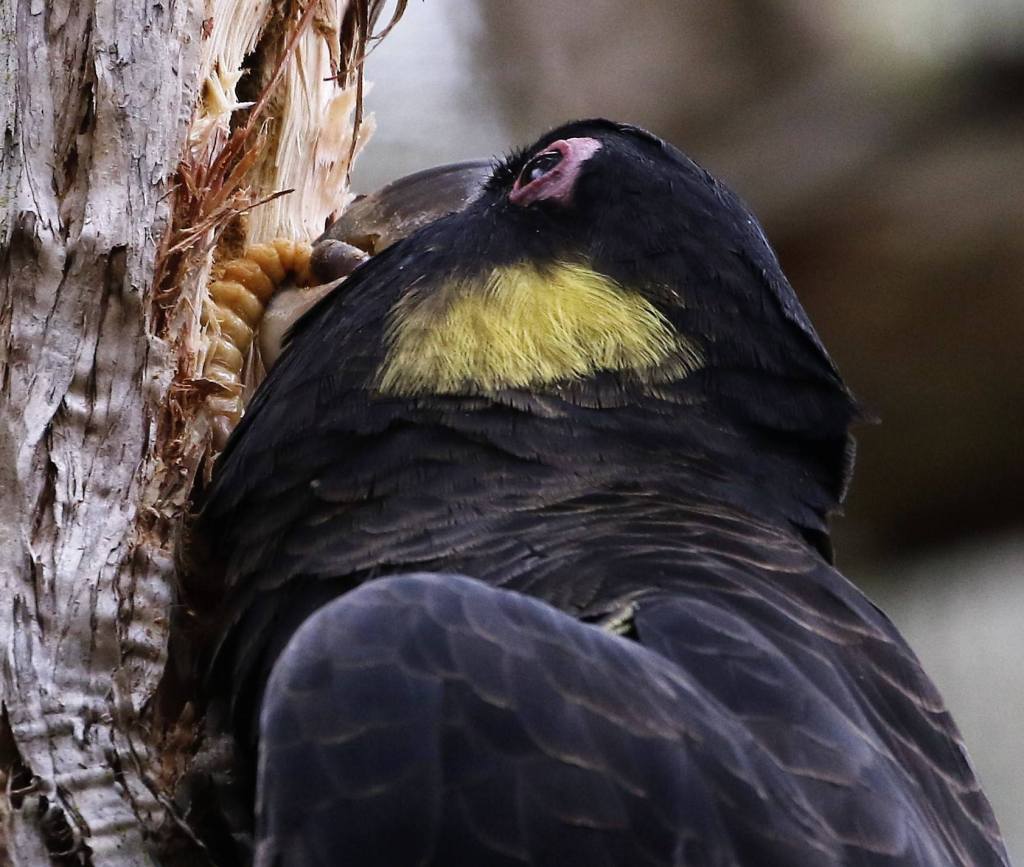
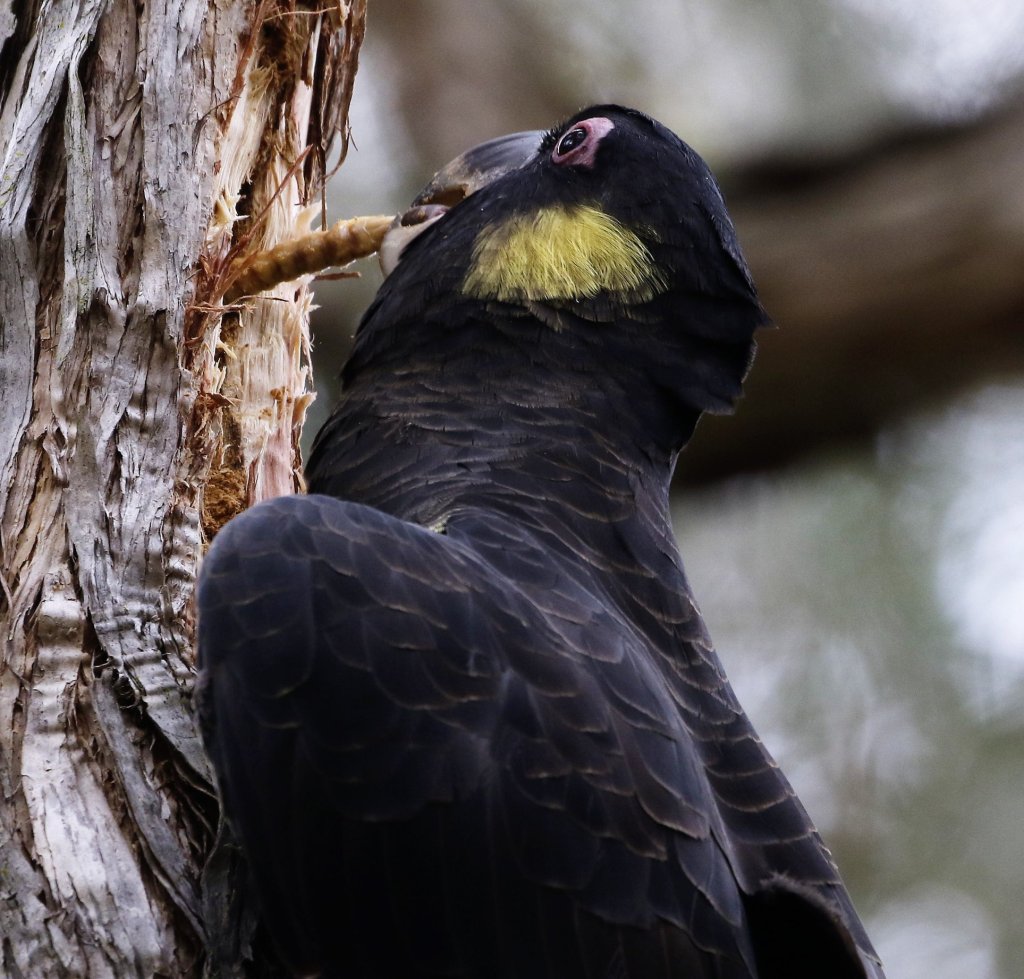
Their natural foods are seeds of eucalypts, banksias, hakeas, grevilleas & wattles, nectar of grass-trees, and caterpillars and larvae that they gouge out of trees. They have also adapted to eating introduced pine tree nuts.
Yellow-tailed Black-Cockatoo gouging for a borer, Mallacoota by Ron RickettsYellow-tailed Black-Cockatoo feeding Mallacoota by Ron RickettsYellow-tailed Black-Cockatoo feeding on cossid larvae Mallacoota by Ron Ricketts
Martin Butterfield tells: “When we lived in Adelaide I would go orienteering in pine forest and when a flock of YTBC were dining above it was like being in a battlefield. They would often lose their grip on the large cones, which meant objects weighing about 1kg would be dropping all through the area from 20m above. Had one hit a runner the consequences would have been ungood.”
“In the 1980s someone (possibly from RAOU) did a major project looking into the distribution of Yellow-tailed Black Cockatoos. One finding that came out of this was that as they love dining on pine cones they were one of the few species that had benefitted from the mass planting of Pinus radiata across SE Australia.
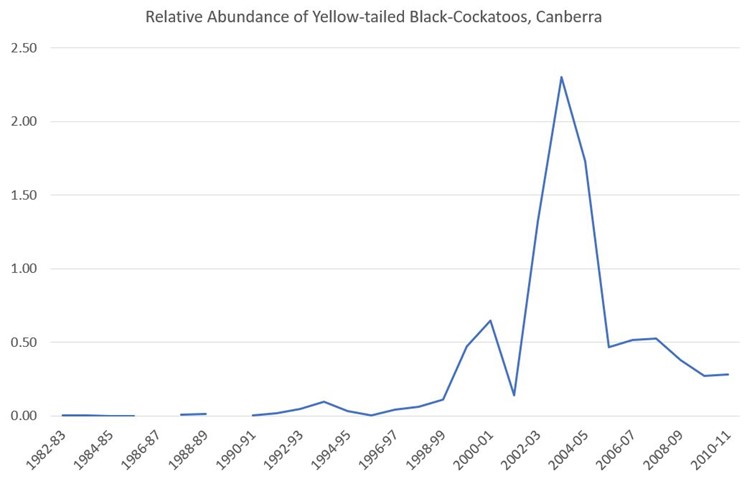
When we moved to Canberra (1983) the species was quite uncommon being found reliably only in the pine forests of the Cotter catchment. Those forests got burnt completely in the fires of January 2003. This drove the cockatoos out on to the urban area as shown by this chart from the COG Garden Bird Survey.
Chart showing abundance of Yellow-tailed Black-Cockatoo around Canberra 1982 – 2011
For the rest of 2003 and most of 2004 the birds travelled round the urban area finding isolated pockets of pines and also feeding on their more traditional foods (eucalypt nuts) in Canberra Nature Park. At times they would gather in flocks of over 100 birds. As the mountain habitat regenerated they moved back to ranges and the huge numbers declined. However the numbers in the urban area have remained higher than they were prior to 2000.”
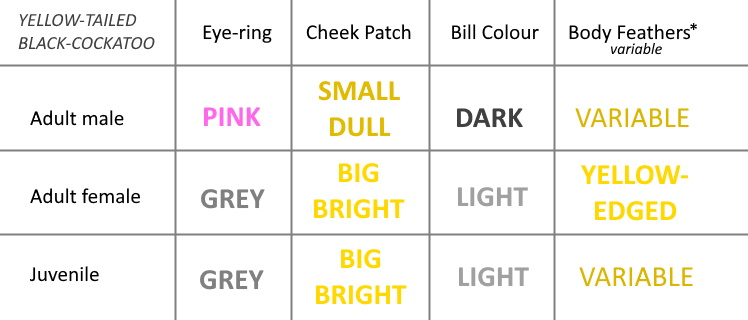
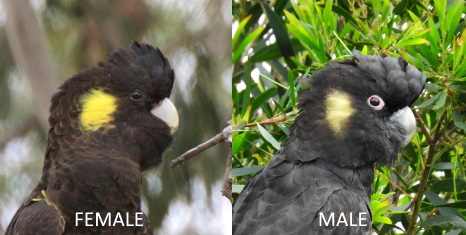
The best way to tell males, females and juveniles apart is from the head. I’ve made a chart to summarise.
Chart showing identification features of male, female and juvenile Yellow-tailed Black-Cockatoos
Head comparison – female left, male right Pics by Martin Maderthaner & Caroline Jones
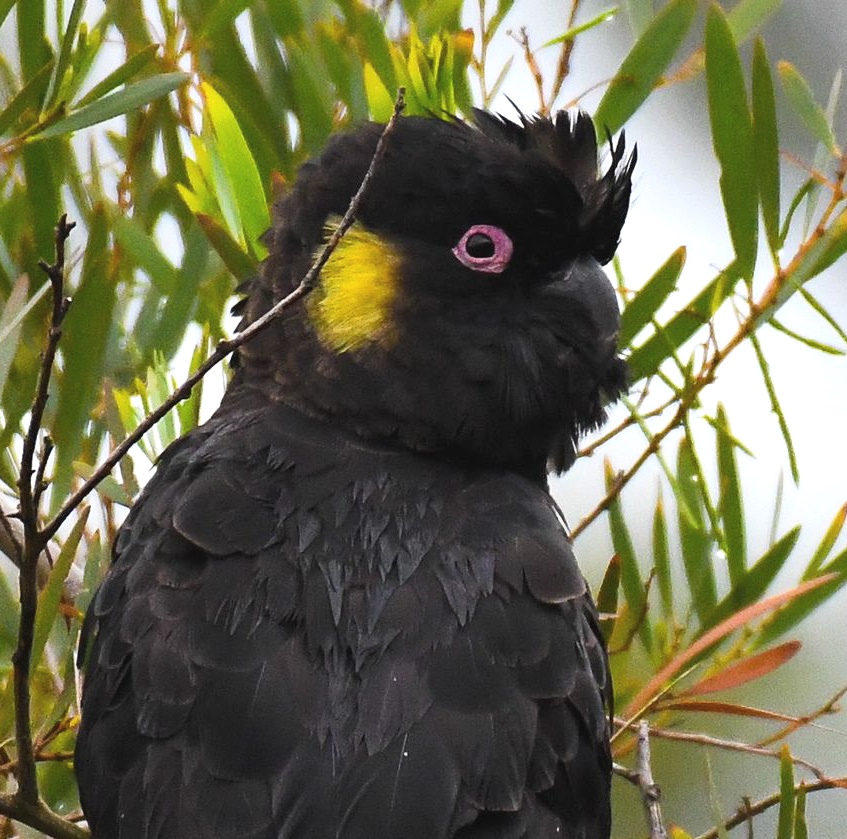
Adult male Yellow-tailed Black-Cockatoo showing pink eye-ring and dark bill by Rob ClayAdult female Yellow-tailed Black-Cockatoo flying showing yellow-edged body feathers Mallacoota by Karen Weil
Location: Eastern Australia from the Eyre Peninsula, SA along the coast through VIC, NSW and southern QLD. Also TAS.
Our subspecies funereus eastern VIC, NSW, QLD. Subspecies xanthanota in TAS and whiteae in west VIC & SA are smaller and have more yellow in the body plumage and less black flecking in the tail panels.
Adult female Yellow-tailed Black-Cockatoo Cape Conran by Martin Maderthaner, Echidna Walkabout
Thanks to Martin Butterfield, Rob Clay, Ron Ricketss, Michael Barnett, Caroline Jones, Karen Weil, Martin Maderthaner for your beautiful pictures and anecdotes.
Bird of the Week: Channel-billed Cuckoo 30 October 2020
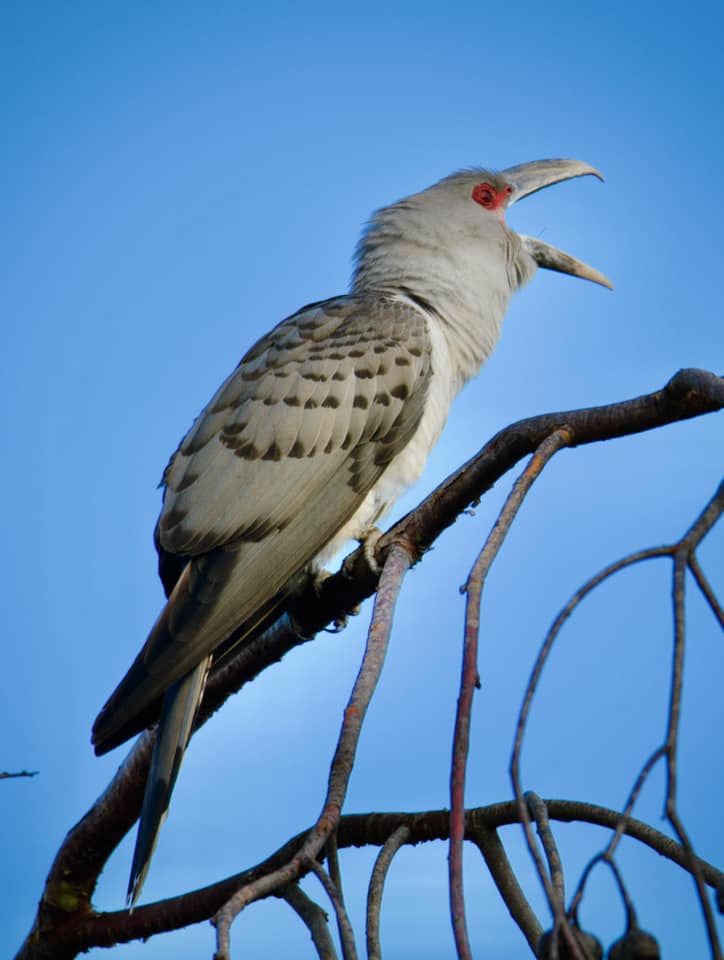
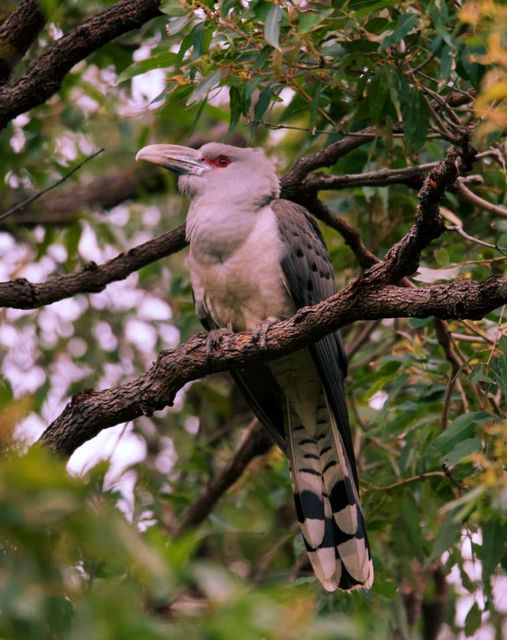
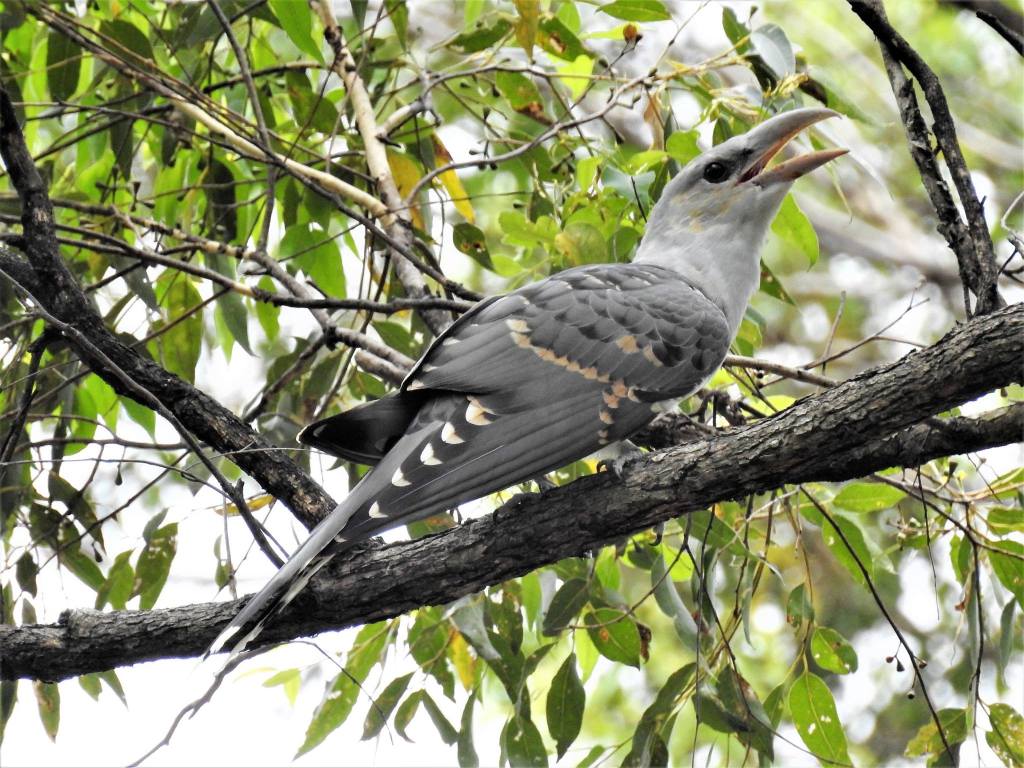
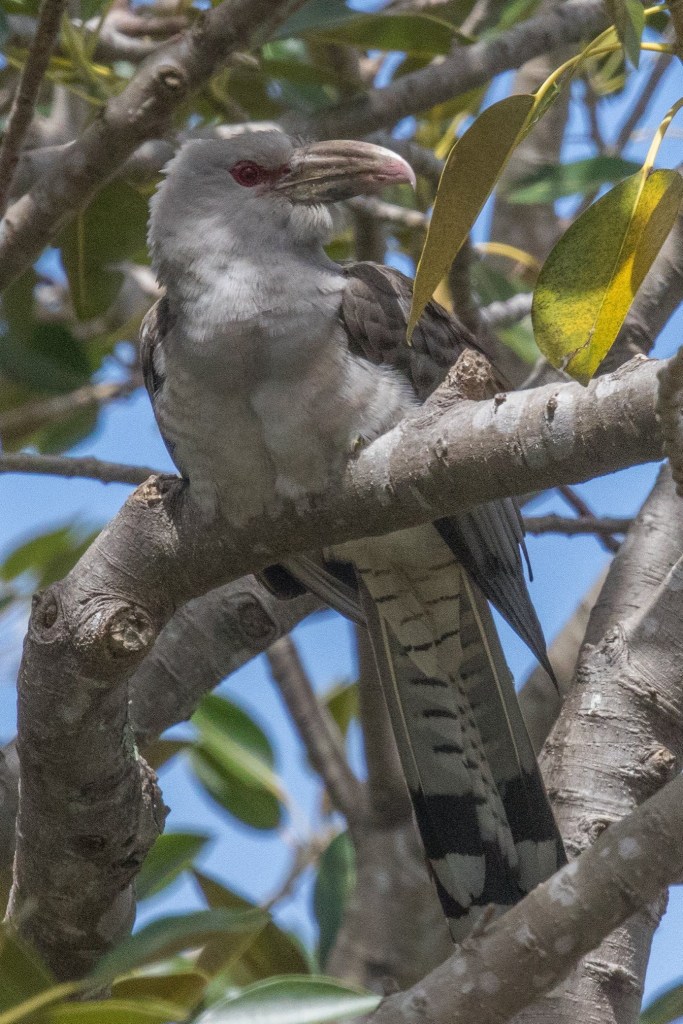
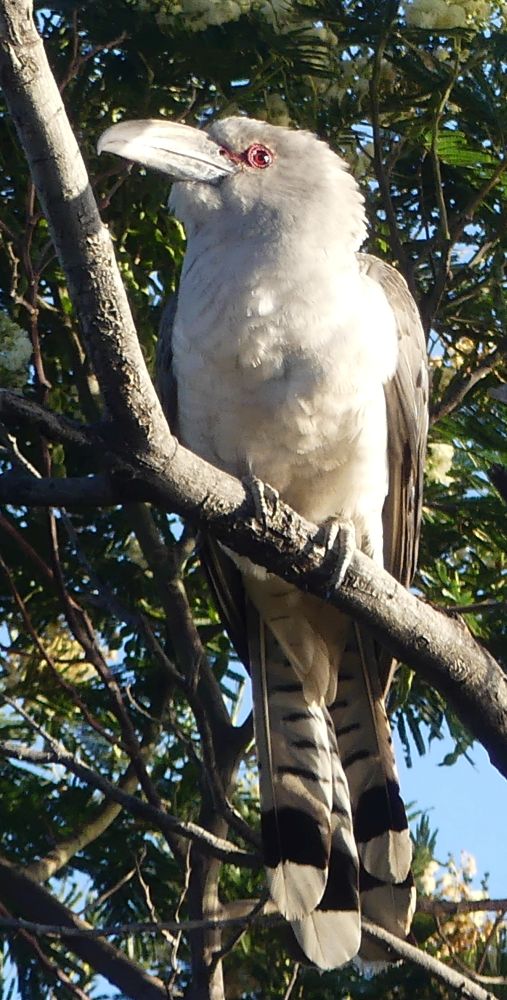
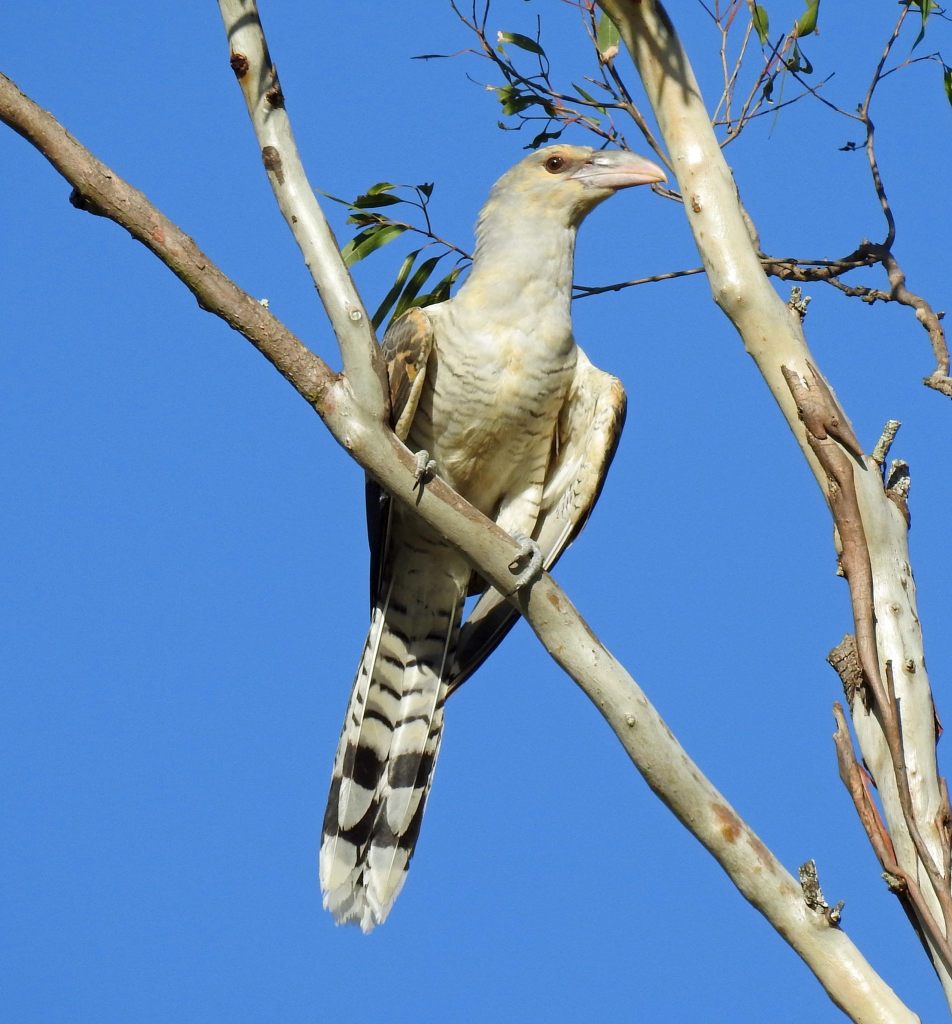
Australia has many cuckoos, including the world’s largest: the Channel-billed Cuckoo. These enormous birds fly into Australia from Indonesia and New Guinea every year, arriving in Mallacoota usually in September or October.
They are huge, but shy, so it’s easy to miss them. In flight they have a long tail, and almost raptor-like shape, except for that enormous bill.
Channel-billed Cuckoo adult, Mallacoota by Martin Ascher
If you hear them in full call, they are impressive. It is a raucous hoot-squawk, very like a Brolga or a Blue-winged Kookaburra. The first time I heard them was at Lake Tyers Forest Park at the Lonely Bay Walk. I was intrigued, but had no idea what it was, and thought maybe a weird kookaburra song! I didn’t report it, but luckily recorded it on video. Years later I realised what it was.
They are cuckoos, and brood parasites. This means that they lay their egg (or possibly two?) in another bird’s nest. But don’t hold that against them – they are a marvel of evolution.
A juvenile Channel-billed Cuckoo in SE QLD by Sue Lee
Did you know that cuckoos have developed a range of strategies to give their babies the best chance of survival? Some lay an egg that is almost exactly the size and colour of the host (Brush Cuckoo, Horsfield’s Bronze-cuckoo). Others lay eggs so dark and matte that the host parent can’t see it (Shining & Little Bronze-cuckoo) . Some cuckoos have chicks that look like the host chicks, so even then the parent can’t reject them (Shining & Little Bronze-cuckoo). Still others have chicks that hatch and learn the call of the host chick within days, even though there is no host chick to copy!!!! (Horsfield’s Bronze-cuckoo)
Read more, and see fascinating pics in this marvellous paper: ResearchGate
Channel-billed Cuckoos are not ‘evicters’ – the baby cuckoo doesn’t chuck its host siblings out of the nest, it is raised alongside the host chicks. But usually the demands of all the chicks are too much for the host parents, and the host chick rarely survives.
Their hosts are usually Pied Currawongs, but ravens, Australian Magpies and sometimes a Mudlark family get to share the load.
Adult Channel-billed Cuckoo Metung, VIC by Jack Winterbottom
Martin Butterfield tells this story: “They are really unusual in Canberra and when one turned up there several (~10?) years ago I went to tick it. After about 30 minutes searching with no luck I met another optimist and we searched together for 15 minutes until a third joined us. Still no joy. So #3 played a call. Instantly a huge grey shape emerged from a eucalypt about 20 m from us – in the middle of the area we had been searching – flew straight over our heads and disappeared.
While I am very cautious about using call back I tried it once on Stingray Point with the local bird and same thing. It called as it flew, ending up (from its own noise) in about Radley Place about 1 km away.
The first sighting this season was one flying below our place calling as it went. About 30minutes later it flew over Betka Rd (3km away) heading West.”
Channel-billed Cuckoo adult male, Mallacoota by Martin Butterfield
Location: Eastern and northern Australia, from East Gippsland VIC to the Kimberley WA and inland to central Australia through western QLD and eastern NT, New Guinea, Timor L’este, Sulawesi & the Banda Arc Indonesia, Bismarck Archipelago.
A couple are usually seen around Melbourne each year, but this seems to be an extension of their range, Martin says: I don’t have detailed records but when we used to have a place at Congo (1984 – 1990) the expert birders in the area (eg Stephen Marchant) used to regard some huge Moreton Bay Figs outside the Moruya Pub as the Southern limit of their range. By the mid-1990s there are several records in Birdata South of Pambula.
 Mallacoota Birds